Key Highlights
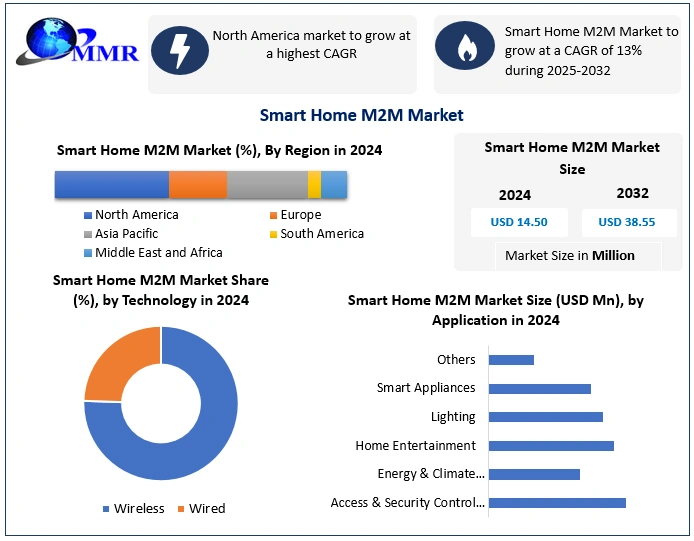
- The Smart Home M2M Market was valued at USD 14.50 billion in 2024.
- The market is expected to reach USD 38.55 billion by 2032.
- Revenue is forecast to grow at a 13% CAGR during 2025–2032.
- North America remains the largest regional market.
- Wireless technology dominates the market by technology.
- Wi-Fi leads the connectivity segment.
- Smart security and energy management remain major adoption drivers.
- Growing smart city investments continue expanding market opportunities.
Why This Matters Now
Connected homes are becoming a critical component of digital lifestyles. Consumers increasingly expect remote control, automation, energy efficiency, and intelligent security from residential environments. As IoT ecosystems mature and wireless connectivity becomes more affordable, Smart Home M2M technology is shifting from premium installations to mainstream residential infrastructure, creating new revenue opportunities for technology providers, telecom operators, and smart device manufacturers.
Market Overview
Smart Home Machine-to-Machine (M2M) Market technology enables connected devices to communicate automatically through wired and wireless networks without requiring direct human intervention. These systems integrate appliances, lighting, surveillance, HVAC, entertainment, and energy management into a unified connected ecosystem.
The market is expanding rapidly as consumers seek greater convenience, enhanced residential security, lower energy consumption, and remote home management. Smartphones, tablets, and cloud platforms have become central control hubs, allowing homeowners to monitor and operate connected devices from virtually anywhere.
Falling prices for IoT-enabled electronics, widespread broadband availability, and improved wireless communication technologies are accelerating adoption across residential markets worldwide.
On the supply side, manufacturers continue introducing interoperable devices supporting multiple communication standards, while cloud computing and artificial intelligence improve automation capabilities and predictive home management.
Despite strong growth, cybersecurity concerns, data privacy issues, and compatibility with legacy infrastructure remain important challenges for industry participants.
Key Trends Driving Growth
IoT Ecosystems Continue Expanding
The rapid growth of connected consumer electronics is increasing demand for seamless machine-to-machine communication across homes. Smart appliances are becoming standard components of residential IoT ecosystems.
Wireless Connectivity Dominates Deployments
Wireless communication protocols including Wi-Fi, Bluetooth, Zigbee, and Z-Wave are replacing traditional wired installations because they reduce installation costs and simplify system expansion.
Smart Security Drives Consumer Spending
Consumers increasingly prioritize intelligent surveillance, remote monitoring, smart locks, smoke detection, and automated emergency alerts, making security one of the strongest drivers of smart home adoption.
Energy Management Gains Strategic Importance
Rising electricity costs and sustainability initiatives are encouraging homeowners to adopt connected thermostats, lighting controls, and energy-efficient automation systems.
Smart Cities Support Connected Homes
Government investment in smart city infrastructure is indirectly accelerating residential IoT adoption by expanding digital connectivity and supporting intelligent building ecosystems.
Explore detailed analysis, insights, and growth opportunities
Segment Insights
Dominant Segment: Wireless Technology
Wireless technology accounted for the largest market share in 2024.
Consumers increasingly prefer wireless systems because they eliminate expensive wiring requirements while providing flexible installation, easier upgrades, and compatibility with expanding smart home ecosystems.
The business impact is significant because wireless solutions reduce installation complexity, expand customer accessibility, and support recurring software and cloud service revenues.
Fastest-Growing Segment: Wi-Fi Connectivity
Wi-Fi represents the fastest-growing connectivity segment.
Most households already possess Wi-Fi infrastructure, allowing consumers to integrate new smart devices without additional networking investment. High bandwidth also supports data-intensive applications including smart surveillance cameras, streaming devices, and intelligent entertainment systems.
This widespread compatibility continues strengthening Wi-Fi’s position as the primary communication standard for connected homes.
Additional Key Sub-segments
Smart Home Surveillance Systems
Security remains one of the most commercially important product categories.
Remote monitoring, motion detection, automated alerts, and cloud video storage continue driving consumer investment in connected surveillance systems.
Cloud-Based Systems
Cloud-based smart home platforms are gaining popularity because they enable remote access, software updates, device synchronization, and scalable home automation without extensive local infrastructure.
Energy & Climate Management
Smart thermostats, HVAC automation, and intelligent energy monitoring systems are becoming essential as consumers seek lower utility costs and improved environmental sustainability.
Smart Appliances
Connected kitchen appliances, washing machines, robotic vacuum cleaners, and entertainment systems continue expanding the overall smart home ecosystem while increasing consumer engagement.
Regional Growth Story
North America
North America leads the global Smart Home M2M Market.
High consumer awareness, advanced broadband infrastructure, widespread IoT adoption, and strong presence of major technology companies continue supporting regional market leadership.
The United States remains the largest market due to rapid adoption of connected security systems and intelligent home automation technologies.
Europe
Europe represents the second-largest regional market.
Growing consumer demand for energy-efficient homes, increasing smart building investments, and strong regulatory focus on sustainability continue accelerating adoption across Germany, the United Kingdom, France, and other major markets.
Asia Pacific
Asia Pacific is emerging as one of the fastest-growing regions.
Rapid urbanization, expanding electronics manufacturing, declining semiconductor costs, and government-supported smart city initiatives are creating substantial growth opportunities across China, Japan, India, and South Korea.
Middle East, Africa, and South America
These regions are witnessing increasing adoption of connected residential technologies as broadband infrastructure improves and smart housing developments become more common in urban centers.
Competitive Landscape
Competition is increasingly focused on ecosystem integration, connectivity platforms, cloud services, cybersecurity, and interoperability rather than standalone hardware products.
Google, Samsung, Honeywell, and Panasonic continue strengthening integrated smart home ecosystems by connecting consumer electronics with cloud-based automation platforms.
Intel Corporation, Cisco Systems, and Telit Communications provide the connectivity infrastructure and communication technologies supporting large-scale M2M deployments.
Telecommunication providers including AT&T, Vodafone Group, Deutsche Telekom, Sprint Corporation, KORE Wireless Group, and Sierra Wireless are expanding IoT connectivity services that enable reliable communication between millions of connected residential devices.
Service providers such as British Gas and Comcast are increasingly integrating smart home platforms into broader digital service portfolios, expanding recurring subscription-based revenue models.
Recent Developments
- Increasing adoption of Wi-Fi, Zigbee, Bluetooth, and Z-Wave communication technologies for residential automation.
- Expansion of cloud-based smart home platforms supporting remote monitoring and intelligent device management.
- Growing investment in smart security systems featuring motion detection, automated alerts, and remote surveillance capabilities.
- Rising deployment of IoT-enabled energy management solutions to improve residential efficiency.
- Continued integration of smart home technologies with global smart city development initiatives.
Analyst Perspective — Komal Patil
The Smart Home M2M Market is evolving beyond connected devices toward fully integrated digital living ecosystems. Advances in wireless connectivity, cloud computing, and IoT interoperability are enabling seamless communication between appliances, security systems, and energy management platforms. Companies that prioritize cybersecurity, cross-platform compatibility, and AI-enabled automation will gain a competitive advantage as consumers increasingly demand intelligent, scalable, and energy-efficient connected homes.
Future Outlook
The strongest growth opportunities will belong to companies that combine secure M2M connectivity, interoperable IoT ecosystems, and AI-powered home automation to deliver seamless, intelligent residential experiences at scale.
About Maximize Market Research
Maximize Market Research Pvt. Ltd. (MMR) is a global market research and consulting company that provides reliable, data-focused, and practical business insights. The firm serves a wide range of industries, including healthcare, pharmaceuticals, technology, automotive, electronics, chemicals, personal care, and consumer goods. Through market forecasts, competitive analysis, strategic consulting, and industry impact assessments, MMR helps organizations understand changing market conditions, identify growth opportunities, and make informed business decisions for long-term success.
Contact Us :
2nd Floor, Navale IT Park Phase 3
Pune Banglore Highway, Narhe
Pune, Maharashtra 411041, India
+91 9607365656
sales@maximizemarketresearch.com
