Key Highlights
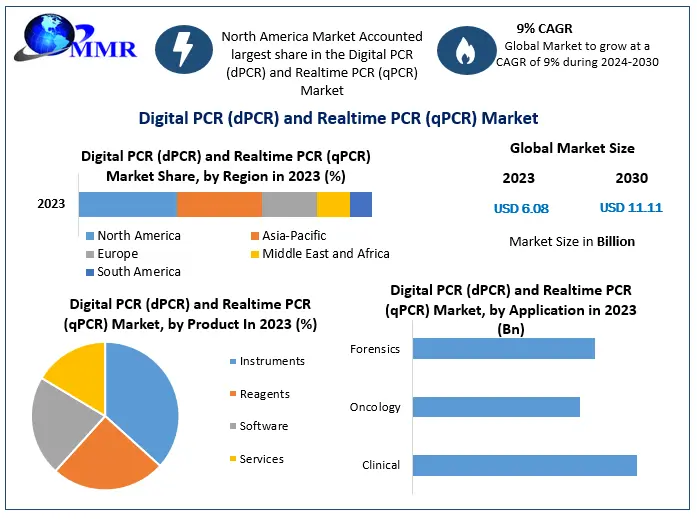
- The market is projected to expand from USD 6.08 billion in 2023 to USD 11.11 billion by 2030 at a 9% CAGR.
- North America remains the largest regional market due to advanced diagnostic infrastructure and sustained research funding.
- Clinical diagnostics continue to generate the highest demand as precision medicine becomes mainstream.
- Digital PCR adoption is increasing because it delivers superior sensitivity, absolute quantification, and improved reproducibility.
- Oncology, infectious disease testing, and genetic screening remain the primary application areas.
- Asia-Pacific is expected to register the fastest growth through expanding biotechnology investments and clinical research activities.
Why This Matters Now
Healthcare systems are shifting toward highly accurate molecular diagnostics that improve disease detection at earlier stages. Digital PCR provides higher analytical precision than conventional PCR technologies, supporting oncology, infectious disease surveillance, genetic testing, and personalized medicine. Falling instrument costs and increasing laboratory automation are making advanced PCR technologies more accessible across research institutes, hospitals, pharmaceutical companies, and contract research organizations.
Market Overview
The Digital PCR (dPCR) and Real-Time PCR (qPCR) Market includes instruments, reagents, software, and analytical services used for molecular detection, gene quantification, mutation analysis, and pathogen identification.
Demand is being driven by growing incidence of cancer, infectious diseases, and inherited genetic disorders. Healthcare providers increasingly require highly sensitive diagnostic tools capable of detecting low-abundance genetic material with greater accuracy.
The market also benefits from expanding pharmaceutical research, increasing investment in biomarker discovery, and rising clinical trial activity. Governments, healthcare organizations, and research institutions continue investing in genomic medicine, strengthening long-term demand for advanced PCR technologies.
Supply-side dynamics remain favorable as manufacturers continue introducing integrated workflows combining automation, cloud-based analysis, and improved reagent chemistry that increase laboratory productivity while reducing testing errors.
Key Trends Driving Growth
Digital PCR is becoming an important complement to conventional qPCR by offering absolute nucleic acid quantification without requiring standard calibration curves. This improves analytical confidence in oncology diagnostics, rare mutation detection, and minimal residual disease monitoring.
Precision medicine initiatives continue encouraging adoption of advanced molecular testing platforms capable of supporting targeted therapies and companion diagnostics.
Growing investments in genomic sequencing are increasing downstream demand for PCR validation technologies across pharmaceutical development and academic research.
Automation is improving laboratory throughput while reducing operational complexity. Integrated software platforms enable standardized workflows and support regulatory compliance across diagnostic laboratories.
Declining sequencing costs and broader global collaboration in infectious disease surveillance are expanding PCR utilization beyond traditional hospital settings into public health laboratories and decentralized testing facilities.
Explore detailed analysis, insights, and growth opportunities
Segment Insights
Dominant Segment: Clinical Applications
Clinical applications represent the largest revenue contributor within the Digital PCR and Real-Time PCR Market.
Hospitals and diagnostic laboratories increasingly rely on PCR technologies for early disease diagnosis, treatment monitoring, infectious disease detection, and precision oncology. Rising cancer incidence worldwide continues expanding demand for molecular testing capable of detecting biomarkers with high sensitivity.
Business impact is significant because clinical laboratories require recurring purchases of reagents, consumables, calibration materials, and software subscriptions, creating stable recurring revenue opportunities for suppliers.
Dominant Product Segment: Reagents
Reagents account for a substantial share of market revenue because every diagnostic procedure requires continuous reagent consumption. As testing volumes increase globally, reagent manufacturers benefit from repeat purchasing and long-term customer relationships.
Fastest-Growing End User: Pharma-Biotech Companies
Pharmaceutical and biotechnology companies are expanding investments in biomarker research, drug discovery, vaccine development, and companion diagnostics.
Digital PCR enables highly accurate quantification of nucleic acids throughout drug development pipelines, improving research efficiency while supporting regulatory submissions.
Business impact includes higher demand for premium PCR platforms capable of delivering reproducible results across multicenter clinical studies.
Additional Growth Segments
Oncology continues leading application growth as precision therapies require highly sensitive biomarker identification.
Contract Research Organizations (CROs) are expanding molecular testing capacity to support pharmaceutical outsourcing, creating additional opportunities for instrument manufacturers.
Academic institutions remain major adopters as governments continue funding genomics, molecular biology, and translational medicine research.
Regional Growth Story
North America
North America maintains market leadership through strong healthcare infrastructure, substantial research funding, widespread adoption of molecular diagnostics, and the presence of leading biotechnology companies.
High investment in cancer diagnostics, infectious disease monitoring, and genomic medicine continues supporting sustained market expansion.
Europe
Europe benefits from established diagnostic laboratories, favorable healthcare systems, and continuous investments in life science research.
Growing emphasis on personalized medicine and precision healthcare is increasing adoption of advanced PCR technologies across clinical and academic institutions.
Asia-Pacific
Asia-Pacific is projected to deliver the fastest growth during the forecast period.
China, Japan, India, and South Korea are investing heavily in biotechnology infrastructure, genomics research, and healthcare modernization. Increasing numbers of CROs and expanding pharmaceutical manufacturing further strengthen regional demand.
Middle East & Africa and South America
Emerging markets are gradually increasing molecular diagnostic capabilities through healthcare modernization programs, expanding laboratory infrastructure, and growing awareness of early disease detection technologies.
Competitive Landscape
Competition remains technology-driven, with companies differentiating through instrument accuracy, workflow automation, reagent quality, software integration, and clinical validation capabilities.
Thermo Fisher Scientific, F. Hoffmann-La Roche, Bio-Rad Laboratories, QIAGEN, and Danaher Corporation continue strengthening their molecular diagnostics portfolios through continuous product innovation and broad laboratory ecosystems.
Companies including Takara Bio, Merck KGaA, Abbott Laboratories, Promega Corporation, Fluidigm Corporation, and bioMérieux focus on expanding specialized applications across oncology, infectious disease diagnostics, and translational research.
The competitive landscape increasingly favors manufacturers capable of delivering complete molecular diagnostic solutions combining instruments, reagents, automation software, technical support, and regulatory compliance.
Recent Developments
- Growing adoption of digital PCR technologies due to improved sensitivity and absolute nucleic acid quantification.
- Increased investment in molecular diagnostics for oncology and infectious disease testing.
- Rising pharmaceutical R&D spending is accelerating adoption of PCR technologies across biomarker discovery and clinical development.
- Healthcare providers continue integrating advanced PCR workflows into precision medicine programs.
- Expanding genomic research funding is increasing demand for high-performance PCR platforms across academic and commercial laboratories.
Analyst Perspective – Komal Patil
The Digital PCR (dPCR) and Real-Time PCR (qPCR) Market is entering a technology-led growth phase where analytical accuracy, automation, and clinical reliability are becoming stronger competitive differentiators than instrument availability alone. Digital PCR is gradually complementing conventional qPCR in applications requiring ultra-sensitive detection, particularly oncology, liquid biopsy, and rare mutation analysis. Companies that integrate advanced instrumentation with scalable software, recurring reagent portfolios, and regulatory-ready workflows will be best positioned to capture long-term value as molecular diagnostics become central to precision healthcare.
Future Outlook
Organizations that combine high-precision molecular diagnostics with automated workflows and scalable reagent ecosystems will secure the strongest competitive advantage as precision medicine adoption accelerates globally.
About Maximize Market Research
Maximize Market Research Pvt. Ltd. (MMR) is a global market research and consulting company that provides reliable, data-focused, and practical business insights. The firm serves a wide range of industries, including healthcare, pharmaceuticals, technology, automotive, electronics, chemicals, personal care, and consumer goods. Through market forecasts, competitive analysis, strategic consulting, and industry impact assessments, MMR helps organizations understand changing market conditions, identify growth opportunities, and make informed business decisions for long-term success.
Contact Us :
2nd Floor, Navale IT Park Phase 3
Pune Banglore Highway, Narhe
Pune, Maharashtra 411041, India
+91 9607365656
sales@maximizemarketresearch.com
