Key Highlights
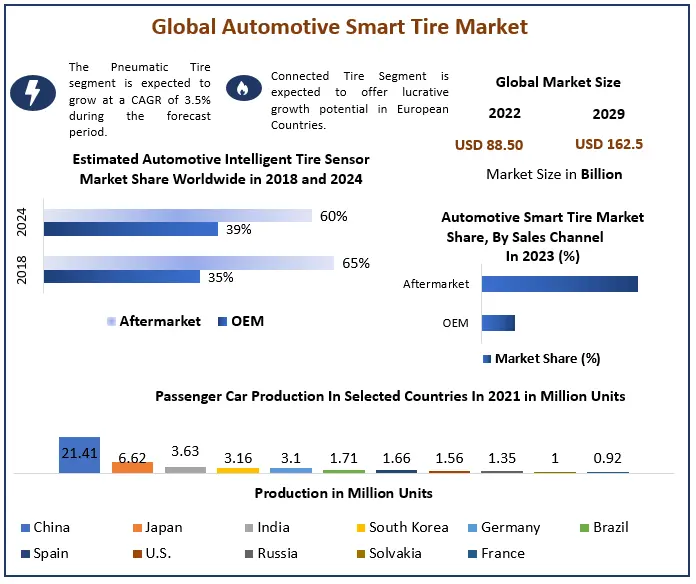
- Automotive Smart Tire Market was valued at USD 88.50 Billion in 2023 and is projected to reach USD 162.5 Billion by 2030, growing at a CAGR of 8.1%.
- Smart tires are evolving from passive vehicle components into connected data platforms supporting safety, efficiency, and predictive maintenance.
- Increasing vehicle connectivity is driving demand for real-time tire monitoring and intelligent vehicle diagnostics.
- Fleet operators are adopting smart tire technologies to improve uptime and reduce maintenance costs.
- Electric vehicle expansion is creating new opportunities for advanced tire sensing and performance optimization.
- OEMs and tire manufacturers are strengthening partnerships to integrate connected tire ecosystems into next-generation vehicles.
Why This Matters Now
The automotive industry is entering a phase where software, sensors, and real-time data influence vehicle performance as much as mechanical engineering. Tires, once viewed primarily as consumable products, are becoming intelligent assets capable of continuously monitoring vehicle conditions and road interaction.
The Automotive Smart Tire Market, valued at USD 88.50 Billion in 2023, is expected to reach USD 162.5 Billion by 2030 at a CAGR of 8.1%. That growth signals more than expanding revenues—it reflects a broader transition toward connected mobility, predictive maintenance, and data-driven transportation strategies. For OEMs, Tier-1 suppliers, fleet operators, insurers, and mobility providers, smart tire technology is becoming a competitive necessity rather than a premium feature.
Market Overview
The Automotive Smart Tires Market Size integrate embedded sensors and communication technologies that collect and transmit information related to tire pressure, temperature, tread wear, road conditions, and overall tire health. This continuous stream of operational data supports safer driving, optimized maintenance schedules, and improved vehicle performance.
The technology aligns closely with the automotive industry’s broader transformation toward connected vehicles and software-defined mobility. Rather than functioning independently, smart tires increasingly interact with advanced driver assistance systems (ADAS), vehicle control units, telematics platforms, and fleet management software.
Growing digitalization across transportation is also changing customer expectations. Consumers increasingly expect vehicles to provide predictive insights rather than reactive warnings, while commercial fleet operators prioritize operational efficiency through data-driven maintenance and asset management.
Key Trends Driving Growth
Vehicle connectivity is reshaping the role of tire technology. Smart tires now contribute data that enhances braking performance, traction control, stability management, and predictive safety systems. As connected vehicles become mainstream, tire intelligence becomes another critical layer within the vehicle data ecosystem.
Electric vehicle adoption is accelerating demand for advanced tire monitoring. EVs generate instant torque, operate with different weight distributions, and require optimized tire performance to maximize driving range. Smart tire systems help manufacturers manage these challenges while improving efficiency and safety.
Fleet digitization is another major growth catalyst. Logistics providers, commercial transportation companies, and mobility operators increasingly rely on predictive maintenance to minimize downtime and reduce operating costs. Real-time tire health monitoring enables maintenance before failures occur, improving fleet utilization and operational reliability.
Software-defined vehicles are also expanding opportunities. As automakers deploy over-the-air software updates and centralized computing architectures, smart tires become valuable data sources supporting vehicle intelligence, diagnostics, and continuous performance optimization.
Safety regulations continue to encourage adoption of advanced tire monitoring technologies. Governments and transportation authorities remain focused on reducing road accidents through improved vehicle safety systems, creating favorable conditions for intelligent tire solutions.
Segment Insights
- Dominant Segment: The supplied report identifies the market segmentation; however, the dominant segment is not specified in the available source material and is therefore not stated here.
- Fastest-Growing Segment: The supplied report does not specify the fastest-growing segment; consequently, no unsupported claim is included.
- Smart tire adoption continues expanding across passenger and commercial vehicle applications as connected vehicle technologies become increasingly integrated.
- Sensor-enabled tire monitoring solutions are gaining strategic importance for predictive maintenance, safety management, and operational efficiency.
Regional Growth Story
North America continues strengthening its position through connected vehicle deployment, advanced automotive technologies, and increasing fleet digitalization. Vehicle manufacturers are investing heavily in software integration, telematics, and intelligent mobility platforms that support smart tire adoption.
Europe’s automotive industry is accelerating digital transformation while maintaining a strong regulatory focus on vehicle safety and emissions. Automotive manufacturers are integrating advanced sensing technologies to improve vehicle intelligence and meet evolving consumer expectations.
China remains a major force in connected mobility and electric vehicle production. Continued investment in intelligent transportation, vehicle electrification, and advanced manufacturing creates favorable conditions for smart tire technology deployment across domestic and export markets.
Japan and South Korea continue leveraging strengths in automotive electronics, sensors, and semiconductor technologies. Their established supplier ecosystems support innovation in intelligent vehicle components, including next-generation tire monitoring systems.
India is witnessing growing interest in connected mobility as vehicle production expands and digital transportation infrastructure develops. Increasing commercial vehicle activity and fleet modernization initiatives create additional opportunities for intelligent tire technologies.
Competitive Landscape
Competition is shifting beyond tire manufacturing toward software-enabled mobility ecosystems. Companies capable of combining advanced materials, embedded sensors, cloud analytics, and vehicle connectivity are positioning themselves for long-term leadership.
OEM partnerships increasingly determine competitive advantage. Vehicle manufacturers seek suppliers capable of delivering integrated intelligent tire solutions that communicate seamlessly with onboard electronics, ADAS platforms, and fleet management systems rather than standalone hardware.
Technology investment also signals a broader industry transition. Suppliers expanding digital capabilities are strengthening pricing power by offering recurring software-enabled services alongside physical tire products. This changes traditional business models from replacement-focused sales toward lifecycle value creation.
Strategic collaboration between tire manufacturers, semiconductor providers, automotive electronics companies, and mobility software developers is becoming equally important. The competitive landscape increasingly rewards ecosystem participation rather than isolated product innovation.
For fleet customers, purchasing decisions are shifting from initial acquisition costs toward total cost of ownership. Vendors capable of demonstrating measurable reductions in downtime, maintenance expenses, and fuel or energy consumption gain stronger competitive positioning.
Recent Developments
- Connected tire technologies continue expanding integration with vehicle telematics platforms.
- Automotive manufacturers are increasing focus on predictive maintenance capabilities.
- Fleet operators are investing in digital asset management supported by real-time tire monitoring.
- Intelligent mobility platforms increasingly incorporate tire analytics into vehicle health management.
- Software integration is becoming a critical differentiator in next-generation smart tire solutions.
Strategic Implications
The Automotive Smart Tire Market represents more than an incremental technology upgrade. It reflects the growing convergence of automotive engineering, IoT connectivity, software analytics, and digital mobility services.
For OEMs, intelligent tires support broader software-defined vehicle strategies by adding valuable operational data that improves vehicle performance and customer experience. Suppliers that invest in sensor integration, cloud connectivity, and predictive analytics are likely to capture greater value than companies competing solely on manufacturing scale.
Fleet operators stand to benefit from reduced maintenance costs, improved asset utilization, and enhanced operational safety through predictive tire management. Insurance providers may also leverage smart tire data to support risk assessment and usage-based insurance models.
Investors should monitor developments in connected vehicle infrastructure, automotive semiconductor availability, sensor innovation, and digital fleet management as these areas increasingly influence smart tire adoption.
Future Outlook
The next generation of mobility will depend on vehicles capable of continuously sensing, interpreting, and responding to their operating environment. Smart tires will become an increasingly important source of real-time intelligence supporting autonomous systems, connected transportation, predictive maintenance, and software-driven vehicle performance.
As automotive ecosystems become increasingly data-centric, intelligent tires will evolve from safety components into strategic digital assets that contribute to vehicle efficiency, sustainability, and operational resilience. The companies that successfully combine tire engineering with software, connectivity, and analytics will define the next competitive frontier, while manufacturers that continue treating tires as standalone hardware risk losing relevance in an increasingly connected mobility economy.
Analyst Perspective
“The Automotive Smart Tire Market is transitioning from conventional tire technology toward intelligent mobility solutions that deliver continuous vehicle insights. As connected vehicles and digital transportation ecosystems expand, smart tire technologies will become a critical differentiator for OEMs, suppliers, and fleet operators pursuing greater safety, efficiency, and predictive maintenance capabilities,” — Tejaswini Kakade, Analyst
About Maximize Market Research
Maximize Market Research Pvt. Ltd. (MMR) is a global market research and consulting company that provides reliable, data-focused, and practical business insights. The firm serves a wide range of industries, including healthcare, pharmaceuticals, technology, automotive, electronics, chemicals, personal care, and consumer goods. Through market forecasts, competitive analysis, strategic consulting, and industry impact assessments, MMR helps organizations understand changing market conditions, identify growth opportunities, and make informed business decisions for long-term success.
2nd Floor, Navale IT Park Phase 3
Pune Banglore Highway, Narhe
Pune, Maharashtra 411041, India
+91 9607365656
sales@maximizemarketresearch.com
