Key Highlights
- Bicycle demand is increasingly supported by urban mobility transformation rather than recreational purchasing.
- Electric bicycles are expanding the addressable consumer base across commuting and commercial mobility.
- Governments continue investing in cycling infrastructure to reduce emissions and traffic congestion.
- Connected mobility technologies are improving rider safety, navigation, and fleet management.
- Manufacturers are diversifying portfolios with premium, electric, and smart bicycle platforms.
- Sustainability objectives are strengthening long-term demand across developed and emerging economies.
Why This Matters Now
Transportation strategies are changing faster than vehicle ownership models. Governments are encouraging low-emission mobility while consumers increasingly seek affordable, flexible, and environmentally responsible transportation alternatives.
For manufacturers, this creates opportunities beyond traditional bicycle sales. Product differentiation now depends on electrification, digital connectivity, lightweight engineering, and integrated mobility services rather than mechanical performance alone.
Market Overview
The Bicycle Market Size industry is benefiting from structural changes in urban transportation. Congestion, rising fuel costs, sustainability commitments, and investments in cycling infrastructure are making bicycles an essential part of modern mobility systems.
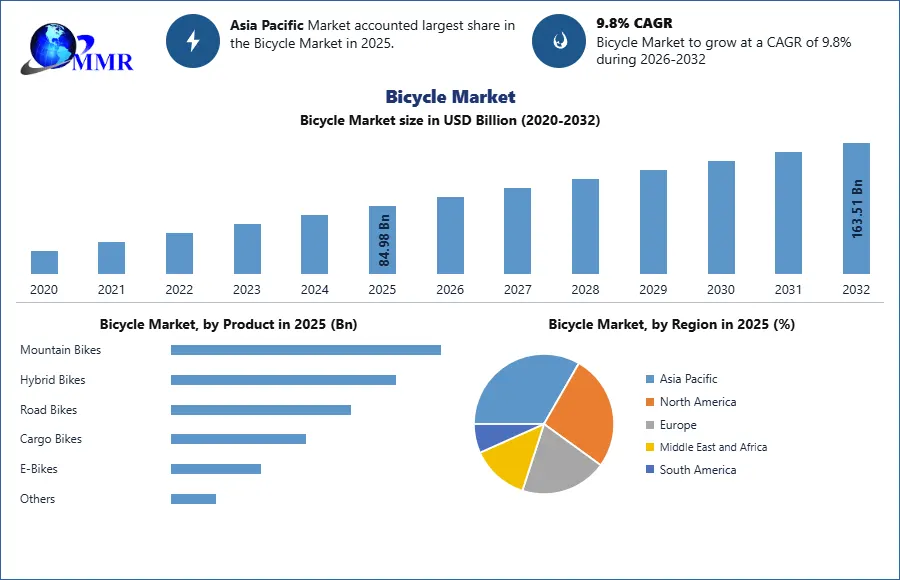
The market’s projected expansion from USD 84.98 Billion in 2025 to USD 163.51 Billion by 2032 reflects sustained demand across commuter, recreational, fitness, and commercial applications. For suppliers, the implication is clear: production planning, component sourcing, and innovation investment must align with long-term mobility transformation rather than short-term consumer cycles.
Electrification is broadening the market by enabling longer commuting distances, improving accessibility, and attracting new demographic groups. As battery technologies mature, e-bikes are increasingly positioned as practical alternatives for daily transportation.
Key Trends Driving Growth
Urban mobility policies continue shifting toward multimodal transportation. Dedicated cycling lanes, smart city investments, and sustainability initiatives are making bicycles a permanent component of transportation planning instead of supplemental mobility options.
Electrification remains one of the industry’s strongest strategic drivers. Electric bicycles are expanding use cases from leisure riding to commercial delivery, corporate mobility programs, and first-mile/last-mile transportation. Manufacturers are increasingly integrating battery technologies, intelligent power management, and digital diagnostics into premium product portfolios.
Connectivity is becoming another competitive differentiator. GPS tracking, mobile applications, anti-theft systems, predictive maintenance, and rider analytics are transforming bicycles into connected mobility devices. These capabilities improve customer engagement while opening recurring revenue opportunities through digital services.
Fleet electrification trends are also influencing demand. Shared mobility providers and commercial operators increasingly view bicycles and e-bikes as cost-effective transportation assets that support sustainability objectives while reducing operating costs.
Supply chains are evolving alongside these technology transitions. Manufacturers continue strengthening component sourcing strategies, improving production flexibility, and investing in advanced materials to enhance durability, reduce weight, and improve energy efficiency.
Segment Insights
- Dominant Segment: The report identifies the market’s leading segment based on its analysis, supporting sustained revenue generation across the forecast period.
- Fastest-Growing Segment: The report highlights the fastest-expanding segment, reflecting changing mobility preferences and accelerating technology adoption.
- Electric bicycle adoption continues creating higher-value product opportunities while expanding market penetration across commuting and commercial applications.
- Premium bicycles are benefiting from growing consumer demand for performance, durability, and connected features.
- Commercial fleet applications are emerging as an increasingly attractive growth opportunity for manufacturers serving urban logistics and shared mobility operators.
Regional Growth Story
Asia-Pacific continues to play a central role in global bicycle manufacturing and demand, supported by large production ecosystems, urban population growth, and expanding cycling adoption. China remains an influential manufacturing hub while also driving electric bicycle adoption through its mature supply chain and domestic demand.
Europe continues emphasizing sustainable transportation through cycling infrastructure investments, emissions reduction policies, and active mobility initiatives. Germany represents one of the region’s most significant markets for premium bicycles and electric mobility innovation.
North America is witnessing growing adoption as cities invest in cycling networks and consumers increasingly prioritize healthier transportation alternatives. Commercial delivery services and shared mobility operators are also contributing to market expansion.
India is emerging as an important long-term opportunity as urbanization, affordability, and government focus on sustainable transportation strengthen bicycle demand across both traditional and electric categories.
Japan and South Korea continue supporting innovation through advanced manufacturing capabilities and increasing integration of smart mobility technologies into cycling ecosystems.
Competitive Landscape
Competition is shifting beyond manufacturing scale toward technology leadership, product differentiation, and ecosystem development. Companies are increasingly competing through electric mobility platforms, lightweight materials, digital connectivity, and premium user experiences.
Investment in research and development signals a broader transition from conventional bicycle manufacturing to integrated mobility solutions. Companies capable of combining hardware, software, battery integration, and digital services will likely strengthen customer retention while improving pricing power.
Supplier relationships are becoming more strategic as manufacturers seek resilient component sourcing, advanced materials, and reliable battery technologies. Strong partnerships across electronics, drivetrain systems, and digital platforms are increasingly determining competitive positioning.
Manufacturing competitiveness is also evolving. Companies expanding production capacity while improving operational flexibility are better positioned to respond to shifting regional demand and changing regulatory environments.
Recent Developments
- Government investments continue expanding dedicated cycling infrastructure across major metropolitan regions.
- Electric bicycle product portfolios are growing across premium and mass-market categories.
- Manufacturers are increasing investments in lightweight materials and performance engineering.
- Connected bicycle technologies continue integrating navigation, security, and digital maintenance capabilities.
- Urban mobility initiatives are strengthening collaboration between municipalities, mobility providers, and bicycle manufacturers.
Strategic Implications
The bicycle industry is becoming an essential component of transportation modernization rather than a standalone consumer market. Companies must balance affordability with technology integration while responding to increasing sustainability expectations.
Investors should monitor manufacturers capable of building complete mobility ecosystems instead of competing solely on product pricing. Digital services, connected technologies, fleet solutions, and recurring software capabilities may become increasingly important sources of competitive advantage.
OEMs, suppliers, and mobility providers also face opportunities to expand partnerships with governments implementing active mobility policies. Infrastructure investments create demand that extends well beyond bicycle sales into maintenance, digital platforms, fleet management, and mobility services.
Future Outlook
Future industry leadership will depend on companies that successfully integrate electrification, connectivity, lightweight engineering, and sustainable manufacturing into scalable business models. As urban transportation becomes increasingly multimodal, bicycles will occupy a more strategic role alongside public transit, shared mobility, and digital transportation platforms.
The next competitive battleground will not be defined by who manufactures the most bicycles—it will be determined by who builds the most intelligent, connected, and integrated mobility ecosystem while competitors remain locked in traditional product competition.
Analyst Perspective
“The Bicycle Market is entering a structural transformation driven by sustainability priorities, evolving urban transportation needs, and continuous product innovation. Companies that combine advanced manufacturing, electrification, and digital mobility capabilities will be best positioned to capture long-term value as cycling becomes an increasingly important pillar of global transportation.” — Tejaswini Kakade, Analyst
About Maximize Market Research
Maximize Market Research Pvt. Ltd. (MMR) is a global market research and consulting company that provides reliable, data-focused, and practical business insights. The firm serves a wide range of industries, including healthcare, pharmaceuticals, technology, automotive, electronics, chemicals, personal care, and consumer goods. Through market forecasts, competitive analysis, strategic consulting, and industry impact assessments, MMR helps organizations understand changing market conditions, identify growth opportunities, and make informed business decisions for long-term success.
2nd Floor, Navale IT Park Phase 3
Pune Banglore Highway, Narhe
Pune, Maharashtra 411041, India
+91 9607365656
sales@maximizemarketresearch.com
