Key Highlights
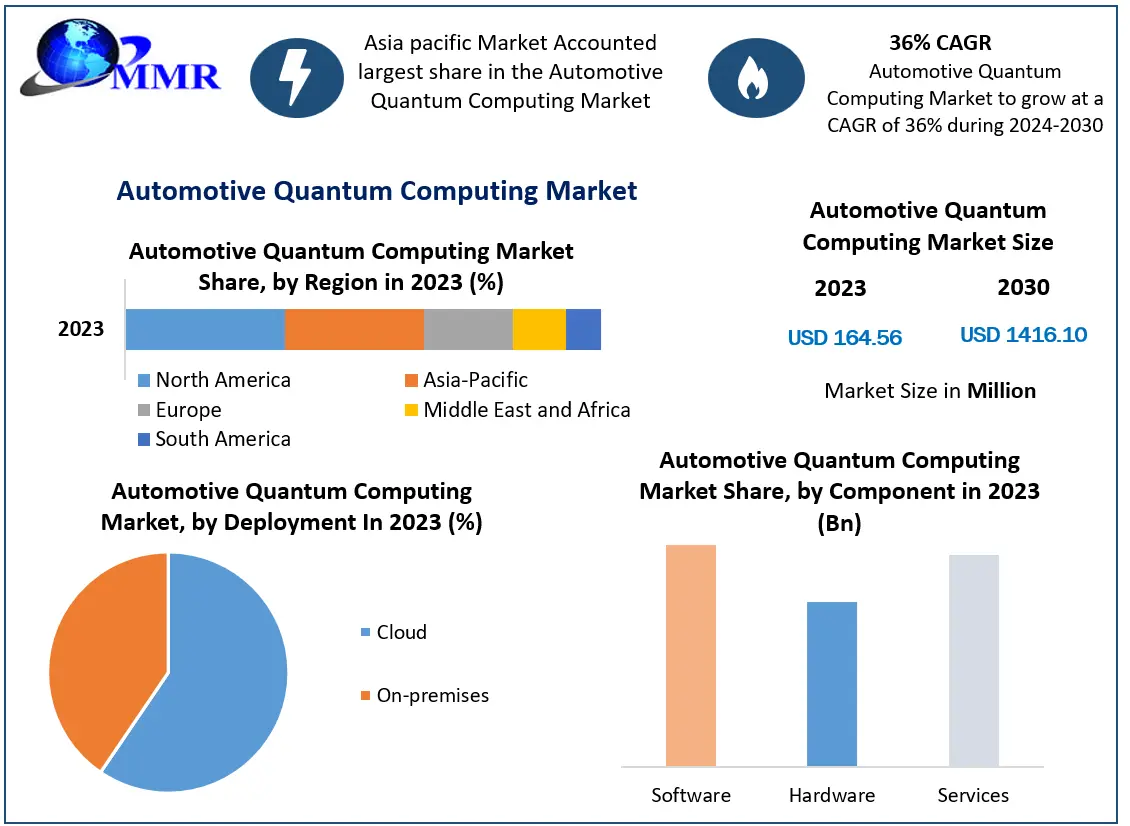
- Automotive Quantum Computing Market reached USD 164.56 million in 2023 and is forecast to reach USD 1,416.10 million by 2030, growing at a 36% CAGR. This growth signals accelerating commercialization of quantum technologies across automotive engineering and mobility applications.
- Software remained the largest component segment in 2023 as automotive companies increasingly develop quantum algorithms before large-scale hardware deployment.
- Improved battery materials and fuel cell optimization represent the leading application area, supported by global electric vehicle adoption.
- North America led the market in 2023, while Europe and Asia-Pacific continue expanding investments in automotive quantum research.
- Cloud deployment is emerging rapidly as OEMs seek scalable access to quantum computing resources without building proprietary infrastructure.
Why This Matters Now
The automotive industry is entering a computing transition that extends beyond artificial intelligence. As electric vehicles, software-defined vehicles, connected mobility, and autonomous driving generate increasingly complex engineering problems, conventional computing approaches are reaching practical limits.
Quantum computing introduces a new capability for solving optimization, simulation, and material discovery challenges that directly influence vehicle performance, battery chemistry, manufacturing efficiency, logistics, and mobility services. Companies that establish quantum expertise today could shorten development cycles while improving product competitiveness as commercialization accelerates.
Market Overview
The Automotive Quantum Computing Market Size was valued at USD 164.56 million in 2023 and is projected to reach USD 1,416.10 million by 2030, registering a 36% CAGR during the forecast period. The rapid expansion demonstrates that automotive companies increasingly view quantum computing as a strategic engineering capability rather than an experimental research project.
What changed is the industry’s focus. Instead of asking whether quantum computing will influence automotive engineering, OEMs and technology suppliers are identifying practical applications with measurable commercial value. Battery optimization, traffic management, autonomous driving algorithms, vehicle routing, and materials discovery have become early deployment priorities because they address computational problems that continue to grow with vehicle electrification and digitalization.
For investors, this market represents a convergence of advanced computing, automotive software, and mobility transformation. For OEMs, it represents another competitive layer in the race toward intelligent, connected, and sustainable transportation.
Key Trends Driving Growth
Electrification remains one of the strongest catalysts for quantum adoption. Battery chemistry optimization requires evaluating enormous combinations of materials and molecular interactions. Quantum computing offers opportunities to accelerate these simulations, supporting improved battery materials and fuel-cell optimization, both identified as major automotive applications.
Autonomous mobility is creating another demand driver. Self-driving systems require continuous optimization across sensor fusion, routing, traffic prediction, and decision-making. As connected vehicles generate larger data volumes, computational efficiency becomes increasingly important.
Software-defined vehicles are also reshaping development priorities. Modern vehicles increasingly depend on software updates, digital engineering, and predictive optimization. Quantum-enabled software platforms may eventually reduce design complexity while improving validation and simulation capabilities.
Manufacturing operations stand to benefit as well. Automotive companies continue pursuing factory digitization, production scheduling improvements, supply-chain optimization, and logistics efficiency. Quantum optimization can potentially reduce production bottlenecks while improving inventory planning across global manufacturing networks.
Cloud deployment further accelerates adoption because manufacturers can access quantum capabilities through technology partners instead of investing in dedicated quantum hardware. This lowers entry barriers and enables experimentation across multiple engineering functions.
Segment Insights
- Dominant Segment: Software held the largest market share in 2023, supported by extensive development of quantum algorithms and software platforms across the quantum computing ecosystem. Major technology companies continue investing in automotive software solutions before hardware reaches broader commercialization.
- Fastest-Growing Segment: Cloud deployment is expected to grow rapidly as automotive manufacturers increasingly access quantum computing through cloud-based platforms developed by technology partners.
- Leading Application: Improved battery materials and fuel-cell optimization accounted for the major application share and are expected to maintain strong growth due to rising electric vehicle demand and global carbon reduction initiatives.
- Hardware Outlook: Hardware remains the second-largest component segment, with multiple technology companies pursuing competing quantum architectures that continue to evolve.
- Services Opportunity: As adoption expands, consulting, implementation, integration, and quantum application development services are expected to gain importance across automotive organizations.
Regional Growth Story
North America maintained market leadership in 2023 because of early quantum adoption, strong technology ecosystems, and significant research and development investments by major industry participants. The region benefits from close collaboration between automotive manufacturers and leading quantum technology companies.
Europe is emerging as a strategic growth center. Germany remains particularly influential as leading automotive manufacturers strengthen participation in national quantum initiatives, including collaboration through the Quantum Technology and Application Consortium (QUTAC). Government-backed research programs continue supporting commercialization across the automotive value chain.
Asia-Pacific combines large-scale vehicle manufacturing with increasing technology investment. China, Japan, South Korea, and India continue expanding automotive production while exploring quantum applications for autonomous driving and electric vehicle battery development. Growing digital infrastructure and research initiatives position the region as a significant future growth engine.
Competitive Landscape
Competition is no longer defined solely by vehicle production volume. Technology capability increasingly shapes long-term automotive leadership.
Software developers are establishing early advantages because practical automotive applications depend first on algorithm development rather than mature quantum hardware. Technology companies investing in automotive optimization software strengthen their influence across future vehicle platforms.
For OEMs, partnerships with cloud providers and quantum specialists reduce technology risk while accelerating experimentation. Tier-1 suppliers gain opportunities by embedding quantum-enabled optimization into engineering, manufacturing, battery development, and mobility services. This shifts competitive positioning from component manufacturing toward integrated digital capabilities.
Companies investing early may achieve faster product development, more efficient battery innovation, improved manufacturing economics, and differentiated mobility platforms as quantum technology matures.
Recent Developments
- Software continues leading market adoption through expanding quantum algorithm development for automotive applications.
- Automotive manufacturers increasingly pursue cloud-based quantum computing partnerships instead of proprietary infrastructure investments.
- European automotive companies continue strengthening collaboration through national quantum technology initiatives.
- Asia-Pacific manufacturers are expanding research into quantum applications for autonomous driving and electric vehicle battery technologies.
- Growing investment in battery materials optimization reinforces quantum computing’s strategic importance for next-generation electric vehicles.
Strategic Implications
Automotive executives should view quantum computing as a long-term competitive capability rather than an isolated technology investment.
OEMs can prioritize battery development, vehicle engineering, manufacturing optimization, and mobility analytics. Tier-1 suppliers can strengthen differentiation through software integration and advanced engineering solutions. Fleet operators may eventually benefit from improved routing optimization and predictive operations, while mobility providers gain new opportunities to improve network efficiency.
The greatest value may emerge where quantum computing complements artificial intelligence, cloud computing, and software-defined vehicle architectures instead of replacing existing digital technologies.
Future Outlook
The next phase of automotive competition will increasingly depend on computational capability as much as manufacturing scale. Quantum computing is expected to become an enabling technology for battery innovation, autonomous mobility, connected vehicles, and intelligent manufacturing.
Manufacturers that integrate quantum capabilities into engineering and product development strategies today are likely to compress innovation cycles and improve future competitiveness, while organizations delaying investment risk falling behind as computational advantage becomes a defining characteristic of next-generation mobility.
Analyst Perspective
“Automotive companies are entering a new era where computational capability will increasingly determine engineering speed, battery innovation, and mobility performance. Organizations that invest early in quantum-enabled automotive applications will be better positioned to compete as digital vehicle ecosystems continue to evolve.” — Tejaswini Kakade
About Maximize Market Research
Maximize Market Research Pvt. Ltd. (MMR) is a global market research and consulting company that provides reliable, data-focused, and practical business insights. The firm serves a wide range of industries, including healthcare, pharmaceuticals, technology, automotive, electronics, chemicals, personal care, and consumer goods. Through market forecasts, competitive analysis, strategic consulting, and industry impact assessments, MMR helps organizations understand changing market conditions, identify growth opportunities, and make informed business decisions for long-term success.
2nd Floor, Navale IT Park Phase 3
Pune Banglore Highway, Narhe
Pune, Maharashtra 411041, India
+91 9607365656
sales@maximizemarketresearch.com
