Key Highlights
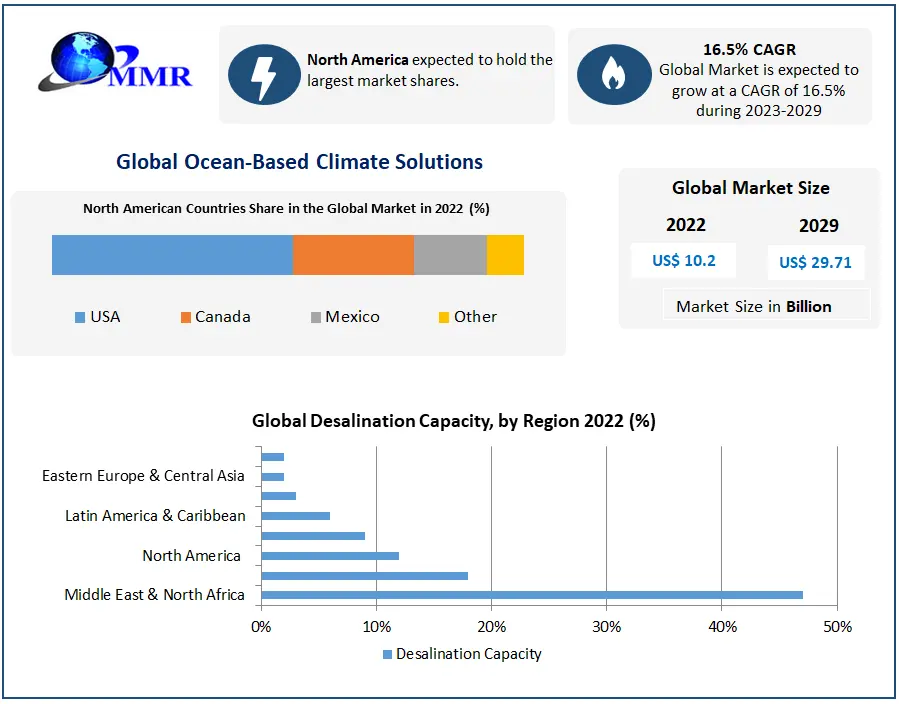
- Market projected to grow from USD 10.2 billion in 2022 to USD 29.71 billion by 2029.
- CAGR estimated at 16.5% during 2023–2029.
- Blue economy initiatives are creating new commercial opportunities across energy, aquaculture, and coastal infrastructure.
- Offshore renewable energy remains one of the fastest commercial deployment areas.
- Marine biofuels and desalination technologies continue attracting public and private investment.
- Europe leads commercialization, while North America and Asia Pacific expand large-scale deployments.
- Climate-focused investments and carbon reduction policies accelerate technology adoption.
Why This Matters Now
Governments are shifting climate investment beyond land-based solutions. Oceans absorb nearly one-quarter of global carbon emissions and regulate planetary temperatures, making them central to future decarbonization strategies. Public funding, private capital, and international climate commitments are accelerating investment in offshore renewable energy, blue carbon restoration, desalination, and marine carbon capture. Companies capable of combining environmental impact with commercial scalability are positioned to benefit from long-term climate infrastructure spending.
Market Overview
The Ocean-Based Climate Solutions Market encompasses technologies and services designed to reduce greenhouse gas emissions, improve marine ecosystem resilience, and support sustainable economic activity across oceans. The market spans offshore renewable energy, blue carbon ecosystems, marine biofuels, desalination, ocean afforestation, ocean alkalinity enhancement, and carbon capture technologies.
Demand is rising as governments pursue net-zero commitments while addressing rising sea levels, biodiversity loss, water scarcity, and ocean acidification. Coastal nations increasingly recognize marine resources as strategic climate assets capable of supporting both environmental protection and economic development.
Supply dynamics are shifting as technology developers, engineering firms, renewable energy companies, and conservation organizations collaborate on scalable ocean solutions. Continuous innovation is reducing deployment costs while improving operational efficiency, making ocean-based climate technologies increasingly attractive for infrastructure investors.
Key Trends Driving Growth
Expansion of Offshore Renewable Energy
Offshore wind, tidal, and wave energy projects continue expanding across Europe, North America, and Asia Pacific. These projects diversify national energy portfolios while reducing dependence on fossil fuels, creating long-term demand for marine engineering, subsea infrastructure, and grid integration technologies.
Blue Carbon Becomes a Commercial Asset
Restoration of mangroves, seagrass beds, and salt marshes is moving beyond conservation into carbon finance. These ecosystems generate measurable carbon sequestration benefits while protecting coastlines, creating new revenue streams through carbon markets.
Advanced Ocean Monitoring Technologies
Autonomous underwater vehicles, marine robotics, satellite monitoring, and digital ocean mapping improve project planning and operational efficiency. Better marine data reduces project risk and supports large-scale deployment.
Sustainable Marine Fuels Gain Momentum
Marine biofuels are emerging as practical alternatives to heavy fuel oil in shipping. Governments and industry are investing in renewable marine fuels to reduce emissions while supporting international decarbonization targets.
Water Security Strengthens Desalination Demand
Growing freshwater shortages increase investment in ocean desalination infrastructure, particularly across the Middle East and North Africa. Technology improvements continue lowering operating costs while improving energy efficiency.
Segment Insights
Dominant Segment: Marine-Based Biofuels
Marine-based biofuels represent one of the strongest commercial opportunities within the market. International shipping contributes significantly to global greenhouse gas emissions, creating urgent demand for cleaner marine fuels.
Government-backed research programs, particularly in sustainable marine fuels, are accelerating commercialization. Biofuel adoption enables shipping companies to reduce emissions without replacing existing vessel fleets, lowering transition costs and improving regulatory compliance.
Business impact: Marine fuel developers gain access to expanding global shipping demand while supporting energy security and emissions reduction objectives.
Explore detailed analysis, insights, and growth opportunities
Fastest-Growing Segment: Ocean-Based Desalination
Ocean desalination continues expanding as water scarcity intensifies worldwide. Coastal cities, industrial facilities, and agricultural users increasingly rely on desalination to secure reliable freshwater supplies.
Large desalination installations across the Middle East demonstrate the commercial viability of the technology. Improvements in membrane efficiency and renewable-powered desalination further strengthen investment attractiveness.
Business impact: Equipment manufacturers, engineering contractors, and infrastructure developers benefit from rising long-term water infrastructure investments.
Additional High-Potential Segments
Ocean Afforestation and Reforestation
Marine ecosystem restoration supports carbon sequestration while strengthening biodiversity and coastal resilience.
Ocean-Based Hydrogen Production
Hydrogen produced using offshore renewable energy presents long-term opportunities for industrial decarbonization and clean transportation.
Marine-Based Agriculture and Aquaculture
Sustainable aquaculture addresses rising global food demand while reducing pressure on wild fisheries and supporting coastal economies.
Regional Growth Story
Europe
Europe leads global commercialization through aggressive offshore wind deployment, marine conservation programs, and renewable energy policies. Countries including the United Kingdom, Germany, Denmark, and the Netherlands continue expanding offshore infrastructure, creating strong demand for marine engineering and subsea technologies.
North America
The United States and Canada invest heavily in offshore renewable energy, ocean carbon capture, and blue economy initiatives. Government funding supports research while private companies accelerate commercialization of emerging technologies.
Asia Pacific
China, Japan, South Korea, and Australia continue expanding offshore wind capacity, tidal energy, and sustainable aquaculture. Rapid industrialization and growing climate commitments support increasing investment across marine technologies.
Middle East & Africa
Water scarcity remains the primary market driver. Countries including Saudi Arabia, the UAE, Qatar, Libya, and Algeria continue expanding desalination infrastructure while evaluating renewable marine technologies.
South America
Brazil, Chile, and Mexico are increasing investments in offshore renewable energy, sustainable fisheries, and coastal conservation, creating new opportunities for marine infrastructure providers.
Competitive Landscape
The market combines renewable energy developers, marine robotics companies, environmental organizations, and technology innovators.
ORPC strengthens its position through tidal and river energy deployment, expanding renewable power solutions for remote communities.
Ocean Infinity enhances offshore operations using autonomous marine robotics while forming partnerships that strengthen geotechnical capabilities for renewable energy developments.
XPRIZE Foundation accelerates technological innovation by supporting breakthrough climate solutions capable of large-scale environmental impact.
Sea Machines advances autonomous marine navigation technologies, improving operational efficiency across commercial marine applications.
Companies including The Ocean Cleanup, Subsea 7, AquaBounty Technologies, Sea Forest, OpenROV, Marine Bio, DeepGreen Metals, Cargill Aqua Nutrition, and The Nature Conservancy continue expanding capabilities across marine sustainability, carbon reduction, aquaculture, and ocean restoration, creating a diversified competitive landscape driven by technology partnerships and environmental innovation.
Recent Developments
- ORPC launched its Decarbonization from Patagonia to Cape Horn initiative in Chile to expand renewable river and tidal energy deployment.
- Schneider Electric collaborated with ORPC to integrate river-current energy into remote microgrid systems, reducing diesel dependence.
- ORPC’s RivGen power system advanced deployment in Canada through testing at Seven Sisters Falls.
- Ocean Infinity formed a joint venture with Gregg Drilling to deliver offshore geotechnical services supporting renewable energy developments.
- Shell partnered with Ocean Infinity to develop autonomous offshore seep detection capabilities using robotic marine technologies.
Analyst Perspective – Komal Patil
Ocean-based climate solutions are evolving from environmental initiatives into strategic infrastructure investments. Blue carbon restoration, offshore renewable energy, marine biofuels, and desalination are creating commercially viable pathways for decarbonization while strengthening energy, water, and food security. Organizations capable of integrating advanced marine technologies with measurable climate outcomes will secure a lasting competitive advantage as governments expand investment in blue economy strategies.
Future Outlook
Companies that successfully combine scalable marine technologies with measurable carbon reduction and sustainable resource management will define the next phase of global climate infrastructure investment.
About Maximize Market Research
Maximize Market Research Pvt. Ltd. (MMR) is a global market research and consulting company that provides reliable, data-focused, and practical business insights. The firm serves a wide range of industries, including healthcare, pharmaceuticals, technology, automotive, electronics, chemicals, personal care, and consumer goods. Through market forecasts, competitive analysis, strategic consulting, and industry impact assessments, MMR helps organizations understand changing market conditions, identify growth opportunities, and make informed business decisions for long-term success.
Contact Us :
2nd Floor, Navale IT Park Phase 3
Pune Banglore Highway, Narhe
Pune, Maharashtra 411041, India
+91 9607365656
sales@maximizemarketresearch.com
