Key Highlights
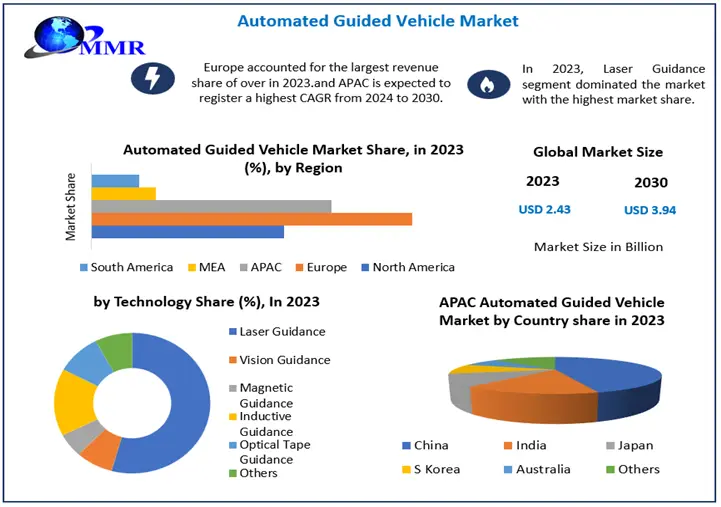
Global automated guided vehicle market valued at USD 2.43 billion in 2023; revenue will reach nearly USD 3.94 billion by 2030 at a 7.15% CAGR, signaling AGVs’ shift from optional automation to core logistics infrastructure for automotive and transportation players.
Towing vehicle AGVs held over 38% of global revenue in 2023, making them the dominant segment for bulk material transport in warehouses and plants and a critical lever for OEMs seeking high-throughput, low-labor automotive logistics flows.
Laser-guided AGVs are the fastest-growing technology segment with an expected 8.05% CAGR, reflecting demand for precise, flexible navigation in complex manufacturing and distribution environments.
Europe currently captures more than 30% of market revenue and remains the leading region, showing mature automation adoption across manufacturing, automotive, and logistics operations.
Asia Pacific is projected to post the fastest CAGR of 8.24%, driven by surging e-commerce activity and increased industrial automation in China, India, and other emerging production hubs.
SMEs in e-commerce, automotive, food and beverage, and pharma are accelerating AGV deployment despite high upfront costs, using automation to close competitiveness gaps with large OEMs and Tier-1 suppliers.
Competitive activity includes partnerships, joint ventures, product launches, and freezer-capable AGVs, signaling deeper penetration into temperature-controlled logistics and specialized automotive and transportation workflows.
Why This Matters Now
Material handling is becoming a frontline battleground for manufacturing competitiveness, logistics resilience, and EV-era supply chain speed, and AGVs sit at the center of that transition. As automotive OEMs electrify portfolios, retool plants, and ramp battery and component flows, AGVs give them a scalable way to redesign intralogistics without adding labor or compromising safety.
For fleet operators, mobility providers, and logistics networks serving EV and parts distribution, AGVs reduce error rates, stabilize throughput, and enable 24/7 operations—capabilities that are now non-negotiable in fast-cycle transportation ecosystems. Regulators and policymakers pushing productivity and safety gains also benefit as AGVs bring standardized, trackable movement into high-risk environments.
Market Overview
The automated guided vehicle market is moving into a sustained growth phase, rising from USD 2.43 billion in 2023 to nearly USD 3.94 billion by 2030 at a 7.15% CAGR. This growth marks a structural shift: AGVs are no longer isolated automation projects, but strategic assets integrated into Industry 4.0 roadmaps in automotive, logistics, healthcare, and food sectors.
AGVs replace or complement forklifts, conveyor systems, and manual carts by autonomously moving raw materials such as paper, rubber, plastic, and metal within plants and warehouses. For automotive and transportation stakeholders, that means fewer bottlenecks, more predictable line feeding, and the ability to scale EV and component flows without proportional labor increases.
Key Trends Driving Growth
The spread of Industry 4.0 and connected manufacturing is the primary driver, putting AGVs at the heart of automated material flows between production lines, storage areas, and outbound docks. Automotive plants, distribution centers, and logistics hubs increasingly view AGVs as foundational to digital twins, real-time inventory visibility, and standardized workflows.
Demand for automated material handling is rising across healthcare, e-commerce, automotive, and food, with a clear focus on product efficiency, time savings, and reduced human error. AGV-enabled automation also supports safer operations by removing people from heavy-load and repetitive transport tasks, which is critical in high-volume automotive and transportation environments.
At the same time, cost-effective mobile robots present a direct competitive alternative to traditional AGVs, especially in retail and e-commerce logistics where flexibility and lower installation costs are decisive. This dynamic forces AGV vendors to move up the value chain with more sophisticated navigation, payload, and integration capabilities that justify investment in complex automotive and industrial contexts.
Request a Free Sample Copy or View Report Summary: https://www.maximizemarketresearch.com/request-sample/11379/
Segment Insights
Dominant Segment – Towing Vehicle AGVs
Towing vehicle AGVs accounted for more than 38% of global revenue in 2023, making them the largest type segment.
They are used to move bulk products to and from warehouse areas and along side path spurs in shipping and receiving zones, giving automotive and logistics operators high-capacity, train-like movement without human drivers.
Fastest-Growing Segment – Laser-Guided Technology
Laser-guided AGVs are expected to post the highest technology CAGR of 8.05% during the forecast period.
Their ability to calculate angle and distance from targets using reflective tapes enables precise navigation, which is vital in dense automotive plants, mixed-traffic warehouses, and complex transport terminals.
Vision-Guided and Magnetic Guidance
Vision-guided AGVs, using cameras and recorded route features, are projected to expand significantly, enabling automation without structural modifications—an advantage for retrofitting existing factories and logistics centers.
Magnetic-guided AGVs, which follow tracks defined by magnetic tape, remain relevant where simple, robust guidance is preferred, such as in repetitive manufacturing or port environments.
End-Use Industries
AGVs serve retail/wholesale, food/pharma, transport/logistics, manufacturing, automotive, ports/terminals, mining and construction, and chemicals, positioning the technology across the full automotive and transportation supply chain.
Regional Growth Story
Europe currently leads the automated guided vehicle market with over 30% revenue share and is expected to maintain its position through 2030. High demand for material handling equipment in manufacturing, coupled with broad automation adoption, sustains AGV deployment in automotive OEMs, fashion logistics, and industrial distribution.
Asia Pacific is set to record the fastest CAGR of 8.24%, driven by rapid e-commerce expansion and rising automation in emerging economies such as China and India. Regional initiatives like Mitsubishi Electric Asia’s Integrated Solutions Centre in Singapore highlight the region’s focus on advanced digital technologies and co-created integrated solutions—including AGVs—for next-generation logistics and manufacturing.
North America remains a critical market with a dense cluster of AGV suppliers that support automotive, industrial, and logistics operations. Activity in Middle East & Africa and South America aligns with broader industrial modernization, with AGVs entering ports, terminals, and growing manufacturing corridors.
Competitive Landscape
The AGV market features global players that increasingly position themselves as end-to-end automation partners rather than equipment vendors. In North America, companies such as JBT Corporation, Hyster-Yale Materials Handling, Seegrid, Kollmorgen, Bastian Solutions, and Rockwell Automation compete on integration depth, technology sophistication, and application breadth across automotive and logistics.
In Europe, KION Group, SSI Schaefer, Swisslog, KUKA, Dematic, ABB, and others leverage strong manufacturing bases and automation expertise to deliver AGVs into automotive plants, distribution centers, and industrial facilities. Their strategies signal a push toward platform-based AGV offerings integrated with warehouse management, manufacturing execution, and robotics ecosystems—reshaping pricing power and technology leadership.
Japan and wider Asia Pacific host Toyota Industrial Corporation, Daifuku, Mitsubishi, and Toyota Industries, whose AGV portfolios complement broader material handling and factory automation solutions. For OEMs and Tier-1 suppliers, partnering with these players increasingly means securing standardized, scalable intralogistics capabilities that align with global EV, connected vehicle, and digital manufacturing programs.
Recent Developments
Kivnon partnered with TAP to distribute AGVs and autonomous mobile robots across aerospace, food, automotive, and retail markets, extending automation reach and signaling a push to capture Industry 4.0-driven demand with broader channel access.
Jungheinrich and Mitsubishi Logisnext Americas expanded their joint venture in North America, creating Rocrich AGV Solutions to consolidate Rocla and Jungheinrich AGV portfolios, reinforcing their position as a unified mobile automation provider.
Dematic launched a new line of freezer-capable AGVs, including high-reach and counterbalance models designed and manufactured in Australia and certified for freezing conditions, opening deeper penetration into cold chain logistics and temperature-sensitive transport operations.
Bastian Solutions introduced a vision-guided tow tractor vehicle branded Raymond Courier, with a 10,000 lb payload capacity and the ability for one operator to control multiple units, highlighting how AGVs amplify workforce productivity and fleet efficiency in warehouses.
Strategic Implications
For automotive OEMs and Tier-1 suppliers, AGVs are now a lever for plant redesign and supply chain resilience, not just incremental warehouse automation. As EV programs, battery plants, and software-defined vehicle architectures multiply material flows, AGVs provide modular, reconfigurable capacity to handle new parts, packs, and assemblies.
SMEs in e-commerce, automotive supply, food & beverage, pharma, and chemicals increasingly view AGVs as a necessary investment to compete globally despite high upfront costs. Rising labor expenses, quality demands, and skill shortages accelerate AGV adoption as SMEs seek productivity, efficiency, and profitability gains that narrow the gap with large, fully automated competitors.
For logistics and fleet operators, integrating AGVs into warehouses, terminals, and cross-docks improves cycle times and reduces human error, supporting tighter service-level agreements and more reliable transport schedules. Technology choices—laser versus vision versus magnetic guidance—will shape how flexibly these networks can respond to shifting automotive demand, EV component flows, and omnichannel logistics requirements.
Future Outlook
With a 7.15% CAGR to 2030 and strong traction in towing vehicles and laser-guided systems, the automated guided vehicle market is set to move deeper into core automotive and transportation operations. As Industry 4.0 adoption rises, AGVs will integrate more tightly with digital control systems, analytics platforms, and broader automation ecosystems, enabling end-to-end orchestration of material flows from inbound parts to outbound finished goods.
Asia Pacific’s 8.24% expected CAGR points to a future in which China, India, and regional hubs become major centers of AGV-enabled logistics, supplying global automotive and mobility markets with faster, more automated operations. Market leaders will be those OEMs, logistics providers, and suppliers that treat AGVs as strategic infrastructure and align them with EV, connectivity, and digital manufacturing programs—while laggards will struggle as manual, fragmented material handling erodes their cost position and responsiveness.
Related Reports
Smart Railways Market https://www.maximizemarketresearch.com/market-report/global-smart-railways-market/39339/
Global Hydrostatic Transmission Market https://www.maximizemarketresearch.com/market-report/global-hydrostatic-transmission-market/68444/
Global Truck Tank Market https://www.maximizemarketresearch.com/market-report/global-truck-tank-market/98676/
Analyst Perspective
“Automated guided vehicles have shifted from peripheral automation to strategic infrastructure for modern logistics and manufacturing,” said Tejaswini Kakade, lead analyst for the Automated Guided Vehicle Market at Maximize Market Research. “Executives who link AGV deployment to Industry 4.0, EV supply chains, and digital factory programs will unlock productivity and resilience advantages that traditional material handling can no longer deliver.”
About Maximize Market Research
Maximize Market Research Pvt. Ltd. (MMR) is a global market research and consulting company that provides reliable, data-focused, and practical business insights. The firm serves a wide range of industries, including healthcare, pharmaceuticals, technology, automotive, electronics, chemicals, personal care, and consumer goods. Through market forecasts, competitive analysis, strategic consulting, and industry impact assessments, MMR helps organizations understand changing market conditions, identify growth opportunities, and make informed business decisions for long-term success.
2nd Floor, Navale IT Park Phase 3
Pune Banglore Highway, Narhe
Pune, Maharashtra 411041, India
+91 9607365656
sales@maximizemarketresearch.com
