Key Highlights
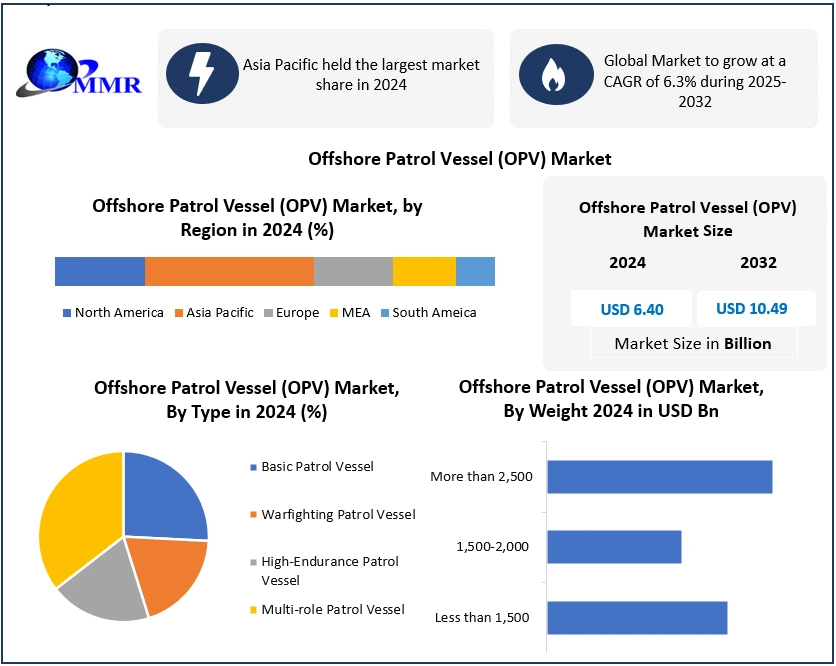
Market Scale: The global offshore patrol vessel (OPV) market was valued at USD 15.65 billion in 2024 and is projected to reach USD 24.31 billion by 2032.
Growth Velocity: The industry is expanding at a steady CAGR of 5.67% through the 2032 forecast period.
Dominant Segment: Steel-hulled vessels currently command the largest market share due to their proven durability, ease of maintenance, and cost-effectiveness in diverse maritime conditions.
Fastest-Growing Segment: Composite-hulled vessels are experiencing the fastest growth, favored for their lightweight properties, radar cross-section reduction, and ability to house advanced sensor suites.
Strategic Driver: Increasing geopolitical tensions and the necessity to secure Exclusive Economic Zones (EEZs) against illegal fishing, piracy, and smuggling are forcing nations to prioritize naval fleet modernization.
Why This Matters Now
The global maritime domain is seeing an unprecedented rise in operational intensity, forcing nations to rethink how they manage coastal security. For defense contractors and shipbuilders, the OPV has transitioned from a secondary auxiliary asset into a primary strategic tool. As governments prioritize persistent surveillance and rapid-response capabilities, the market for these vessels is becoming a critical theater for industrial investment, requiring a blend of advanced software integration and robust naval engineering.
Market Overview
The Offshore Patrol Vessels Market represent the frontline of modern maritime sovereignty. With a valuation of USD 15.65 billion in 2024, the market reflects the strategic prioritization of “presence” over brute force. Unlike heavy combatant frigates or destroyers, OPVs provide the ideal balance of endurance, range, and operational cost, allowing navies to maintain a continuous presence in critical waterways. The shift toward USD 24.31 billion by 2032 signals that governments are moving away from reactive maritime policy toward a proactive, persistent-surveillance model.
Key Trends Driving Growth
The most impactful trend in the OPV market is the integration of “modular mission suites.” Modern vessels are increasingly being built with internal bays and deck space to accommodate autonomous surface and underwater vehicles (USVs/UUVs). This capability allows a single hull to perform multiple roles, from mine countermeasures to environmental monitoring, drastically reducing the total number of ships required for a given theater of operations. Additionally, the shift toward digitized, software-defined architectures allows for real-time data fusion, enabling OPVs to act as mobile hubs for regional maritime security networks.
Segment Insights
Dominant Segment: Steel-Hulled Vessels. Steel remains the industry workhorse. Its ubiquity in global shipyards ensures that maintenance and repairs can be performed in virtually any port, making it the preferred choice for navies operating in high-tempo, long-duration patrol environments.
Fastest-Growing Segment: Composite-Hulled Vessels. While steel dominates in raw numbers, composites are capturing market share where speed, stealth, and efficiency are paramount. These vessels allow for greater payload capacity and reduced fuel burn, providing a distinct performance advantage for interdiction missions.
Regional Growth Story
The Asia-Pacific region stands as the dominant force in the OPV market, driven by intense territorial disputes and the requirement for increased coastal monitoring. Countries like India, Australia, and various Southeast Asian nations are heavily investing in indigenous shipbuilding capabilities to bolster their maritime defenses. Simultaneously, Europe continues to hold a significant market position, characterized by the export of high-end, technologically sophisticated vessel designs to the Middle East and South America, where nations seek to modernize their aging fleets with proven, modular platforms.
Competitive Landscape
The market is dominated by established naval shipbuilders, including Damen Shipyards, BAE Systems, Naval Group, and Fincantieri. Competition is increasingly focused on the “total lifecycle value.” Navies are no longer just buying a hull; they are purchasing a technology platform that must remain relevant for 25 to 30 years. Consequently, shipbuilding giants are forming strategic alliances with software and sensor providers to offer “integrated naval systems.” This signals a shift toward vertical integration; the shipbuilder who can best integrate autonomous vehicle launch-and-recovery systems and long-range communications will capture the bulk of future contract awards.
This competitive activity suggests that manufacturing prowess alone is no longer enough to win major tenders. The next generation of OPV procurement will be won by those who can provide digital twins, predictive maintenance modules, and cyber-hardened command systems. Companies that fail to pivot from traditional welding and structural engineering toward system-level engineering and digital architecture will find themselves sidelined in the high-stakes naval procurement environment.
Recent Developments
Autonomous Integration: Major tenders now explicitly require space for launch-and-recovery modules to support unmanned aerial and underwater vehicles, signaling the end of the “manned-only” patrol era.
Indigenous Production Focus: Nations such as India and Indonesia are leveraging domestic shipbuilding mandates to incentivize the local production of globally designed OPV hulls, spurring massive growth in local maritime engineering clusters.
Advanced Sensor Suites: There is a marked increase in the integration of synthetic aperture radar and persistent infrared surveillance, turning OPVs into primary nodes for regional intelligence gathering.
Strategic Implications
For investors and defense stakeholders, the OPV market represents a rare convergence of traditional heavy industry and modern software-driven defense. As supply-chain restructuring continues, naval shipyards with resilient, localized raw-material access will gain a competitive advantage. Furthermore, the push for environmental sustainability in naval fleets is driving initial research into hybrid-electric propulsion, which, while in its infancy, will eventually become a primary selection criterion for major procurement programs, necessitating early-stage R&D investment.
Future Outlook
The offshore patrol vessel market is shifting from a static fleet management challenge into a dynamic, software-defined maritime surveillance operation. We anticipate a radical polarization in the industry: the market leaders will be shipyards that successfully transition into system integrators, providing persistent, autonomous-capable vessels that act as the eyes and ears of national defense, while laggards that remain focused solely on hull construction will see their relevance and margins evaporate in a digital-first naval landscape.
Analyst Perspective
“The offshore patrol vessel is undergoing a total transformation, morphing from a simple patrol platform into a sophisticated, multi-domain command node,” states Tejaswini Kakade, Analyst at Maximize Market Research. “As nations face increasingly complex maritime threats, the ability to pack advanced sensor intelligence and autonomous mission-support capabilities into a cost-efficient hull will define the winners of the next decade of naval procurement.”
About Maximize Market Research
Maximize Market Research Pvt. Ltd. (MMR) is a global market research and consulting company that provides reliable, data-focused, and practical business insights. The firm serves a wide range of industries, including healthcare, pharmaceuticals, technology, automotive, electronics, chemicals, personal care, and consumer goods. Through market forecasts, competitive analysis, strategic consulting, and industry impact assessments, MMR helps organizations understand changing market conditions, identify growth opportunities, and make informed business decisions for long-term success.
2nd Floor, Navale IT Park Phase 3
Pune Banglore Highway, Narhe
Pune, Maharashtra 411041, India
+91 9607365656
sales@maximizemarketresearch.com
