Key Highlights
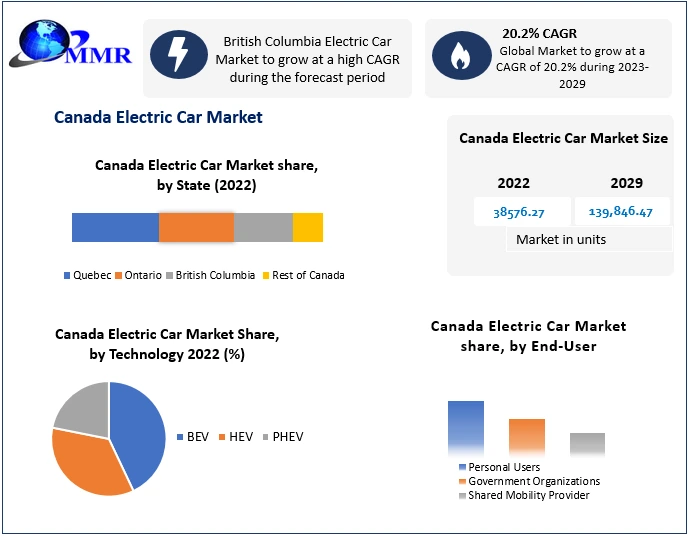
Market Growth: The market is projected to reach 139,846.47 thousand units by 2029, growing at a CAGR of 20.2% (2023–2029).
Regulatory Catalyst: Federal mandates require 20% of passenger vehicle sales to be electric by 2026, targeting 100% by 2035.
Segment Leadership: BEVs remain the dominant technology, recording 85,000 units in 2022—a 44.1% increase year-over-year.
Infrastructure Investment: Over USD 900 million in federal investments (grants and financing) is currently fueling the expansion of national charging networks.
Why This Matters Now
The Canadian automotive sector is pivoting from internal combustion engine (ICE) reliance to a mandated, electrification-first model. With a 2035 target for 100% zero-emission passenger vehicle sales, OEMs face an immediate deadline to localize supply chains and align product portfolios with Canadian regulatory realities. Failure to secure market share today leaves incumbents vulnerable to aggressive new entrants and global players already leveraging localized federal incentives.
Market Overview
In 2022, The Canada Electric Car Market accounted for 38,576.27 thousand units. The trajectory is clear: aggressive government decarbonization targets—aimed at reducing greenhouse gas emissions by 12 megatonnes of CO2 by 2030—are shifting consumer behavior and capital deployment. The transition is no longer a niche environmental movement but a structured industrial mandate backed by the iZEV Program, which provides direct point-of-sale grants up to USD 5,000 for qualifying vehicles.
Key Trends Driving Growth
Policy-Linked Adoption: Government initiatives are the primary market lubricant. By tying incentives directly to electric range, the federal government is steering manufacturers toward higher-performance battery architectures.
Charging Density Shifts: While urban centers like Toronto and Montreal see higher adoption, the infrastructure challenge remains spatial. Government-backed investment of USD 400 million for charger construction and USD 500 million in financing through the Canada Infrastructure Bank signals a shift from private-sector reliance to public-private utility models.
Performance Optimization: Lithium-ion technology remains the industry standard, but the market is diversifying into NMC (Nickel Manganese Cobalt) for high-density, long-range applications, and LFP (Lithium Iron Phosphate) for cost-sensitive commercial fleets.
Segment Insights
Dominant Segment (Technology): Battery Electric Vehicles (BEV) held the largest market share in 2022, with sales surging 44.1% over the prior year. This reflects a definitive consumer preference for full-electric over hybrid alternatives.
Fastest-Growing Segment (Battery Type): Lithium-ion Batteries are experiencing the most rapid growth due to their superior energy density and weight-to-performance ratio, making them the default choice for passenger EV architecture.
Charging Infrastructure: Normal Charging currently dominates the market volume. Its prevalence in residential and workplace settings makes it the bedrock of daily commuter operations, contrasting with the targeted role of Super Charging for corridor transit.
End-Use Dynamics: The Passenger Cars segment is the primary engine of volume growth, currently pressured by mandatory zero-emission targets that outpace historical adoption curves.
Regional Growth Story
Regional disparity dictates the speed of the national transition. Quebec remains the primary market, leveraging provincial-level incentives—up to USD 7,000—that layer on top of federal support. This has fostered an ecosystem of car-sharing and public-private pilot programs that familiarize consumers with EV dynamics. Ontario follows as the second-largest market, benefiting from a high density of public charging stations in key hubs like Toronto, Hamilton, and Ottawa, which minimizes range anxiety and sustains high adoption rates.
Competitive Landscape
The competitive field is bifurcated between legacy global OEMs and emerging domestic innovators. While international giants like Tesla, Hyundai, Ford, and Kia command volume through established distribution and scale, Canadian players—such as Daymak and BAC—are carving out niches in specialized mobility.
The strategic shift is evident: Electra Meccanica has moved away from its three-wheeled “SOLO” platform to focus on four-wheeled electric vehicles, signaling that the Canadian market is prioritizing mainstream passenger standards over experimental urban micro-mobility. Furthermore, BAC’s deployment of 3D printing in manufacturing demonstrates a Tier-1 level commitment to reducing capital expenditure and accelerating design iteration cycles, a necessity for OEMs looking to maintain margins amidst rising battery costs.
Recent Developments
Daymak Innovation: Crowdfunding the “Spiritus,” a two-seater EV integrating solar panels and wireless charging, signaling a move toward autonomous-ready, self-sustaining mobility concepts.
BAC Manufacturing: Full integration of the Ultimaker 3D printing ecosystem, cutting manufacturing cycle times and improving component precision.
OEM Pivot: Major global OEMs are increasingly centering their Canadian product roadmaps on high-capacity NMC battery platforms to meet stringent range requirements.
Strategic Implications
The mandate for 20% electric sales by 2026 acts as a hard stop for ICE-dominant strategies. For investors and fleet operators, the implication is a forced transition to operational efficiency. The current market shows that success is predicated on two factors: proximity to charging hubs and the ability to leverage government-backed financial subsidies. Suppliers must shift toward LFP battery integration for commercial fleets while maintaining NMC production for consumer passenger vehicles to capture both ends of the market.
Future Outlook
The Canadian electric car market is entering a phase of forced consolidation. Manufacturers that fail to harmonize their supply chains with the federal government’s 2035 zero-emission timeline will be rapidly displaced by competitors capable of integrating regional battery supply chain requirements with localized charging infrastructure. Market leadership will be defined not by sales volume alone, but by the ability to scale high-density battery technology while leveraging the federal infrastructure bank’s capital for fleet-wide electrification.
Analyst Perspective
“The Canada Electric Car market has transitioned from a phase of early-adopter experimentation to one of rigorous regulatory compliance. With the 2035 zero-emission mandate now governing OEM product planning, we are seeing a shift where technology leadership—specifically in battery efficiency and charging integration—is no longer a competitive advantage but a minimum requirement for market survival,” states Tejaswini Kakade, Analyst at Maximize Market Research.
About Maximize Market Research
Maximize Market Research Pvt. Ltd. (MMR) is a global market research and consulting company that provides reliable, data-focused, and practical business insights. The firm serves a wide range of industries, including healthcare, pharmaceuticals, technology, automotive, electronics, chemicals, personal care, and consumer goods. Through market forecasts, competitive analysis, strategic consulting, and industry impact assessments, MMR helps organizations understand changing market conditions, identify growth opportunities, and make informed business decisions for long-term success.
2nd Floor, Navale IT Park Phase 3
Pune Banglore Highway, Narhe
Pune, Maharashtra 411041, India
+91 9607365656
sales@maximizemarketresearch.com
