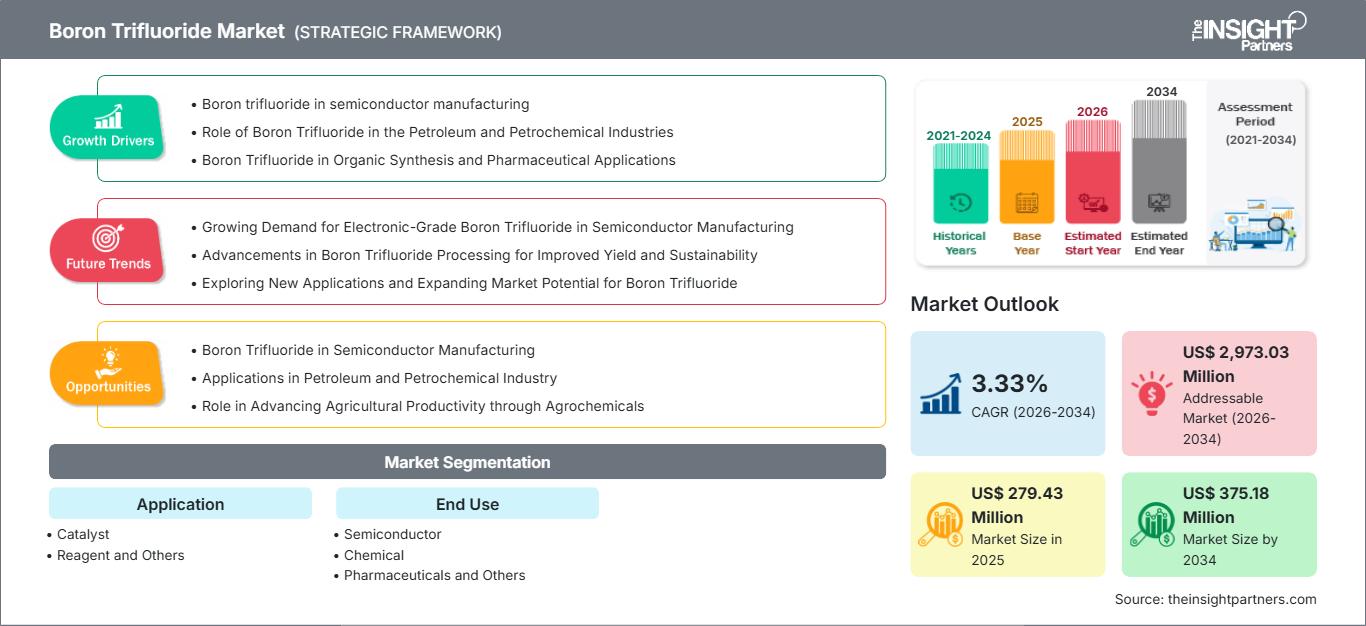
Semiconductor plants run on gases most people never hear about. Boron trifluoride is one of the quiet ones. The Boron Trifluoride market size was assessed at US$ 279.43 Million in 2025 and is projected to reach US$ 375.18 Million by 2034, growing at a CAGR of 3.33% during the forecast period 2026–2034. That growth traces back to the widening reach of the Boron Trifluoride Market, which now touches chip manufacturing, chemical synthesis, and pharmaceutical production alike.
What Is Boron Trifluoride?
Boron trifluoride is a colourless gas used mainly as a catalyst. It speeds up chemical reactions without being consumed in the process. Its strongest demand comes from semiconductor manufacturing, where it plays a role in ion implantation during chip production.
What Is Driving Demand for Boron Trifluoride?
Chip demand is not slowing down. Every new data centre, smartphone, and electric vehicle needs semiconductors, and semiconductor fabrication needs precise doping gases. Boron trifluoride’s role in ion implantation makes it essential to this process, so as fab capacity expands, so does demand for this gas.
Request a Sample Copy of the Report: https://www.theinsightpartners.com/sample/TIPRE00022223
Pharmaceutical synthesis is another growth driver. Boron trifluoride acts as a catalyst in several drug manufacturing processes, particularly where precise, controlled reactions matter. As generic drug production scales up in Asia, this demand grows alongside it.
Specialty chemical manufacturing adds further support. Boron trifluoride helps produce polymers, resins, and other fine chemicals where reaction control is critical. What makes this particularly significant is how tightly its demand tracks broader industrial output, rather than any single end market.
Government investment in domestic chip manufacturing is reshaping where this demand sits geographically. The United States, India, and several European nations have all announced new fab investments. Each new facility adds fresh, steady demand for catalyst gases like boron trifluoride.
Segments Covered
By Application: Catalyst, Reagent, Others. Catalyst use leads by a wide margin, driven by its central role in semiconductor and chemical processing.
By End Use: Semiconductor, Chemical, Pharmaceuticals, Others. Semiconductor manufacturing is the fastest-growing segment, tied directly to global chip fabrication expansion.
By Geography: North America, Europe, Asia Pacific, and South and Central America. Asia Pacific holds the largest share, anchored by its dominant chip manufacturing base.
Key Market Players
- Tanfac Industries Limited
- BASF SE
- AK Scientific, Inc.
- Linde plc
- Chemos GmbH & Co. KG
- Laborchemie Apolda GmbH
- Hunan Heaven Materials Development Co., Ltd.
- Hangzhou Yuhao Chemical Technology Co., Ltd.
- Hangzhou Meite Industry Co., Ltd.
- Stella Chemifa Corporation
These companies compete on purity grade, supply reliability, and specialty gas handling capability. Several are expanding production near major semiconductor hubs to shorten delivery times. High-purity electronic grade material remains the most competitive segment.
Sustainability and Innovation Trends
Gas handling safety has become a bigger focus across this industry. Boron trifluoride is corrosive and reactive, so manufacturers are investing in better containment and delivery systems to reduce leaks and worker exposure. This is not just regulatory pressure. Buyers now expect proof of safe handling before signing supply contracts.
Purity levels are also rising. Semiconductor manufacturers demand ever-higher purity gases as chip designs shrink further. Producers are refining purification methods to meet these stricter specifications, since even trace impurities can affect chip yield at advanced nodes.
Buy Premium Report: https://www.theinsightpartners.com/buy/TIPRE00022223
Regional Outlook
Asia Pacific dominates the boron trifluoride market, driven by Taiwan, South Korea, China, and Japan’s massive semiconductor manufacturing footprint. New fab investments across the region keep demand for electronic-grade gases high.
North America is growing quickly too, supported by fresh domestic chip manufacturing investment under recent industrial policy. Europe follows a similar path, with semiconductor self-sufficiency initiatives driving new demand. South and Central America remains a smaller market, with growth largely tied to chemical and pharmaceutical manufacturing rather than semiconductors.
Related Reports:
About The Insight Partners
The Insight Partners is among the leading market research and consulting firms in the world. We take pride in delivering exclusive reports along with sophisticated strategic and tactical insights into the industry. Reports are generated through a combination of primary and secondary research, solely aimed at giving our clientele a knowledge-based insight into the market and domain. This is done to assist clients in making wiser business decisions. A holistic perspective in every study undertaken forms an integral part of our research methodology and makes the report unique and reliable.
Contact Us:
If you have any queries about this report or if you would like further information, please contact us:
Phone: +1-646-491-9876
E-mail: sales@theinsightpartners.com
Also Available in: Korean | German | Japanese | French | Chinese | Italian | Spanish
