Nuclear Power Market Overview
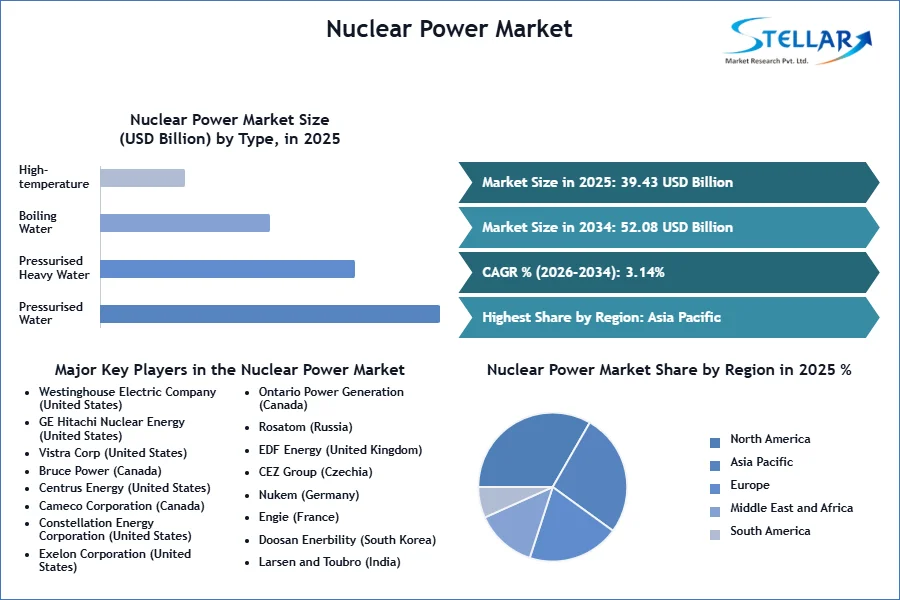
Nuclear Power Market size was valued at USD 39.43 Bn in 2025, and the total Nuclear Power revenue is expected to grow at a CAGR of 3.14% from 2026 to 2034, reaching nearly USD 52.08 Bn.
The Nuclear Power Market is witnessing significant transformation as countries accelerate efforts to achieve energy security, reduce carbon emissions, and expand reliable clean energy generation. Nuclear power is emerging as a strategic component of the global energy mix due to its ability to provide stable, large-scale electricity production while supporting climate goals.
Unlike intermittent renewable sources such as solar and wind, nuclear energy delivers continuous baseload power with minimal greenhouse gas emissions during operation. Growing electricity demand from industrial expansion, urbanization, digital infrastructure, and artificial intelligence-driven data centers is increasing the need for dependable energy sources, creating new opportunities for nuclear power development.
According to market analysis, the Nuclear Power Market is expected to experience steady growth during the forecast period, supported by government investments, reactor modernization programs, advanced nuclear technologies, and rising interest in small modular reactors (SMRs).
𝐃𝐨𝐰𝐧𝐥𝐨𝐚𝐝 𝐅𝐫𝐞𝐞 𝐏𝐃𝐅 𝐁𝐫𝐨𝐜𝐡𝐮𝐫𝐞: https://www.stellarmr.com/report/req_sample/nuclear-power-market/2690
Market Growth Drivers Fueling Nuclear Energy Expansion
Rising Demand for Clean and Reliable Energy
One of the primary factors driving the Nuclear Power Market is the increasing global demand for low-carbon electricity. Governments worldwide are adopting strategies to balance energy reliability with environmental sustainability. Nuclear power provides a consistent electricity supply while helping countries reduce dependence on fossil fuels.
The growing adoption of renewable energy has also highlighted the importance of grid stability. Nuclear plants complement renewable sources by providing continuous power generation when solar and wind output fluctuates. As nations work toward net-zero emissions targets, nuclear energy is becoming an important part of long-term energy strategies.
Government Support and Energy Security Initiatives
Energy security concerns have encouraged several countries to expand domestic nuclear capabilities. Rising fuel price volatility and geopolitical uncertainties have increased interest in energy sources that can provide long-term stability.
Countries across North America, Europe, and Asia-Pacific are introducing policies to extend the operational life of existing nuclear reactors and support the construction of new facilities. Financial incentives, regulatory reforms, and public-private partnerships are encouraging investment throughout the nuclear energy value chain.
Growth of Small Modular Reactors (SMRs)
Small Modular Reactors are becoming a major opportunity area within the Nuclear Power Market. These advanced reactors offer advantages such as reduced construction timelines, lower upfront investment requirements, enhanced safety features, and flexible deployment options.
SMRs are being explored for electricity generation, industrial applications, remote locations, and hydrogen production. Their modular design enables faster manufacturing and installation compared with traditional large-scale reactors, making them attractive for countries seeking scalable clean energy solutions.
Technological Advancements Transforming the Nuclear Power Industry
Innovation is reshaping the nuclear energy sector through advanced reactor designs, digital monitoring systems, artificial intelligence integration, and improved safety technologies.
Next-generation reactors are being developed with enhanced passive safety systems that reduce operational risks. Advanced fuel technologies are also improving reactor efficiency and extending fuel cycles, helping reduce operational costs.
Digitalization is becoming increasingly important in nuclear operations. Artificial intelligence, predictive maintenance, robotics, and advanced analytics are being implemented to improve plant performance, optimize maintenance schedules, and enhance safety management.
Additionally, nuclear technology is expanding beyond traditional electricity generation. Emerging applications include nuclear-powered hydrogen production, district heating, desalination, and industrial process energy, creating new market opportunities.
Key Market Challenges and Restraints
Despite strong growth potential, the Nuclear Power Market faces several challenges.
High Construction and Capital Costs
Building nuclear power plants requires significant financial investment and long development timelines. Large-scale reactor projects often face cost overruns, financing challenges, and complex approval processes. These factors can delay new nuclear capacity additions, particularly in developing economies.
Regulatory and Public Acceptance Challenges
Nuclear projects operate under strict regulatory frameworks due to safety requirements and environmental considerations. Obtaining approvals can be a lengthy process, affecting project timelines.
Public concerns related to radioactive waste management, nuclear accidents, and long-term safety also influence market expansion. Industry stakeholders are addressing these concerns through improved reactor designs, stronger safety standards, and advanced waste management technologies.
Regional Insights: Global Nuclear Power Market Expansion
Asia-Pacific Leading Nuclear Energy Development
The Asia-Pacific region represents one of the fastest-growing markets for nuclear power due to increasing electricity demand, industrial growth, and government investments.
Countries such as China, India, South Korea, and Japan are expanding nuclear capacity to support economic development while reducing carbon emissions. China continues to invest heavily in new reactor construction and advanced nuclear technologies, making it a major contributor to global nuclear capacity growth.
India is also focusing on nuclear expansion as part of its clean energy strategy. The country is investing in reactor development, domestic nuclear technology capabilities, and long-term capacity expansion plans.
North America Strengthening Existing Nuclear Infrastructure
North America remains a significant market due to its established nuclear fleet and increasing focus on reactor life extension programs. The United States is emphasizing nuclear energy as part of its clean energy transition strategy, with investments in advanced reactors and existing plant modernization.
Government support for advanced nuclear technologies and clean energy initiatives is expected to create new opportunities for market participants.
Europe’s Focus on Energy Independence
European countries are reassessing the role of nuclear power due to energy security concerns and climate objectives. Several nations are extending reactor lifespans and exploring next-generation nuclear technologies to reduce reliance on imported energy resources.
Competitive Landscape of the Nuclear Power Market
- Bruce Power (Canada)
- Centrus Energy (United States)
- Cameco Corporation (Canada)
- Constellation Energy Corporation (United States)
- Exelon Corporation (United States)
- Ontario Power Generation (Canada)
- Rosatom (Russia)
- EDF Energy (United Kingdom)
- CEZ Group (Czechia)
- Nukem (Germany)
𝐃𝐨𝐰𝐧𝐥𝐨𝐚𝐝 𝐅𝐫𝐞𝐞 𝐏𝐃𝐅 𝐁𝐫𝐨𝐜𝐡𝐮𝐫𝐞: https://www.stellarmr.com/report/req_sample/nuclear-power-market/2690
Future Outlook of the Nuclear Power Market
The future of the Nuclear Power Market is expected to be shaped by rising electricity demand, decarbonization initiatives, technological innovation, and energy security priorities.
As countries continue transitioning toward cleaner energy systems, nuclear power is likely to play a larger role alongside renewable energy sources. Investments in advanced reactors, digital transformation, and sustainable nuclear technologies will create new growth opportunities.
The expansion of artificial intelligence applications, electric vehicle adoption, industrial electrification, and data center infrastructure is expected to increase global electricity consumption, strengthening demand for reliable power generation.
By the forecast period, the nuclear sector is expected to evolve from traditional large-scale reactors toward a more diversified ecosystem featuring SMRs, advanced reactors, and integrated clean energy solutions.
Conclusion
The Nuclear Power Market is entering a new phase of growth as global economies seek reliable, low-carbon, and secure energy solutions. While challenges related to cost, regulation, and public perception remain, advancements in reactor technology and increasing government support are creating favorable conditions for industry expansion.
With rising investments in clean energy infrastructure and growing demand for stable electricity supply, nuclear power is positioned to remain a critical component of the global energy transition. Companies that focus on innovation, safety, and sustainable nuclear solutions will be well-positioned to benefit from emerging market opportunities.
Media Contact
Stellar Market Research
Website: Stellar Market Research – Global Research Reports & Consulting
Email: sales@stellarmr.com
