Key Highlights
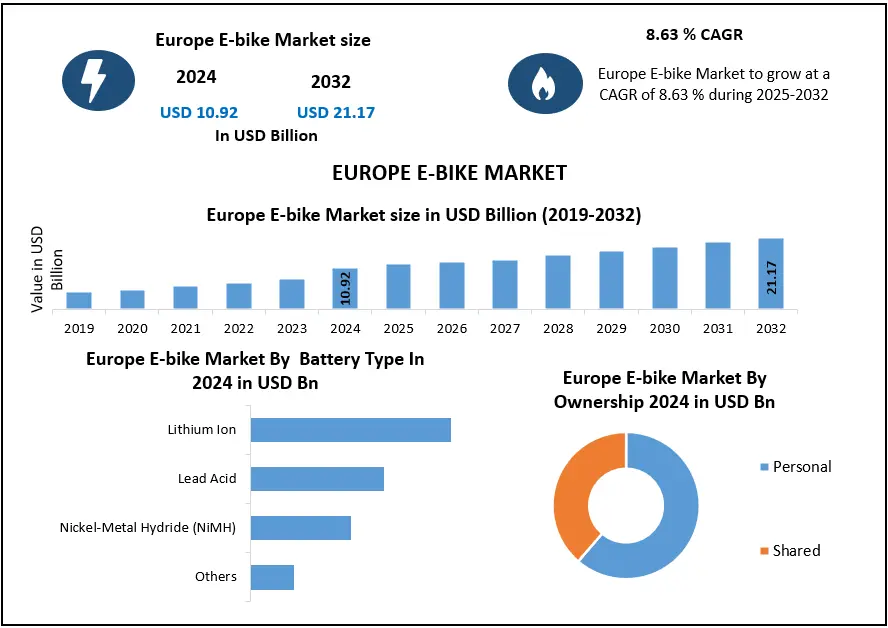
Europe E‑Bike Market size is USD 10.92 billion in 2024 and is projected to reach nearly USD 21.17 billion by 2032, growing at a CAGR of 8.63%, showing that electric two‑wheelers are becoming a mainstream pillar of European mobility.
E‑bikes are used for commuting, leisure, logistics, and tourism, turning what was once a cycling niche into a multi‑use, multi‑segment electric vehicle market.
OEMs, component suppliers, and mobility platforms now treat e‑bikes as strategic assets in electrification portfolios, not just accessory products, with implications for batteries, motors, connectivity, and service networks.
Why This Matters Now
Electrification in Europe is no longer confined to cars and buses; e‑bikes are quietly redefining how cities move, how logistics operates on the last mile, and how consumers think about daily transport. A market that will almost double from USD 10.92 billion in 2024 to about USD 21.17 billion by 2032 at 8.63% CAGR means e‑bikes are now central to the region’s decarbonization and congestion strategies.
For automotive and transportation stakeholders, this is a direct competitive challenge. Every commute shifted to an e‑bike, every parcel delivered on an electric cargo bike, and every shared e‑bike subscription alters demand for traditional vehicles, parking, and fuel—and opens new opportunities in batteries, motors, connectivity, and mobility services.
Market Overview
The Europe E‑Bike Market sits at the intersection of three structural trends: urbanization, electrification, and digital mobility platforms. With 2024 revenues at USD 10.92 billion and a projected climb to nearly USD 21.17 billion by 2032, the market is entering a mature growth phase where scale and specialization matter as much as innovation.
E‑bikes combine mechanical bicycle architecture with electric drive systems—batteries, motors, controllers—and often connectivity modules for tracking, diagnostics, and user apps. That gives them a cost‑effective path into EV adoption: they require far less capital than cars, but still deliver emissions reductions, noise reductions, and flexibility in dense cities.
Key Trends Driving Growth
One major change is policy: European cities and national governments are promoting cycling and light electric mobility through infrastructure investments, incentives, and restrictions on ICE vehicles in urban cores. E‑bike lanes, secure parking, and integration with public transport make e‑bikes credible alternatives to cars for short and medium trips.
Another trend is technology convergence. Advances in lithium‑ion batteries, compact mid‑drive motors, and integrated electronics have pushed e‑bike range, performance, and reliability higher while reducing weight. This makes e‑bikes attractive not only to enthusiasts but also to older riders, commuters with hills to climb, and logistics operators seeking low‑emission, agile vehicles.
A third trend is platformization: e‑bike sharing schemes, subscription models, and connected fleet platforms are turning e‑bikes into revenue‑generating assets rather than simple consumer products. Data on usage, routes, and battery health feeds into optimization algorithms, making operations more efficient and strengthening the business case for cities and operators.
Request a Free Sample Copy or View Report Summary: https://www.maximizemarketresearch.com/request-sample/21420/
Segment Insights
Dominant Segment – Urban Commuter / Pedal‑Assist E‑Bikes
Urban commuter and pedal‑assist e‑bikes dominate the European market, driven by daily trips in congested cities, growing cycle lanes, and user demand for moderate assistance rather than high speeds.
This segment benefits most from policy support and infrastructure and becomes the primary target for OEMs, retailers, and sharing platforms.
Fastest‑Growing Segment – Cargo and Utility E‑Bikes
Cargo and utility e‑bikes—used for family transport, goods delivery, and urban logistics—are the fastest growing segment as retailers and logistics operators seek low‑emission, low‑cost last‑mile solutions.
Their growth directly affects van and small truck demand in dense urban areas and opens a new market for robust frames, high‑torque motors, larger batteries, and fleet management software.
Motor, Battery, and Connectivity Layers
The drive system segment—motors, batteries, controllers, sensors—is strategically critical, as performance and reliability determine user satisfaction and fleet uptime.
Connectivity and software features, such as smartphone integration, GPS tracking, anti‑theft, and remote diagnostics, increasingly influence buyer decisions, tying e‑bikes to broader EV and SDV ecosystems.
Regional Growth Story
Europe is not a uniform market. Countries like Germany, the Netherlands, Belgium, and Austria lead in e‑bike penetration and infrastructure, while others are catching up. Germany stands out for strong production and sales, leveraging established bicycle and automotive supply chains to scale e‑bike manufacturing and export.
The Netherlands and Belgium show how high e‑bike adoption reshapes everyday travel. In these markets, e‑bikes represent a large share of new bicycle sales, demonstrating that electrification of cycling can become the norm rather than the exception.
Southern and Eastern European markets present growth upside as income levels rise, infrastructure improves, and tourism and leisure cycling expand. For OEMs and suppliers, tailoring product mixes—commuter, trekking, cargo—to country‑specific patterns becomes essential.
Competitive Landscape
The Europe E‑Bike Market features a mix of bicycle OEMs, automotive‑linked mobility brands, component suppliers, and digital platform players. Traditional bicycle groups have expanded their portfolios with e‑bike lines, relying on strong dealer networks and brand recognition to capture early adopters.
New entrants and automotive‑adjacent firms are focusing on design, connectivity, and subscription models, positioning e‑bikes as part of broader mobility packages that may include car‑sharing, micro‑mobility, and public transport integration. This changes competitive dynamics: software, data, and service quality matter as much as hardware.
Battery and motor suppliers hold increasing influence. Those that can offer efficient, durable systems and integrate seamlessly with frames and controls gain bargaining power and long‑term contracts. As safety and reliability expectations rise, low‑quality imports without strong support networks face growing scrutiny.
Recent Developments
Governments and municipalities continue to roll out cycling infrastructure, low‑emission zones, and incentive schemes that directly benefit e‑bike adoption.
OEMs are launching lighter, more integrated e‑bike models with hidden batteries, compact mid‑drive motors, and cleaner cable routing, enhancing aesthetics and perceived quality.
Fleet operators and delivery companies are piloting and scaling cargo e‑bike fleets in major European cities, testing new logistics models and route optimization tools.
Digital platforms for e‑bike subscription, sharing, and fleet management are expanding, offering embedded insurance, maintenance, and data analytics services.
Strategic Implications
For automotive OEMs, e‑bikes are both competition and complement. They compete with small cars and scooters for urban trips but also offer a way to build broader mobility ecosystems: branded e‑bikes can be integrated into customer offerings, loyalty programs, and fleet packages.
Tier‑1 suppliers see a parallel opportunity: they can extend expertise in batteries, motors, sensors, and connectivity from automotive into e‑bikes, diversifying revenue streams and de‑risking dependence on four‑wheel volumes. High‑voltage EV know‑how translates into robust low‑voltage systems and safety standards for e‑bikes.
City planners and regulators can use e‑bike growth to meet emissions and congestion targets faster than relying solely on car electrification. Strategic investments in infrastructure, parking, and charging (for fast‑charge hubs or swap stations) will determine how far and how fast the mode shift progresses.
For fleets and mobility platforms, the economics are clear: e‑bikes have lower acquisition and operating costs than cars or vans, can access restricted zones, and often deliver similar or better delivery times in dense urban areas. Building robust maintenance, charging, and data systems around these fleets becomes a key competitive differentiator.
Future Outlook
With the Europe E‑Bike Market forecast to rise from USD 10.92 billion in 2024 to nearly USD 21.17 billion by 2032, e‑bikes will remain central to Europe’s electric mobility story through the decade. Growth will likely moderate compared to pandemic boom years, but the structural drivers—urbanization, decarbonization, and digital platforms—remain firmly in place.
Future market leaders will be those OEMs, suppliers, fleets, and mobility platforms that treat e‑bikes as core strategic assets—integrating them into EV portfolios, connectivity ecosystems, and city partnerships—while laggards that dismiss e‑bikes as peripheral or short‑lived trends will find their urban relevance and mobility economics eroding in a two‑wheeled, electric Europe.
Related Reports
Global Automotive Chrome Accessories Market https://www.maximizemarketresearch.com/market-report/global-automotive-chrome-accessories-market/82138/
Global Highway Driving Assist Market https://www.maximizemarketresearch.com/market-report/global-highway-driving-assist-market/101677/
Global Automotive Inner Fenders Market https://www.maximizemarketresearch.com/market-report/global-automotive-inner-fenders-market/90352/
Analyst Perspective
“E‑bikes have moved from the margins of cycling to the center of European mobility policy and consumer behavior,” said Tejaswini Kakade, lead analyst for the Europe E‑Bike Market. “Players who build serious strategies around e‑bike design, batteries, connectivity, and city partnerships will gain durable advantages in the race for clean, efficient urban transport.”
About Maximize Market Research
Maximize Market Research Pvt. Ltd. (MMR) is a global market research and consulting company that provides reliable, data-focused, and practical business insights. The firm serves a wide range of industries, including healthcare, pharmaceuticals, technology, automotive, electronics, chemicals, personal care, and consumer goods. Through market forecasts, competitive analysis, strategic consulting, and industry impact assessments, MMR helps organizations understand changing market conditions, identify growth opportunities, and make informed business decisions for long-term success.
2nd Floor, Navale IT Park Phase 3
Pune Banglore Highway, Narhe
Pune, Maharashtra 411041, India
+91 9607365656
sales@maximizemarketresearch.com
