Key Highlights
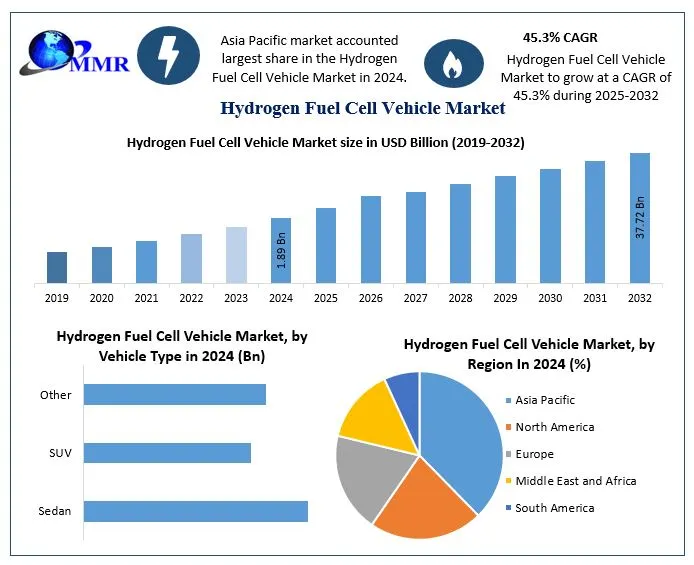
Market Valuation: The global FCEV market is projected to skyrocket from USD 1.89 billion in 2024 to USD 37.72 billion by 2032.
Expansion Rate: The market is poised to grow at an exceptional CAGR of 45.3% during the 2025–2032 forecast period.
Technology Leadership: Proton Exchange Membrane (PEM) fuel cells are the dominant technology segment, favored for their efficiency and power-to-weight ratio.
Global Momentum: Over 10 countries, including Germany, Spain, and the EU, have codified detailed hydrogen strategies, creating a robust regulatory tailwind for infrastructure investment.
Primary Drivers: Public-private partnerships and the urgent need to decarbonize heavy-duty sectors that cannot be electrified via batteries are central to market acceleration.
Why This Matters Now
The transport sector is at an inflection point where battery-electric solutions hit diminishing returns for heavy-duty, long-haul applications. Hydrogen fuel cell vehicles (FCEVs) provide the necessary high-energy density required to decarbonize commercial logistics, mining, and industrial transport without the excessive weight penalty of massive battery packs. OEMs failing to integrate hydrogen into their zero-emission portfolios now risk being locked out of the next generation of industrial heavy-transport contracts.
Market Overview
The global Hydrogen Fuel Cell Vehicles Market is transitioning from demonstration-scale projects to commercial-scale deployment. By producing only water vapor as a byproduct, FCEVs offer a true zero-emissions alternative that aligns with increasingly stringent global climate goals. With USD 1.89 billion in value as of 2024, the industry is leveraging institutional capital and government subsidies to bridge the cost gap between hydrogen and conventional fossil-fuel powertrains.
Key Trends Driving Growth
Industrial Decarbonization: Hydrogen is emerging as the essential link for industries like steel and heavy logistics that face insurmountable technological limitations with direct electrification.
Cost Competitiveness: Renewable hydrogen production methods are rapidly decreasing in price, narrowing the gap with conventional fuel sources and improving the total cost of ownership for commercial fleet operators.
Policy Convergence: With more than 10 major nations, including Australia, Chile, and Portugal, formalizing hydrogen roadmaps, the market is benefiting from unprecedented regulatory certainty and infrastructure funding.
Get a free sample
Segment Insights
Dominant Segment (Technology): Proton Exchange Membrane (PEM) Fuel Cells currently dominate the market. Their compact design and quick startup capability make them the gold standard for current vehicular applications like the Hyundai Nexo.
Fastest-Growing Segment: Heavy-duty commercial transportation is identified as the fastest-growing application area, as the weight-to-range advantage of hydrogen becomes a critical economic necessity for logistics providers.
Regional Growth Story
The European Union and major economies like Germany and Spain are leading the charge, driven by aggressive regional hydrogen strategies and infrastructure development. These regions have successfully integrated public-private funding models to de-risk investments in hydrogen refueling stations. Conversely, Asia-Pacific and South America are emerging as critical expansion zones, with governments increasingly viewing hydrogen as both a climate solution and an opportunity for energy-intensive manufacturing growth.
Competitive Landscape
The market is characterized by a sophisticated ecosystem of industrial giants and specialized innovators. Companies like Toyota, Hyundai, General Motors, Cummins, and Ballard Power Systems are moving beyond individual vehicle sales to influence the broader infrastructure supply chain.
This competitive activity signals that market leadership is no longer just about engine performance; it is about “ecosystem integration.” OEMs providing complementary hydrogen fuel incentives—such as Toyota’s complimentary hydrogen credit programs—are effectively capturing early-adopter market share. Partnerships with energy providers, such as those seen with Nikola and Plug Power, indicate that OEMs are increasingly functioning as energy service providers. Manufacturers that control the nexus of vehicle supply, fuel availability, and long-term maintenance contracts will gain the pricing power to dominate the commercial transit segment.
Recent Developments
Strategic Hubs: Accelerated funding through programs like the Bipartisan Infrastructure Law in the US is fueling Regional Clean Hydrogen Hubs, which link production sites directly to transport corridors.
Technological Maturation: Advances in PEM efficiency are allowing for smaller, lighter fuel cell stacks, directly increasing payload capacity for commercial trucks.
Policy Formalization: The recent adoption of hydrogen strategies by countries like Finland and Portugal has triggered a surge in capital expenditure toward heavy-duty FCEV fleet orders.
Strategic Implications
For OEMs, the shift to hydrogen is an operational imperative rather than a product diversification strategy. Fleet operators should prioritize FCEV integration to mitigate long-term carbon tax liabilities and capitalize on government-backed refueling infrastructure. Suppliers must pivot toward manufacturing mass-scale membrane materials and hydrogen storage systems, as these will be the primary bottlenecks in the coming decade of high-growth deployment.
Future Outlook
The FCEV market is heading toward a decisive competitive inflection point by 2030. The leaders of tomorrow will be those who have successfully internalized the “fuel-plus-vehicle” value proposition, effectively insulating their customers from the volatility of external hydrogen pricing. Companies that continue to treat hydrogen mobility as a secondary technology to batteries will find themselves excluded from the high-margin heavy-duty freight sector, leaving the market to firms that viewed hydrogen as the backbone of zero-emission industrial logistics from the outset.
Analyst Perspective
“The hydrogen fuel cell market has graduated from a niche prototype phase to a core pillar of global industrial decarbonization. As we approach 2032, the winners will be those who successfully synchronize vehicle hardware innovation with the massive scaling of localized hydrogen refueling infrastructure,” says Tejaswini Kakade, Analyst at Maximize Market Research.
About Maximize Market Research
Maximize Market Research Pvt. Ltd. (MMR) is a global market research and consulting company that provides reliable, data-focused, and practical business insights. The firm serves a wide range of industries, including healthcare, pharmaceuticals, technology, automotive, electronics, chemicals, personal care, and consumer goods. Through market forecasts, competitive analysis, strategic consulting, and industry impact assessments, MMR helps organizations understand changing market conditions, identify growth opportunities, and make informed business decisions for long-term success.
2nd Floor, Navale IT Park Phase 3
Pune Banglore Highway, Narhe
Pune, Maharashtra 411041, India
+91 9607365656
sales@maximizemarketresearch.com
