Key Highlights
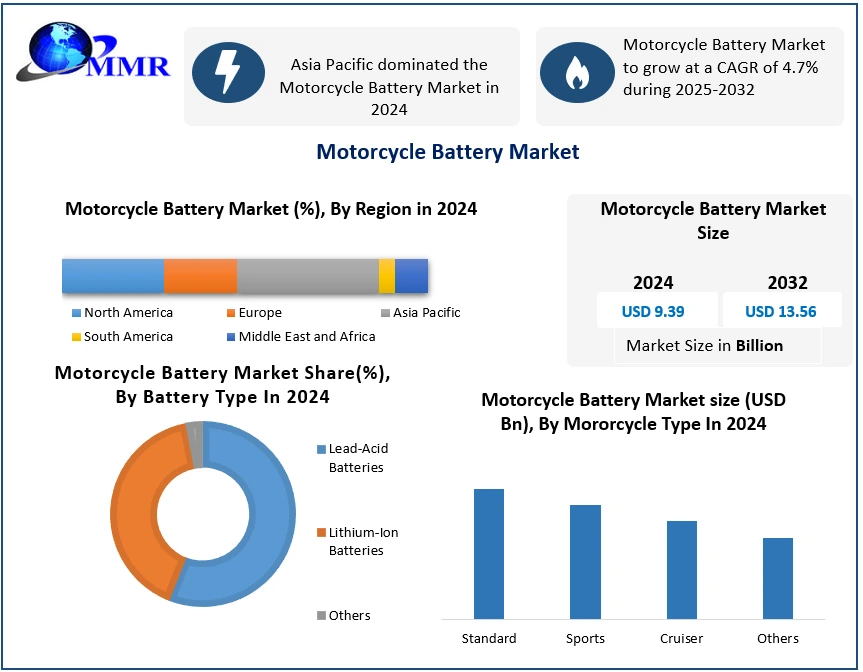
Market Growth: The global motorcycle battery market is expected to grow from USD 9.39 billion in 2024 to USD 13.56 billion by 2032, at a CAGR of 4.7%.
Dominant Segment: Lead-Acid Batteries (including AGM and VRLA) remain the dominant technology due to their reliability and cost-effectiveness in high-volume markets.
Fastest-Growing Segment: Lithium-Ion Batteries are seeing rapid acceleration, driven by the shift toward electric motorcycles and premium performance models.
Regional Leadership: The Asia-Pacific region dominates the market, supported by the world’s highest volume of two-wheeler production and consumption in economies like India and China.
Why This Matters Now
The motorcycle industry is currently undergoing a structural dichotomy. While internal combustion engine (ICE) two-wheelers continue to rely on the proven, low-cost reliability of lead-acid battery technology, the accelerating transition to electric drivetrains is forcing a rapid pivot toward lithium-ion innovation. OEMs, Tier-1 suppliers, and fleet operators must now manage a two-speed supply chain, balancing the volume-heavy legacy market with the high-growth, high-tech demands of the electric future.
Market Overview
The Global Motorcycle Battery Market was valued at USD 9.39 billion. This sector is undergoing a shift driven by rapid urbanization and rising two-wheeler ownership in emerging economies, combined with a technological migration toward electric mobility in developed markets. While lead-acid batteries maintain dominance by powering the majority of global ICE two-wheeler sales, the demand for lithium-ion systems is scaling in response to performance requirements in North American and European premium motorcycle segments.
Key Trends Driving Growth
Resilience of Traditional Power: In price-sensitive markets such as India, Southeast Asia, and Africa, lead-acid batteries (including flooded, AGM, and gel types) remain the preferred choice. Their affordability, durability in varied climates, and low-maintenance requirements ensure they remain the bedrock of the global motorcycle aftermarket.
Electrification Momentum: The growth of electric motorcycles and scooters is shifting the R&D focus toward lithium-ion technology. These batteries offer the longer lifespan, faster recharge capabilities, and consistent performance required for modern urban commuting and e-mobility platforms.
The Infrastructure Hurdle: Market adoption in the electric segment is currently tempered by insufficient charging infrastructure. This restraint is a critical focal point for mobility strategists, as the lack of reliable charging stations for daily use and long-distance travel remains a primary barrier to consumer transition.
Get a free sample
Segment Insights
Dominant Segment (Technology): Lead-Acid Batteries held the largest market share in 2024. Their dominance is rooted in the extensive volume of ICE-powered two-wheelers that define current global logistics and daily transport.
Fastest-Growing Segment (Technology): Lithium-Ion Batteries are the fastest-growing category. As OEMs increasingly standardize electric drivetrains, the demand for high-energy-density, lightweight, and high-performance battery systems is rising exponentially.
Market Application: The aftermarket segment continues to play a vital role, driven by the massive installed base of existing motorcycles requiring routine replacement of conventional battery units.
Regional Growth Story
The Asia-Pacific region stands as the undisputed center of the global motorcycle battery market. China and India, as the world’s largest producers and consumers of two-wheelers, sustain high demand for both traditional lead-acid and emerging battery technologies. This region is the primary battleground for manufacturers, where established firms are expanding production capacity and localizing supply chains to capture the massive volume of the commuting class.
Competitive Landscape
The market is populated by long-standing industrial leaders, including GS Yuasa, Exide Technologies, EnerSys, and East Penn Manufacturing. The current competitive environment is defined by “bimodal innovation”—companies are aggressively scaling lithium-ion manufacturing to secure future EV leadership while simultaneously defending their high-margin leadership in lead-acid and AGM segments.
Recent strategic moves by firms like GS Yuasa—which reported significant revenues from lightweight, maintenance-free units—signal that the industry is prioritizing reliability. The ability to pivot between traditional and advanced technologies is not just an operational necessity; it is a defensive moat against new-age EV entrants. Manufacturers that can provide “drop-in” solutions for both ICE and electric platforms are gaining significant leverage with major OEMs who are cautious about the pace of the powertrain transition.
Recent Developments
Expansion of Production Capacity: Major players have significantly expanded production lines, particularly in India and Southeast Asia, to meet the massive demand for maintenance-free and AGM batteries.
Technological Diversification: Industry leaders are increasingly marketing premium lithium-ion units that exceed standard automotive needs, including applications in specialty fields like satellite power.
Strategic Distribution Networks: Established OEMs are doubling down on robust distribution networks, ensuring that whether a rider requires a standard lead-acid replacement or a modern electric battery, the supply chain is localized and responsive.
Strategic Implications
For stakeholders, the implication is clear: do not bet exclusively on one technology. While lead-acid technology provides the current financial stability required to fund R&D, lithium-ion is the non-negotiable future of the segment. Fleet operators should prioritize battery longevity and maintenance-free options for their daily urban assets, whereas OEMs should align their product roadmaps with the shifting regulatory and consumer sentiment favoring long-range electric mobility.
Future Outlook
The motorcycle battery market is entering a decade of forced evolution. Market leaders will be defined by their ability to maintain the high-volume, low-cost efficiency of traditional battery manufacturing while simultaneously scaling the capital-intensive infrastructure required for lithium-ion and future-generation storage systems. The competitive chasm will widen between firms that treat electrification as a long-term risk and those that view it as the primary catalyst for market expansion, with the latter group poised to command the high-growth corridors of the global two-wheeler sector.
Analyst Perspective
“The motorcycle battery industry is currently balancing the immediate, high-volume reliability of lead-acid technology with the necessary, high-performance future of lithium-ion mobility. Success through 2032 will be determined by a company’s ability to optimize the traditional supply chain while concurrently scaling battery innovation for the global e-mobility shift,” states Tejaswini Kakade, Analyst at Maximize Market Research.
About Maximize Market Research
Maximize Market Research Pvt. Ltd. (MMR) is a global market research and consulting company that provides reliable, data-focused, and practical business insights. The firm serves a wide range of industries, including healthcare, pharmaceuticals, technology, automotive, electronics, chemicals, personal care, and consumer goods. Through market forecasts, competitive analysis, strategic consulting, and industry impact assessments, MMR helps organizations understand changing market conditions, identify growth opportunities, and make informed business decisions for long-term success.
2nd Floor, Navale IT Park Phase 3
Pune Banglore Highway, Narhe
Pune, Maharashtra 411041, India
+91 9607365656
sales@maximizemarketresearch.com
