Key Highlights
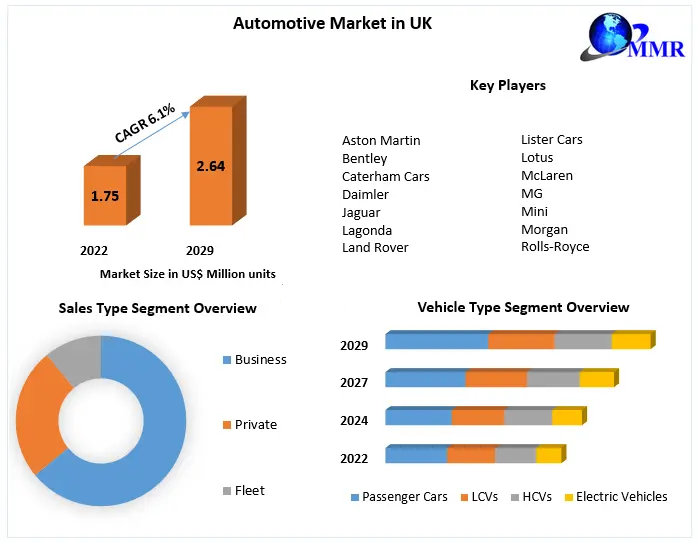
Automotive Market in UK recorded 1.75 million units in 2022 and is projected to grow at a 6.1% CAGR over the forecast period, marking a modest recovery in volumes alongside deep structural change.
EV adoption, charging infrastructure expansion, and net‑zero commitments are converting the UK car parc from ICE‑centric to electrified, with BEVs nearing one‑fifth of new registrations in recent data.
Software‑defined vehicles, connectivity, and ADAS are becoming standard expectations, turning the UK into a test bed for digital automotive services and new mobility business models.
Why This Matters Now
Unit growth of 6.1% CAGR matters, but the real story in the Automotive Market in UK is the quality of those units: how many are electric, connected, and software‑upgradable—and who controls the data and energy flows they generate. The UK’s trajectory toward a 2030 ban on new petrol and diesel car sales, combined with net‑zero 2050 targets, means every vehicle sold today has strategic implications for OEM portfolios, supplier investments, and fleet planning.
Investors, OEMs, and Tier‑1 suppliers cannot treat the UK as just another mature market; it is a regulatory and technology benchmark for Europe and beyond. Fleet operators and mobility providers face a compressed transition window where electrification, charging, and digital platforms must be scaled in synchrony—or face stranded assets and eroding competitiveness.
Market Overview
The Automotive Market in UK stood at 1.75 million units in 2022, reflecting a recovery phase after pandemic and supply‑chain disruptions and a pivot toward electrified and connected vehicles. The expected 6.1% CAGR over the forecast period suggests steady volume growth, but the composition of sales—by powertrain and digital content—is where strategic shifts occur.
Recent data show BEVs approaching 19.6% of new car registrations, with plug‑in hybrids and full hybrids also gaining share while diesel and petrol volumes decline. Fleet and business buyers drive much of this growth, leveraging tax benefits and total cost of ownership advantages, while private buyers remain more cautious, constrained by upfront costs and charging concerns.
Key Trends Driving Growth
The first major change is policy: the UK’s planned ban on new pure petrol and diesel cars around 2030, coupled with net‑zero 2050 commitments, has accelerated OEM EV launches, battery investments, and dealer network transformation. Every increment in BEV share shifts supplier demand toward batteries, power electronics, and software, and away from traditional engine and exhaust components.
Second, charging infrastructure is expanding rapidly, with over 71,000 public charge points in operation by late 2024 and continued investment in fast‑charging and home charging solutions. This expansion reduces operational barriers for fleets and higher‑income households, but uneven coverage and reliability still slow mass private adoption.
Third, software and connectivity are reshaping vehicle value. Over‑the‑air updates, telematics, and advanced driver assistance systems transform cars into rolling software platforms, making cybersecurity, data governance, and digital experience central to competitive positioning. This shift favors OEMs and Tier‑1s with strong software stacks and tight semiconductor supply relationships.
Request a Free Sample Copy or View Report Summary: https://www.maximizemarketresearch.com/request-sample/86645/
Segment Insights
Dominant Segment – ICE and Hybrid Passenger Cars (Volume Lens)
Internal combustion engine vehicles plus conventional hybrids still represent the majority of the UK market by units, driven by legacy fleets, affordability, and infrastructure familiarity.
For OEMs and suppliers, this dominant segment finances the transition but faces tightening emissions requirements and residual‑value risks as policy and consumer sentiment move toward zero‑emission options.
Fastest‑Growing Segment – Battery Electric Vehicles (Growth Lens)
BEVs show the fastest growth in the UK, with registrations increasing more than 20% year‑on‑year and reaching nearly 20% market share.
This growth creates new demand for batteries, high‑voltage wiring, thermal management, power electronics, and charging solutions, and reorients plant and supplier investments toward electric architectures.
Fleet Electrification Dynamics
Fleet and business buyers account for close to 60% of new car registrations and a disproportionate share of BEV uptake.
Their decisions on procurement cycles, leasing structures, and charging infrastructure shape utilization patterns and influence secondary market supply of used EVs, which in turn affects private adoption.
Software‑Defined Vehicle and SDV Adoption
The shift towards SDVs—vehicles where functions are largely determined by software—creates new layers of complexity in the UK market.
OEMs need robust OTA pipelines, cybersecurity frameworks, and data platforms, pushing Tier‑1s and tech partners to provide integrated hardware‑software solutions.
Regional Growth Story
Within Europe, the UK remains one of the largest new‑car markets, trailing only Germany in total registrations, and acting as an important test market for EV and SDV offerings. The UK’s dense urban centers, such as London, Manchester, and Birmingham, are early adopters of low‑emission zones, congestion charges, and EV‑friendly policies, increasing the relative appeal of electric cars and new mobility services.
Trade flows with the European Union, the United States, and Asian manufacturing hubs influence production and supply decisions. Post‑Brexit trade arrangements and local content requirements push OEMs and suppliers to reassess plant footprints, component sourcing, and logistics strategies for the UK market. As semiconductor and battery supply chains re‑globalize following recent shocks, the UK’s ability to attract investment in local assembly and R&D becomes critical.
Competitive Landscape
The UK automotive market includes global OEMs, domestic brands, and emerging EV‑only manufacturers, all battling for share in a transitioning environment. Established OEMs balance legacy ICE portfolios with expanding EV and hybrid lines, seeking to meet emissions targets while protecting margins and dealer relationships.
EV‑focused brands compete on software, user experience, and charging integration, using direct‑to‑consumer models and digital channels to bypass traditional sales friction. Their presence pressures incumbents to accelerate digital transformation and rethink retail formats.[ev]
Tier‑1 suppliers see a reshuffled landscape: those strong in batteries, power electronics, ADAS, and connectivity grow in strategic importance, while component suppliers tied primarily to ICE powertrains face demand headwinds. Semiconductor and battery technology players gain negotiating leverage as their products become central to vehicle performance, safety, and range.
Recent Developments
BEV registrations hit 381,970 units in 2024, reaching 19.6% of the UK car market, though still short of government ZEV targets, highlighting both momentum and gap.
Diesel registrations fell sharply, and petrol volumes declined, signaling structural demand shifts rather than cyclical fluctuations.[ev]
The UK expanded public charging to over 71,000 points, with emphasis on fast chargers and corridor coverage, aiming to support rising EV share.
UK‑based firms introduced next‑generation LMFP battery cathodes promising up to 20% range increases, strengthening the local technology base and consumer confidence.
Strategic Implications
For OEMs, the Automotive Market in UK requires integrated strategies across powertrain, software, and charging. They must decide how quickly to pivot lineups toward BEVs and advanced hybrids, which plants to retool, and how to price vehicles amid technology cost curves and policy incentives.
Tier‑1 suppliers need to reposition portfolios toward EV and SDV content: batteries, inverters, sensors, domain controllers, and cybersecurity solutions. Those that move early secure platform positions and volume commitments; those that delay risk being squeezed as OEMs consolidate EV and digital suppliers.
Fleet operators gain a window to lock in cost advantages and ESG credentials through accelerated EV adoption, but must invest in charging and digital fleet management to realize these gains. Private buyers remain sensitive to price and infrastructure; targeted financing, used‑EV channels, and clear charging propositions will be decisive for mass adoption.
Policy makers must balance ambitious ZEV targets with realistic infrastructure deployment and consumer support programs. Misalignment between targets and enabling conditions could strain OEM compliance and slow private adoption, while well‑calibrated measures can cement the UK’s role as a leading EV market.
Future Outlook
A 6.1% CAGR in the Automotive Market in UK signals steady volume growth, but the true trajectory lies in how quickly the market’s 1.75 million units from 2022 evolve into predominantly electrified, connected, and software‑defined vehicles. As EV share climbs, charging coverage expands, and software becomes the primary differentiator, competitive positions will be reshaped across the value chain.
Future market leaders will be OEMs, suppliers, fleets, and platforms that treat the UK’s shift to electrification and software‑defined mobility as a system‑level transformation—investing in batteries, chips, charging, data, and customer experience together—while laggards that cling to ICE‑heavy portfolios, fragmented digital offerings, and minimal infrastructure collaboration will find their share, profitability, and policy headroom shrinking rapidly in the UK’s next automotive decade.
Related Reports
Global Automotive Electrical Distribution System Market https://www.maximizemarketresearch.com/market-report/automotive-electrical-distribution-system-market/97963/
Global Plant Data Services Market https://www.maximizemarketresearch.com/market-report/global-plant-data-services-market/79559/
Global Intelligent Steering System Market https://www.maximizemarketresearch.com/market-report/global-intelligent-steering-system-market/106612/
Analyst Perspective
“The UK automotive market is moving beyond simple volume recovery into a fundamental reshaping of powertrain, software, and infrastructure,” said Tejaswini Kakade, lead analyst for the Automotive Market in UK. “Players who align their EV, SDV, and charging strategies with the country’s net‑zero agenda will define the next generation of competitive advantage.”
About Maximize Market Research
Maximize Market Research Pvt. Ltd. (MMR) is a global market research and consulting company that provides reliable, data-focused, and practical business insights. The firm serves a wide range of industries, including healthcare, pharmaceuticals, technology, automotive, electronics, chemicals, personal care, and consumer goods. Through market forecasts, competitive analysis, strategic consulting, and industry impact assessments, MMR helps organizations understand changing market conditions, identify growth opportunities, and make informed business decisions for long-term success.
2nd Floor, Navale IT Park Phase 3
Pune Banglore Highway, Narhe
Pune, Maharashtra 411041, India
+91 9607365656
sales@maximizemarketresearch.com
