Asia-Pacific Glass Curtain Wall Market: Smart Urban Development and Sustainable Construction Fuel Industry Growth
The Asia-Pacific Glass Curtain Wall Market is witnessing robust growth as rapid urbanization, commercial infrastructure development, and green building initiatives reshape the region’s construction landscape. Glass curtain walls have become a preferred façade solution for modern buildings due to their energy efficiency, aesthetic appeal, and ability to enhance natural lighting while improving overall building performance.
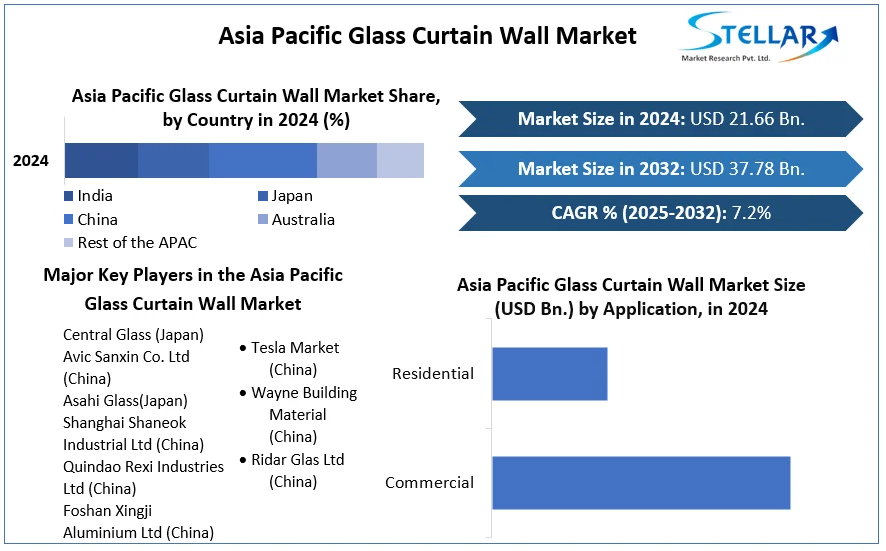
According to Stellar Market Research, the Asia-Pacific Glass Curtain Wall Market was valued at USD 21.66 billion in 2024 and is projected to reach USD 37.78 billion by 2032, expanding at a CAGR of 7.2% during the forecast period.
What is a Glass Curtain Wall?
A glass curtain wall is a non-load-bearing exterior façade system that encloses a building while supporting only its own weight. Unlike structural walls, curtain walls are designed to resist wind, rain, temperature changes, and seismic movement while providing superior insulation and a modern architectural appearance.
Glass curtain walls are commonly installed in:
- Commercial office buildings
- Shopping malls
- Hotels and resorts
- Hospitals
- Airports
- Residential high-rise buildings
- Government infrastructure projects
These systems improve energy efficiency, maximize daylight penetration, and enhance the visual appeal of contemporary buildings.
𝐃𝐨𝐰𝐧𝐥𝐨𝐚𝐝 𝐅𝐫𝐞𝐞 𝐏𝐃𝐅 𝐁𝐫𝐨𝐜𝐡𝐮𝐫𝐞: https://www.stellarmr.com/report/req_sample/Asia-Pacific-Glass-Curtain-Wall-Market/965
Key Market Growth Drivers
Rapid Urbanization Across Asia-Pacific
Rapid population growth and urban expansion in countries such as China, India, Indonesia, Vietnam, and the Philippines are driving demand for high-rise residential and commercial buildings. This has significantly increased the adoption of glass curtain wall systems.
Expansion of Commercial Construction
The construction of office complexes, retail centers, hotels, airports, and mixed-use developments continues to accelerate throughout the region. Developers increasingly prefer glass curtain walls because they offer attractive building designs while improving energy performance.
Growing Focus on Green Buildings
Governments across Asia-Pacific are promoting sustainable construction through stricter building codes and green certification programs. Glass curtain walls help reduce energy consumption by improving thermal insulation and allowing greater use of natural daylight.
Increasing Investment in Smart Cities
Large-scale smart city initiatives across China, India, Singapore, and other Asian countries are creating substantial opportunities for advanced façade systems used in modern infrastructure projects.
Market Segmentation
By Type
The market is segmented into:
- Unitized Systems
- Stick-Built Systems
- Others
Unitized systems accounted for the largest market share in 2024 due to their faster installation, superior quality control, and suitability for high-rise construction projects. These systems are manufactured off-site and assembled quickly at construction locations, reducing labor requirements and project timelines.
By Application
Major application segments include:
- Commercial
- Residential
The commercial segment dominates the market, driven by increasing investments in office buildings, hotels, hospitals, retail centers, and corporate campuses.
By Construction Type
The market covers:
- New Construction
- Refurbishment
New construction accounts for the largest share, while refurbishment projects are growing steadily as older buildings undergo energy-efficiency upgrades and façade modernization.
Emerging Industry Trends
Several technological innovations are transforming the Asia-Pacific Glass Curtain Wall Market:
- Smart glass with dynamic light control
- Double- and triple-glazed energy-efficient façades
- Building-integrated photovoltaic (BIPV) glass
- Low-emissivity (Low-E) coated glass
- Prefabricated modular curtain wall systems
- BIM-enabled façade design and installation
- AI-assisted building energy management
Manufacturers are also introducing advanced glazing technologies that improve thermal insulation, reduce solar heat gain, and lower building energy consumption.
Market Challenges
Despite strong growth prospects, the market faces several challenges:
- High installation costs
- Fluctuating prices of aluminum and glass
- Skilled labor shortages
- Complex installation for large-scale projects
- Rising maintenance requirements for high-rise façades
Manufacturers are addressing these challenges through modular construction methods, automation, and improved material technologies that reduce installation time and lifecycle costs.
Competitive Landscape
The Asia-Pacific Glass Curtain Wall Market features several established manufacturers, including:
- Central Glass (Japan)
- Asahi Glass (Japan)
- AVIC Sanxin Co., Ltd. (China)
- Shanghai Shaneok Industrial Ltd. (China)
- Qingdao Rexi Industries Ltd. (China)
- Foshan Xingji Aluminium Co., Ltd. (China)
- Wayne Building Material (China)
- Ridar Glass Ltd. (China)
These companies continue to invest in product innovation, sustainable façade technologies, production capacity expansion, and strategic partnerships to strengthen their market positions.
𝐃𝐨𝐰𝐧𝐥𝐨𝐚𝐝 𝐅𝐫𝐞𝐞 𝐏𝐃𝐅 𝐁𝐫𝐨𝐜𝐡𝐮𝐫𝐞: https://www.stellarmr.com/report/req_sample/Asia-Pacific-Glass-Curtain-Wall-Market/965
Regional Outlook
China remains the largest market in the Asia-Pacific region due to its extensive commercial construction activity, rapid urbanization, and large-scale infrastructure investments. India is expected to witness strong growth as smart city initiatives, metro rail projects, commercial real estate development, and premium residential construction continue to expand. Japan, South Korea, Australia, and ASEAN countries also contribute significantly to regional demand through ongoing investments in modern infrastructure and energy-efficient buildings.
Future Outlook
The outlook for the Asia-Pacific Glass Curtain Wall Market remains highly positive as governments and private developers continue investing in sustainable urban infrastructure. The adoption of smart glass technologies, modular construction, and energy-efficient façades is expected to accelerate over the forecast period.
As cities across Asia-Pacific focus on reducing carbon emissions and improving building performance, glass curtain walls will remain a key component of modern architectural design and green construction strategies.
Conclusion
The Asia-Pacific Glass Curtain Wall Market is poised for strong growth through 2032, driven by rapid urbanization, expanding commercial construction, smart city development, and increasing demand for sustainable buildings. With continuous advancements in glazing technologies, modular façade systems, and energy-efficient construction materials, glass curtain walls will continue to play a vital role in shaping the future of modern architecture across the Asia-Pacific region.
