The Convertible Bond Market is gaining strong traction as companies increasingly seek flexible financing solutions that balance debt obligations with potential equity growth. Convertible bonds provide issuers with lower-cost capital access while offering investors fixed-income protection and equity upside opportunities, making them increasingly attractive during periods of market uncertainty and changing interest rate environments.
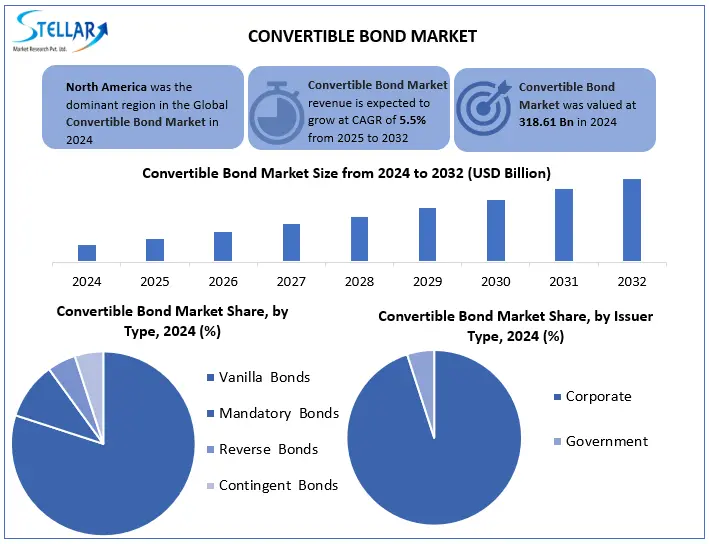
According to Stellar Market Research, the Convertible Bond Market was valued at USD 318.61 billion in 2024 and is expected to reach USD 488.97 billion by 2032, growing at a CAGR of 5.5% during 2025–2032. Rising demand from high-growth companies, increasing institutional participation, and the growing use of hybrid financing strategies are accelerating market expansion.
Hybrid Financing Strategies Reshape Corporate Capital Markets
The global financial landscape is witnessing a shift toward flexible funding mechanisms as companies navigate changing interest rates, economic uncertainty, and evolving investor expectations. Convertible bonds have emerged as a strategic financing instrument because they combine characteristics of both traditional debt and equity securities.
Unlike conventional bonds, convertible bonds allow investors to convert their holdings into company shares under predefined conditions. This structure enables businesses to access capital at relatively lower interest costs while delaying immediate equity dilution.
Technology companies, biotechnology firms, renewable energy businesses, and high-growth enterprises are increasingly adopting convertible bonds to finance expansion, research activities, acquisitions, and infrastructure investments.
The growing preference for alternative financing models is expected to support long-term demand for convertible bond issuance globally.
Vanilla Convertible Bonds Dominate Market Structure
Based on type, the vanilla convertible bonds segment dominates the Convertible Bond Market due to its flexibility, investor familiarity, and widespread adoption among corporate issuers. Vanilla convertibles represent approximately 65–70% of total issuance volume, making them the preferred choice for companies seeking financing flexibility.
Key convertible bond categories include:
Vanilla convertible bonds
Mandatory convertible bonds
Reverse convertible bonds
Contingent convertible bonds
Vanilla convertible bonds provide companies with lower coupon payments while allowing investors to participate in potential equity appreciation.
Mandatory and contingent convertible bonds are gaining attention in specific applications, particularly among financial institutions and companies seeking structured capital solutions.
Corporate Issuers Drive Market Growth
The corporate issuer segment dominates the Convertible Bond Market, accounting for approximately 90–95% of total issuance volume. Corporations increasingly use convertible bonds as an efficient way to raise growth capital while managing financing costs and shareholder dilution.
Technology companies represent a significant share of convertible bond issuance due to their high growth requirements and preference for flexible financing structures. Healthcare and consumer sectors are also increasing adoption as companies invest in innovation, expansion, and strategic acquisitions.
Convertible bonds are particularly attractive for companies with strong growth potential but uncertain short-term profitability because they provide access to capital without immediate pressure from equity markets.
Technology Sector and Growth Companies Create New Opportunities
The technology sector has become one of the largest contributors to convertible bond demand. Companies involved in artificial intelligence, cloud computing, semiconductors, and software development are increasingly utilizing convertible financing to support expansion.
In 2024, technology and healthcare companies accounted for a major portion of convertible bond activity as businesses sought capital for innovation and market expansion.
AI infrastructure companies are especially driving interest as they require substantial investments in:
Data center expansion
Semiconductor development
Cloud infrastructure
Advanced computing systems
Convertible bonds provide these companies with funding flexibility while maintaining strategic control over ownership structures.
Rising Hedge Fund Participation Supports Market Liquidity
Institutional investors, particularly hedge funds, play an important role in supporting convertible bond market liquidity. Convertible arbitrage strategies allow investors to benefit from pricing differences between bond and equity markets.
Hedge funds contribute significantly to trading activity, with arbitrage strategies accounting for around 30% of convertible market liquidity.
The participation of sophisticated investors improves market efficiency and encourages greater issuance activity.
Asset managers are also increasing allocations toward convertible securities because they offer portfolio diversification, fixed-income characteristics, and potential equity participation.
Interest Rate Environment Influences Market Dynamics
Interest rate movements significantly impact convertible bond demand. During periods of higher borrowing costs, companies often consider convertible bonds attractive because they can offer lower coupon rates compared with traditional corporate debt.
For investors, convertible bonds provide an opportunity to achieve higher returns than conventional fixed-income securities when underlying equity prices perform positively.
However, interest rate volatility can create uncertainty in valuation models and influence investor demand.
Financial institutions and investment managers are increasingly using advanced analytics and artificial intelligence tools to improve pricing models and risk assessment for convertible securities.
Artificial Intelligence and Data Analytics Transform Valuation
Technology adoption is reshaping convertible bond analysis and investment strategies. Market participants are increasingly using AI-based models, machine learning algorithms, and automated analytics platforms to evaluate pricing, credit risk, and conversion potential.
Emerging technology applications include:
AI-driven valuation models
Algorithmic trading systems
Risk prediction platforms
Automated portfolio optimization
Advanced analytics help investors better understand the relationship between bond pricing, equity volatility, interest rates, and issuer credit quality.
The adoption of digital financial technologies is expected to improve transparency and efficiency across convertible bond markets.
North America Leads Global Convertible Bond Market
North America dominates the Convertible Bond Market, accounting for approximately 45–50% of total issuance activity. The region’s leadership is supported by deep capital markets, strong institutional investor participation, and a well-established technology and biotechnology ecosystem.
The United States represents the largest contributor due to high convertible bond activity among technology, healthcare, and emerging growth companies.
Major financial institutions and investment firms in North America actively participate in issuance, underwriting, trading, and investment activities, strengthening regional market development.
Asia-Pacific Emerges as a Growth Market
The Asia-Pacific region is expected to witness increasing adoption of convertible bonds due to expanding technology sectors, rising corporate financing requirements, and growing capital market development.
China, Japan, South Korea, and India are emerging as important markets due to:
Technology company expansion
Startup ecosystem growth
Increasing foreign investment
Infrastructure development
As companies across Asia seek flexible financing options, convertible bonds are expected to gain greater acceptance among issuers and investors.
Regulatory Landscape and Risk Management Trends
Regulatory frameworks play an important role in shaping convertible bond market operations. Financial authorities continue focusing on transparency, investor protection, disclosure requirements, and market stability.
Stricter reporting requirements for institutional investors and hedge funds may influence trading strategies and liquidity conditions.
Market participants are increasingly investing in compliance technologies and risk management systems to navigate evolving financial regulations.
Competitive Landscape
The Convertible Bond Market includes investment banks, asset managers, hedge funds, and institutional investors competing through underwriting expertise, investment strategies, and innovative financial structures.
Key players include:
Goldman Sachs
Morgan Stanley
BlackRock
PIMCO
Citadel
Goldman Sachs maintains a strong position in technology and biotechnology convertible offerings, while BlackRock remains a major institutional investor in convertible securities. Citadel plays an important role in convertible arbitrage and secondary market liquidity.
Recent Industry Developments
Goldman Sachs (2025): Led a USD 500 million convertible bond offering for AI company Anthropic, supporting cloud infrastructure expansion through flexible financing.
Morgan Stanley (2025): Structured a contingent convertible bond transaction linked to healthcare sector milestones, expanding innovative financing solutions for biotechnology companies.
BlackRock (2024): Increased focus on convertible securities investment strategies as institutional investors sought hybrid assets offering downside protection and equity participation.
Citadel (2024): Expanded convertible arbitrage activities using advanced trading technologies to improve market-making capabilities.
Technology and Healthcare Companies (2024): Increased convertible bond issuance to fund AI development, biotechnology research, and business expansion initiatives.
Market Challenges
Despite strong growth prospects, the Convertible Bond Market faces several challenges.
Complex valuation processes remain a major concern because convertible bonds depend on multiple factors, including interest rates, equity volatility, credit risk, and conversion terms.
Additional challenges include:
Limited secondary market liquidity
Market volatility
Regulatory changes
Potential shareholder dilution risks
Companies and investors are addressing these challenges through improved analytics, structured products, and enhanced risk management practices.
Future Outlook
The Convertible Bond Market is expected to experience steady growth through 2032 as companies increasingly adopt flexible financing strategies and investors seek hybrid investment opportunities.
Future market development will be shaped by technology sector expansion, institutional investment growth, AI-driven financial analytics, and evolving capital market strategies.
As businesses continue balancing growth requirements with financing efficiency, convertible bonds are expected to remain an important instrument connecting debt markets and equity opportunities.
About Stellar Market Research
Stellar Market Research is a global market research and business consulting firm delivering comprehensive industry intelligence, customized research solutions, and strategic insights across various industries. The company provides market analysis, competitive intelligence, forecasting, and business consulting services to help organizations identify opportunities and make informed strategic decisions. With expertise across finance, technology, healthcare, energy, chemicals, and consumer sectors, Stellar Market Research supports businesses, investors, and stakeholders through reliable research methodologies and actionable market insights.
Media Contact
Stellar Market Research
Website: Stellar Market Research – Global Research Reports & Consulting
Email: sales@stellarmr.com
