Asia Pacific Crude Steel Market: Infrastructure Expansion, Industrial Growth, and Green Steel Transition Driving Future Demand
The Asia Pacific Crude Steel Market is experiencing strong growth due to rapid industrialization, infrastructure development, urbanization, and increasing demand from construction, automotive, transportation, and energy sectors. Crude steel remains a fundamental material supporting economic development, with applications ranging from buildings and bridges to vehicles, machinery, appliances, and energy infrastructure.
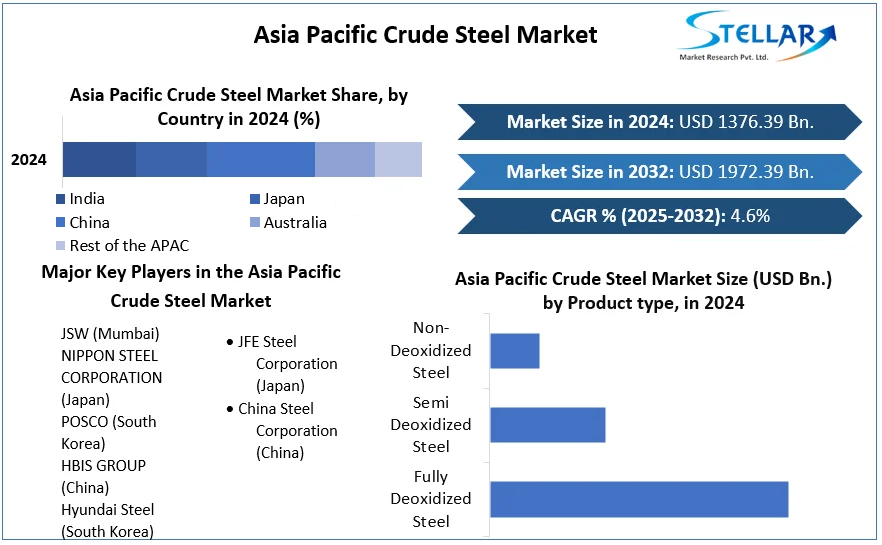
According to Stellar Market Research, the Asia Pacific Crude Steel Market was valued at USD 1,376.39 billion in 2024 and is expected to reach USD 1,972.39 billion by 2032, growing at a CAGR of 4.6% during 2025–2032. The market expansion is supported by increasing infrastructure investments, manufacturing growth, and advancements in steel production technologies.
Rising Infrastructure Development Boosting Steel Demand
Infrastructure development is one of the major factors driving crude steel consumption across the Asia Pacific region. Governments are investing heavily in transportation networks, smart cities, renewable energy projects, residential construction, and industrial infrastructure.
Steel plays a critical role in construction because of its strength, durability, recyclability, and versatility. Increasing demand for bridges, railways, commercial buildings, and large-scale infrastructure projects is creating continuous opportunities for steel producers.
Countries such as China, India, Japan, South Korea, and ASEAN nations are witnessing significant infrastructure expansion, contributing to higher crude steel demand
𝐃𝐨𝐰𝐧𝐥𝐨𝐚𝐝 𝐅𝐫𝐞𝐞 𝐏𝐃𝐅 𝐁𝐫𝐨𝐜𝐡𝐮𝐫𝐞: https://www.stellarmr.com/report/req_sample/Asia-Pacific-Crude-Steel-Market/991
Automotive and Manufacturing Industries Supporting Market Growth
The automotive industry is another important consumer of crude steel in Asia Pacific. Vehicle manufacturers use steel for body structures, chassis, safety components, and other automotive applications.
Growing vehicle production, rising electric vehicle adoption, and increasing demand for lightweight and high-strength steel products are encouraging innovation within the steel industry.
Apart from automotive applications, crude steel is widely used in machinery, consumer appliances, industrial equipment, and manufacturing sectors. The expansion of industrial production across emerging economies is expected to support long-term market growth.
Transition Toward Sustainable Steel Production
The steel industry is increasingly focusing on reducing carbon emissions and adopting environmentally friendly production methods. Traditional blast furnace-based steel production is gradually being complemented by Electric Arc Furnace (EAF) technology, which enables steel production using recycled scrap materials and requires lower energy consumption.
Green steel initiatives are gaining momentum as governments and companies work toward achieving sustainability targets. Investments in renewable energy integration, hydrogen-based steel production, and recycling technologies are expected to shape the future of the crude steel market.
Market Segmentation Overview
The Asia Pacific Crude Steel Market is segmented based on product type, application, and geography.
By Product Type
Fully Deoxidized Steel
Fully deoxidized steel is widely used in applications requiring high-quality and reliable steel properties. It offers improved strength and consistency, making it suitable for demanding industrial applications.
Semi Deoxidized Steel
Semi deoxidized steel provides a balance between cost efficiency and performance, making it suitable for various construction and manufacturing applications.
Non-Deoxidized Steel
Non-deoxidized steel is used in applications where specific mechanical properties are not highly critical.
By Application
Construction
Construction represents one of the largest application segments due to extensive usage in buildings, infrastructure projects, bridges, and structural components.
Automotive
The automotive sector relies on crude steel for vehicle manufacturing, including passenger vehicles, commercial vehicles, and electric vehicles.
Transportation
Steel is essential for railways, shipping infrastructure, and transportation networks due to its durability and strength.
Energy
Steel is used in power plants, renewable energy structures, pipelines, and energy infrastructure projects.
Packaging and Consumer Appliances
Steel continues to be used in packaging materials, household appliances, and various consumer products.
Regional Market Outlook
China
China remains one of the most influential steel-producing countries in the Asia Pacific region. Large-scale infrastructure projects, industrial manufacturing, and construction activities continue to support steel demand.
India
India is emerging as a major growth center for crude steel due to infrastructure development, manufacturing expansion, urbanization, and government initiatives supporting industrial growth.
Japan and South Korea
Japan and South Korea continue to focus on advanced steel technologies, automotive-grade steel production, and sustainable manufacturing practices.
ASEAN Countries
Increasing industrialization and infrastructure investments in Southeast Asian countries are creating new opportunities for steel manufacturers.
Key Market Growth Drivers
Rapid Urbanization and Infrastructure Investment
Growing urban populations and infrastructure modernization projects are increasing demand for steel across residential, commercial, and public infrastructure sectors.
Expansion of Automotive Manufacturing
Rising vehicle production and demand for advanced steel materials are strengthening crude steel consumption.
Industrial Growth in Emerging Economies
Manufacturing expansion in developing Asia Pacific economies is creating new opportunities for steel producers.
Development of Green Steel Technologies
Sustainability initiatives and low-carbon steel production technologies are encouraging innovation across the industry.
Challenges Affecting Market Growth
Despite positive growth prospects, the Asia Pacific Crude Steel Market faces challenges such as raw material price fluctuations, environmental regulations, production overcapacity, and increasing pressure to reduce carbon emissions.
Steel manufacturers are addressing these challenges through recycling initiatives, energy-efficient technologies, and investments in sustainable production processes.
𝐃𝐨𝐰𝐧𝐥𝐨𝐚𝐝 𝐅𝐫𝐞𝐞 𝐏𝐃𝐅 𝐁𝐫𝐨𝐜𝐡𝐮𝐫𝐞: https://www.stellarmr.com/report/req_sample/Asia-Pacific-Crude-Steel-Market/991
Competitive Landscape
The Asia Pacific Crude Steel Market includes major global and regional steel producers focusing on capacity expansion, technological advancement, and sustainable manufacturing. Key players include JSW Steel, Nippon Steel Corporation, POSCO, HBIS Group, Hyundai Steel, JFE Steel Corporation, and China Steel Corporation.
Future Outlook of Asia Pacific Crude Steel Market
The future of the Asia Pacific Crude Steel Market will be shaped by infrastructure expansion, manufacturing growth, automotive demand, and sustainable steel production technologies.
As countries continue investing in urban development, renewable energy infrastructure, and industrial modernization, crude steel will remain a critical material for economic growth. The adoption of green steel technologies and advanced manufacturing processes will further transform the industry during the forecast period of 2025–2032.
