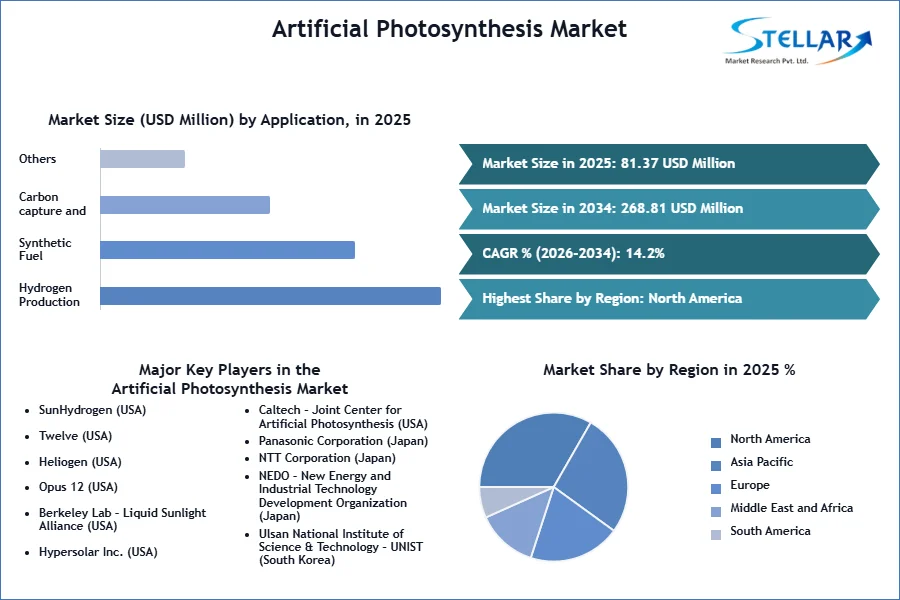
The Artificial Photosynthesis Market was estimated at USD 81.37 Mn. in 2025 and is expected to grow at a CAGR of 14.2% from 2026 to 2034, reaching nearly USD 268.81 Mn. by 2034.
The Artificial Photosynthesis Market is emerging as a breakthrough clean energy technology as industries worldwide seek sustainable alternatives for fuel production, carbon reduction, and renewable energy storage. By replicating natural photosynthesis, artificial photosynthesis systems use sunlight, water, and carbon dioxide to generate valuable fuels and chemicals, supporting global decarbonization efforts.
Artificial Photosynthesis Emerges as a Strategic Climate Technology
The global energy transition is accelerating investments in technologies capable of reducing carbon emissions while meeting increasing energy demand. Artificial photosynthesis is gaining importance because it offers a pathway to convert renewable solar energy into chemical fuels rather than relying only on electricity generation.
The technology mimics the natural process of plants by using solar energy to convert carbon dioxide and water into energy-rich molecules. These outputs can include hydrogen, synthetic fuels, and chemical feedstocks, creating opportunities across energy, transportation, chemical manufacturing, and industrial sectors.
Unlike traditional renewable energy sources, artificial photosynthesis has the potential to address energy storage challenges by producing fuels that can be stored and transported. This capability makes it particularly attractive for hard-to-electrify industries such as aviation, heavy manufacturing, and chemical processing.
Governments, research institutions, and energy companies are increasingly supporting artificial photosynthesis research as part of broader strategies focused on net-zero emissions and clean technology development.
𝐃𝐨𝐰𝐧𝐥𝐨𝐚𝐝 𝐅𝐫𝐞𝐞 𝐏𝐃𝐅 𝐁𝐫𝐨𝐜𝐡𝐮𝐫𝐞: https://www.stellarmr.com/report/req_sample/Artificial-Photosynthesis-Market/2796
Rising Green Hydrogen Demand Drives Market Expansion
The hydrogen production segment dominates the Artificial Photosynthesis Market, accounting for more than 60% of market share in 2024. The increasing global demand for green hydrogen is one of the primary factors accelerating investments in artificial photosynthesis technologies.
Green hydrogen is becoming a key solution for reducing emissions in industries including:
Steel production
Chemical manufacturing
Transportation
Energy storage
Refining operations
Artificial photosynthesis provides an alternative approach to hydrogen generation by directly converting solar energy into chemical energy.
More than 35 countries have introduced hydrogen strategies or roadmaps, creating favorable conditions for investment in advanced hydrogen technologies. As governments increase funding for clean energy infrastructure, artificial photosynthesis is expected to gain importance as a future hydrogen production pathway.
Advanced Technologies Improve Artificial Photosynthesis Efficiency
The Artificial Photosynthesis Market is segmented based on technology into:
Co-electrolysis
Photo-electrocatalysis
Other emerging technologies
Co-electrolysis and photo-electrochemical technologies are receiving significant attention due to their potential to improve solar-to-fuel conversion efficiency.
Researchers and companies are focusing on developing:
Advanced semiconductor catalysts
Nanostructured materials
High-performance photoelectrodes
Durable catalytic systems
AI-assisted material discovery methods
Improving catalyst stability remains a major research priority because long-term operational performance is essential for commercial adoption.
Recent advancements in photoelectrochemical systems have demonstrated progress toward scalable hydrogen production, although further improvements are required before widespread industrial deployment.
Carbon Capture and Utilization Creates New Growth Opportunities
Beyond hydrogen production, artificial photosynthesis is gaining attention for carbon capture and utilization applications. The ability to convert captured carbon dioxide into valuable products creates opportunities for developing circular carbon economies.
Potential applications include:
Synthetic fuels
Renewable chemicals
Carbon-based materials
Industrial feedstocks
Companies are increasingly exploring artificial photosynthesis as a technology that can simultaneously reduce greenhouse gas emissions and generate commercially valuable products.
This dual capability positions artificial photosynthesis as a potential solution for industries seeking both environmental compliance and economic value creation.
Government Policies Support Clean Technology Development
Government initiatives supporting renewable energy, hydrogen production, and carbon neutrality are playing an important role in market development.
Major policy factors influencing the Artificial Photosynthesis Market include:
Clean hydrogen investment programs
Carbon reduction regulations
Renewable energy incentives
Research funding initiatives
Public-private technology partnerships
Countries including the United States, Japan, Germany, South Korea, and China are investing heavily in clean energy innovation to strengthen energy security and achieve climate targets.
These initiatives are encouraging collaborations between universities, technology developers, and industrial companies.
North America Leads Global Market Growth
North America dominates the Artificial Photosynthesis Market, supported by advanced research infrastructure, strong corporate participation, and government-backed clean energy programs.
The United States represents the leading contributor due to:
Strong renewable energy investments
Advanced research institutions
Hydrogen development programs
Presence of innovative technology companies
Organizations and companies across North America are actively developing artificial photosynthesis systems focused on hydrogen production, carbon conversion, and sustainable fuels.
The region’s strong innovation ecosystem is expected to maintain its leadership position during the forecast period.
Asia-Pacific Emerges as a High-Potential Market
The Asia-Pacific region is expected to witness significant growth due to increasing renewable energy investments, industrial decarbonization initiatives, and government support for hydrogen technologies.
Major markets include:
China
Japan
South Korea
India
Australia
Japan and South Korea are investing significantly in hydrogen technologies, while China is expanding renewable energy capacity and clean technology manufacturing.
India is also emerging as a promising market due to its growing renewable energy sector and focus on hydrogen development.
Challenges Limiting Commercial Adoption
Despite strong growth potential, artificial photosynthesis technology faces several challenges.
Key market restraints include:
Limited commercial scalability
High research and development costs
Catalyst durability issues
Lower efficiency compared with mature technologies
Complex infrastructure integration
Many artificial photosynthesis projects remain in pilot or demonstration stages. Moving from laboratory-scale systems to commercial-scale production remains one of the biggest challenges facing the industry.
Improving efficiency, reducing costs, and increasing system durability will be essential for widespread adoption.
Sustainability Impact and Industrial Transformation
Artificial photosynthesis supports global sustainability objectives by enabling renewable fuel production and reducing dependence on fossil-based energy sources.
The technology contributes to:
Carbon emission reduction
Renewable hydrogen generation
Circular carbon utilization
Sustainable chemical production
As companies increasingly prioritize ESG goals and governments strengthen climate policies, artificial photosynthesis is expected to become an important component of future clean energy strategies.
Competitive Landscape
The Artificial Photosynthesis Market includes technology developers, energy companies, research organizations, and advanced materials companies.
Key players include:
SunHydrogen
Twelve
Siemens Energy
Panasonic Corporation
ENGIE
Heliogen
NTT Corporation
Sunfire GmbH
Companies are focusing on:
Catalyst innovation
Pilot-scale projects
Strategic partnerships
Hydrogen technology development
Carbon conversion solutions
Market participants are investing in research collaborations and commercialization strategies to improve efficiency and accelerate adoption.
𝐃𝐨𝐰𝐧𝐥𝐨𝐚𝐝 𝐅𝐫𝐞𝐞 𝐏𝐃𝐅 𝐁𝐫𝐨𝐜𝐡𝐮𝐫𝐞: https://www.stellarmr.com/report/req_sample/Artificial-Photosynthesis-Market/2796
Recent Industry Developments
Twelve (2025): Secured additional funding from investors including Amazon’s Climate Pledge Fund, Mitsui, and Development Bank of Japan to accelerate carbon-to-fuel technology deployment.
Twelve (2024): Raised USD 645 million in funding led by TPG Rise Climate to expand sustainable aviation fuel production using carbon conversion technology.
UNIST (2024): Researchers demonstrated advances in scalable photoelectrochemical systems for green hydrogen production under real sunlight conditions.
SunHydrogen (2025): Continued development of solar-powered hydrogen generation technologies focused on improving efficiency and scalability.
Siemens Energy (2025): Expanded clean hydrogen technology initiatives supporting industrial decarbonization and renewable energy integration.
Future Outlook
The Artificial Photosynthesis Market is expected to experience strong growth through 2032 as industries accelerate their transition toward low-carbon energy solutions.
Future market expansion will be influenced by:
Increasing green hydrogen demand
Advances in catalyst technology
Carbon utilization opportunities
Government clean energy investments
Commercial demonstration projects
Although the technology is still developing, continued innovation and investment are expected to improve performance and reduce costs.
Artificial photosynthesis has the potential to become a significant clean energy technology by connecting renewable electricity, carbon management, and sustainable fuel production into a single integrated solution.
About Stellar Market Research
Stellar Market Research is a global market research and business consulting firm providing comprehensive industry intelligence, strategic analysis, and customized research solutions across various industries. The company delivers reliable market forecasts, competitive assessments, emerging trend analysis, and actionable insights to support businesses, investors, and organizations in making informed decisions. With expertise across energy, technology, healthcare, chemicals, consumer goods, and industrial sectors, Stellar Market Research helps clients identify growth opportunities and develop effective strategies.
Media Contact
Stellar Market Research
Website: Stellar Market Research – Global Research Reports & Consulting
Email: sales@stellarmr.com
