North America Connected Oil Field Market: Industry Analysis, Growth Trends, Key Drivers, and Future Outlook (2025–2032)
The North America Connected Oil Field Market is experiencing steady growth as oil and gas operators increasingly adopt digital technologies to improve operational efficiency, maximize production, and reduce exploration and maintenance costs. A connected oil field integrates technologies such as the Internet of Things (IoT), artificial intelligence (AI), cloud computing, big data analytics, automation, and advanced sensors to enable real-time monitoring and data-driven decision-making across oil and gas operations.
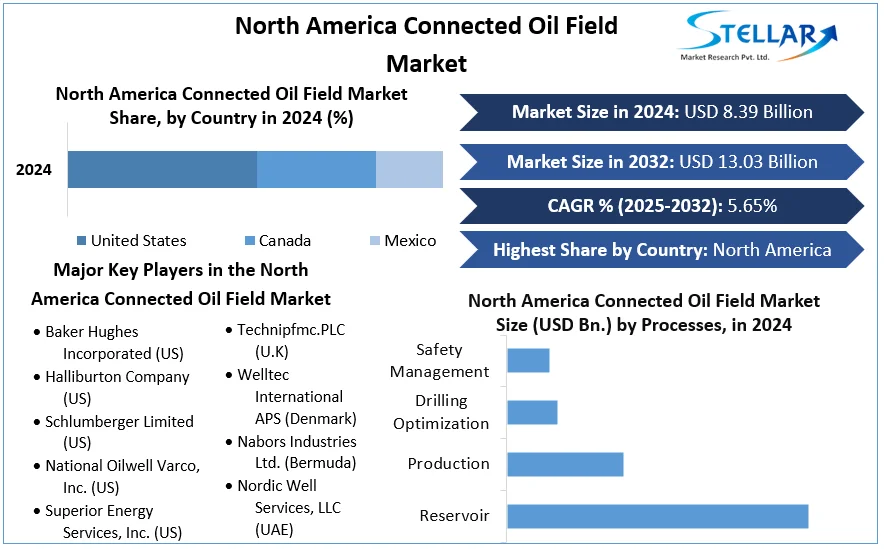
According to Stellar Market Research, the North America Connected Oil Field Market was valued at USD 8.39 billion in 2024 and is projected to reach USD 13.03 billion by 2032, expanding at a CAGR of 5.65% during the forecast period (2025–2032).
Digital Oilfield Technologies Driving Market Growth
Oil and gas companies across North America are rapidly implementing digital oilfield technologies to improve drilling efficiency, optimize production, reduce downtime, and enhance worker safety. Real-time monitoring systems combined with predictive analytics allow operators to make faster operational decisions while minimizing equipment failures and maintenance costs.
Increasing investments in automation and intelligent reservoir management continue to accelerate market growth.
𝐃𝐨𝐰𝐧𝐥𝐨𝐚𝐝 𝐅𝐫𝐞𝐞 𝐏𝐃𝐅 𝐁𝐫𝐨𝐜𝐡𝐮𝐫𝐞: https://www.stellarmr.com/report/req_sample/North-America-Connected-Oil-Field-Market/1204
Expansion of Shale Oil and Gas Production
North America remains one of the world’s leading oil and gas producing regions, supported by extensive shale resources in the United States and Canada. Continued development of unconventional resources, particularly in the Permian Basin, is driving demand for connected oil field solutions that improve drilling accuracy, reservoir management, and production optimization.
Key Growth Drivers of the North America Connected Oil Field Market
Increasing Adoption of Artificial Intelligence
Artificial intelligence is transforming upstream operations by enabling:
- Predictive maintenance
- Reservoir modeling
- Automated drilling optimization
- Production forecasting
- Equipment performance monitoring
AI-powered analytics help operators reduce operational risks while improving overall field productivity.
Growing Use of IoT Sensors
Connected oil fields utilize smart sensors to continuously monitor wells, pipelines, pumps, compressors, and production equipment.
Real-time operational data enables companies to:
- Detect equipment failures early
- Improve production efficiency
- Reduce unplanned downtime
- Enhance worker safety
Rising Investment in Digital Infrastructure
Oil producers continue investing in cloud platforms, wireless communication systems, industrial automation, and data analytics to improve operational visibility and decision-making.
Digital transformation has become a strategic priority for companies seeking to improve return on investment while lowering production costs.
Focus on Operational Efficiency
With fluctuating oil prices and increasing pressure to improve profitability, operators are adopting connected oil field technologies that optimize resource utilization and streamline production workflows.
Challenges Facing the Market
High Initial Capital Investment
Deploying connected oil field infrastructure requires significant investment in:
- IoT sensors
- Communication networks
- Cloud computing platforms
- Advanced software
- Cybersecurity systems
These upfront costs can limit adoption among smaller operators.
Cybersecurity Risks
As oil fields become increasingly digitized, protecting operational technology (OT) systems from cyber threats has become a major industry challenge.
Integration with Legacy Infrastructure
Many mature oil fields continue operating with older production equipment, making digital integration more complex and requiring phased modernization programs.
𝐃𝐨𝐰𝐧𝐥𝐨𝐚𝐝 𝐅𝐫𝐞𝐞 𝐏𝐃𝐅 𝐁𝐫𝐨𝐜𝐡𝐮𝐫𝐞: https://www.stellarmr.com/report/req_sample/North-America-Connected-Oil-Field-Market/1204
North America Connected Oil Field Market Segmentation
The market is segmented based on process, solution, and country.
By Process
Production
The production segment dominates the market, accounting for more than half of the market share. Connected production systems help operators optimize well performance, allocate production efficiently, and maximize recovery while reducing operating costs.
Reservoir
Digital reservoir management combines geological data, reservoir simulation, and predictive analytics to improve hydrocarbon recovery and production planning.
Drilling Optimization
Advanced drilling technologies improve well placement, reduce drilling time, and increase operational efficiency.
Safety Management
Connected monitoring systems enhance worker safety through continuous surveillance, predictive alerts, and automated emergency response capabilities.
By Solution
Hardware
Includes:
- Smart sensors
- Controllers
- Communication devices
- Monitoring equipment
These components collect operational data across oil field assets.
Software & Services
Software solutions provide:
- Data analytics
- Asset performance management
- Predictive maintenance
- Production optimization
- Reservoir simulation
Data Storage Solutions
Cloud-based and on-premise storage platforms support secure management and analysis of large operational datasets.
Regional Analysis
United States
The United States represents the largest market in North America due to extensive shale production, widespread digital oilfield adoption, and continuous investment in upstream exploration. Major producing regions such as the Permian Basin continue driving demand for connected oil field technologies.
Canada
Canada continues investing in digital technologies to improve oil sands production, pipeline monitoring, and operational efficiency across conventional and unconventional energy projects.
Mexico
Mexico is expected to witness strong growth as offshore exploration expands and energy sector modernization encourages greater adoption of connected oil field solutions. Government initiatives supporting drilling and production activities are expected to strengthen future demand.
Competitive Landscape
The North America Connected Oil Field Market is highly competitive, with global oilfield service providers and industrial technology companies investing heavily in AI, IoT, automation, and cloud-based digital platforms.
Major companies operating in the market include:
- Baker Hughes Incorporated
- Halliburton Company
- SLB (Schlumberger)
- National Oilwell Varco
- Weatherford International
- Emerson Electric Co.
- Rockwell Automation
- TechnipFMC
- Siemens AG
- Nabors Industries
- Trican Well Service Ltd.
- Kongsberg Oil & Gas Technologies
Emerging Trends in the North America Connected Oil Field Industry
AI-Powered Predictive Maintenance
Artificial intelligence is enabling predictive maintenance that reduces equipment failures and improves operational uptime.
Digital Twin Technology
Digital twins allow operators to simulate oil field performance, evaluate production scenarios, and optimize maintenance planning.
Cloud-Based Oilfield Platforms
Cloud computing enables centralized access to production data, improving collaboration between field engineers and operational teams.
Automation and Remote Operations
Remote monitoring, autonomous drilling systems, and automated production controls are reducing manual intervention while improving safety and efficiency.
Future Outlook of the North America Connected Oil Field Market
The North America Connected Oil Field Market is expected to maintain healthy growth through 2032 as oil and gas companies continue investing in digital transformation, intelligent automation, and advanced analytics. Growing adoption of AI, IoT, cloud computing, and predictive maintenance technologies will support more efficient production, improved safety, and lower operating costs across upstream operations.
Conclusion
The North America Connected Oil Field Market is playing a pivotal role in modernizing the region’s oil and gas industry through digital innovation. Rising investments in artificial intelligence, IoT-enabled monitoring, cloud computing, and automation are transforming how operators manage reservoirs, drilling activities, and production assets.
As companies continue embracing connected oil field technologies to enhance productivity, improve safety, and optimize resource recovery, the market is expected to remain a key driver of innovation and operational excellence across North America’s energy sector.
