Key Highlights
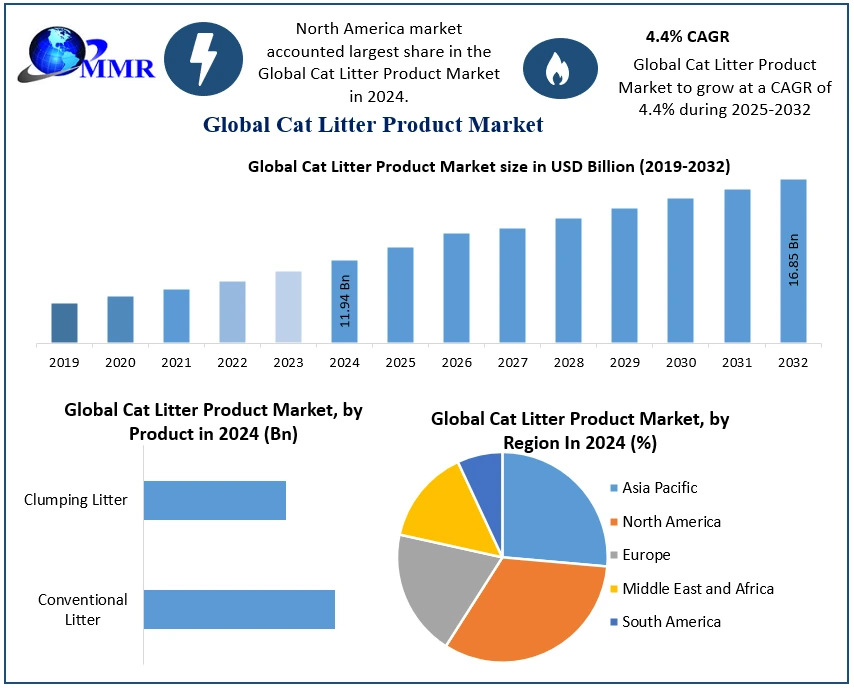
Market valuation expanded to USD 11.94 billion in 2024 and is projected to reach USD 16.85 billion by 2032, sustaining a compound annual growth rate (CAGR) of 4.4% over the 2025–2032 forecast matrix.
The offline distribution channel held the dominant market position in 2024, securing a verified 61% share of total global revenue allocations.
The Asia Pacific regional marketplace is positioned as the fastest-growing geographical segment, propelled by an influx of nuclear households and expanding disposable income.
Clumping litter configurations dominate the product classification segment due to intense consumer requirements for localized odor control and accelerated scoopability.
Raw material infrastructure remains anchored by clay cat litter processing systems, while silica-based crystal compounds are growing due to low waste generation metrics.
Why This Matters Now
Consumer goods companies relying purely on generic, heavy-bulk pet products face immediate margin erosion as specialized health-tracking and bio-synthetic distribution systems secure premium market shelf space. Fast-moving consumer goods (FMCG) executives who ignore the fast transition toward diagnostic and ultra-absorbent hygiene substrates risk absolute retail obsolescence as urban multi-cat households demand strict odor mitigation and structural convenience. This market shift redefines standard supermarket pet aisle economics, turning low-margin commodities into high-margin functional health indicators.
Market Overview
The global cat litter product market is undergoing a sustained capital expansion, growing from an established baseline value of USD 11.94 billion in 2024 to a projected revenue target of USD 16.85 billion by 2032. This performance trajectory reflects a steady compound annual growth rate of 4.4% across the designated eight-year forecast window spanning from 2025 to 2032. The institutional tracking data gathered from 2019 through 2024 confirms a permanent upward trajectory in global procurement volume.
This financial expansion demonstrates that corporate capital is migrating rapidly toward sophisticated pet hygiene formulations that resolve high-density urban living challenges. Contemporary retail store placement spans distinct design frameworks, including heavy clay-based aggregates, engineered silica crystal lines, and premium clumping compounds configured for automated, tech-enabled litter boxes.
Key Trends Driving Growth
Urban residential real estate adjustments are forcing a comprehensive restructuring of consumer pet asset strategies. The primary growth driver remains the steady escalation of global cat ownership, catalyzed by the expansion of dual-income households and a distinct preference for self-sufficient animal companions suitable for restricted metropolitan living areas. This demographic movement increases the demand for high-performance clumping and odor-control media that maintain strict sanitary baselines within hybrid work-from-home environments.
Concurrently, intense public interest in preventative pet medical diagnostics is creating lucrative sub-categories for advanced structural materials. Specialized formulations, exemplified by advanced silica crystal sand variants like the Alpha Paw Genius Litter, integrate proactive health-monitoring features that change color to reveal abnormalities in urine pH, alkalinity, albumin levels, or the presence of blood. These value-added health features allow pet owners to detect medical complications early, transforming standard waste-disposal substrate purchasing into an active layer of veterinary triage.
Segment Insights
Dominant Segment (Product): Clumping litter architectures dominate the global category mix, driven by immediate consumer requirements for isolated waste removal without necessitating total substrate box replacement. These formulations rely on sodium bentonite compounds to instantly isolate liquids and solid waste, directly reducing material consumption rates for the end-user.
Dominant Segment (Raw Material): Clay cat litter processing secured the absolute highest material market share in 2024 due to its solid-formation properties, dust-free performance, and structural affordability for middle-class and low-income demographics.
Dominant Segment (Distribution Channel): The offline channel remained the dominant route-to-market in 2024, commanding 61% of total market revenue because consumers value the ability to physically evaluate product weight and brand variants prior to purchase.
Fastest-Growing Segment (Distribution Channel): The online distribution channel is expanding at the highest velocity within the channel matrix, driven by subscription-based automated purchasing applications and doorstep delivery services engineered by specialized e-commerce platforms.
Material Sub-Segments: The broader manufacturing pipeline maintains clear separation between conventional coarse litters, premium ultra-clumping clay, silica gel matrices, and alternative biodegradable resource materials.
Regional Growth Story
North America retained the largest regional market share in 2024, cementing its status as the primary engine for premium pet care technology monetization. The region benefits from a highly mature cat ownership culture and a strong corporate retail landscape that rapidly absorbs product lines featuring environmental innovations and health diagnostics. This deep market penetration provides the initial volume needed for industrial suppliers to scale manufacturing automation.
Europe held the second-largest global market share in 2024, driven by an expansion in multi-cat residential households and a high consumer preference for indoor feline companions. Concurrently, the Asia Pacific region is projected to register the highest growth rate from 2025 to 2032. This acceleration is confirmed by substantial increases in regional pet ownership metrics between 2018 and 2022, during which cat ownership expanded by 15% in Indonesia, 14% in India, and 13% in South Korea, alongside a verified 34% cat ownership share among pet owners in India by 2024.
Competitive Landscape
The global market matrix includes major processing and chemical companies such as Hydroworx, Dynamika, Hydro Physio, PHYSIO-TECH, Aqquatix, Poolstar, SwimEx, H2O For Fitness, Hydrorider, Waterflex, Biotech, EWAC Medical, Tudor Treadmills, DWS, Rent the Runway, Share Wardrobe, Elanic Services Private Limited, Secoo Holding Limited, Stylish Play, FlyRobe, Walkin Closet, Secret Wardrobe, Bag Borrow Steal, and Dress & Go. This complex manufacturing environment signals that raw material security and technology-driven functionality are the primary levers for market share retention. Generic packaging operations face severe margin compression as dominant market leaders utilize integrated supply chains to control premium mineral deposits and synthetic sand production.
To defend their corporate positions, dominant consumer brand groups are executing advanced product development pathways and targeted retail partnerships to lock in premium shelf placement. These strategic actions indicate that the next 12 to 24 months will bring intense portfolio shakeups, as legacy FMCG companies acquire specialized natural-material startups to quickly add eco-friendly lines. Competitors must prepare for a retail marketplace where basic low-cost clay lines are increasingly replaced by premium health-monitoring substrates that command higher margins per unit.
Recent Developments
Industrial producers expanded production lines for high-margin diagnostic litters, utilizing non-clumping crystal sand matrices designed to shift color to signal changes in feline pH and alkalinity levels.
Corporate retail distributors optimized regional fulfillment hubs to cater to the fast-growing online subscription segment, reducing shipping costs for heavy-bulk clay and silica shipments.
Processing plants integrated advanced mineral processing techniques to eliminate fine dust particles from standard clay formulations, mitigating respiratory risks for indoor pets and owners.
Strategic Implications
FMCG category managers must immediately alter their shelf-allocation frameworks to favor high-margin clumping and advanced silica configurations over legacy conventional products. Devoting valuable brick-and-mortar space to non-clumping, low-margin clay aggregates represents a sub-optimal allocation of retail resources when urban consumers show a willingness to pay premium prices for superior odor control. Furthermore, manufacturers must rapidly deploy direct-to-consumer auto-ship models to retain volume that would otherwise migrate to digital subscription platforms.
Product development teams must focus on minimizing the environmental footprint of their product lifecycles. Traditional strip-mined clay is facing intense pushback due to its non-biodegradable nature and its impact on landfill accumulation. Processing operations that fail to incorporate renewable, biodegradable, or highly efficient low-waste silica alternatives will find themselves excluded from major corporate retail sustainability mandates.
Future Outlook
The market will separate into highly profitable consumer brands that dominate the high-margin health-tracking and subscription delivery segments, and undifferentiated commodity processors whose margins will be squeezed by rising transportation costs and strict environmental disposal regulations.
Analyst Perspective
“The rapid structural evolution of the global cat litter product market points to a permanent transition toward specialized functionality and proactive pet care management,” states Dr. Rucha Deshpande, Research Analyst. “As metropolitan multi-cat households expand globally, those consumer goods enterprises that successfully combine advanced diagnostic chemistry with an optimized multi-channel retail footprint will secure dominant market shares across both mature Western economies and the fast-accelerating Asia Pacific theater.”
About Maximize Market Research
Maximize Market Research Pvt. Ltd. (MMR) is a global market research and consulting company that provides reliable, data-focused, and practical business insights. The firm serves a wide range of industries, including healthcare, pharmaceuticals, technology, automotive, electronics, chemicals, personal care, and consumer goods. Through market forecasts, competitive analysis, strategic consulting, and industry impact assessments, MMR helps organizations understand changing market conditions, identify growth opportunities, and make informed business decisions for long-term success.
2nd Floor, Navale IT Park Phase 3
Pune Banglore Highway, Narhe
Pune, Maharashtra 411041, India
+91 9607365656
sales@maximizemarketresearch.com
