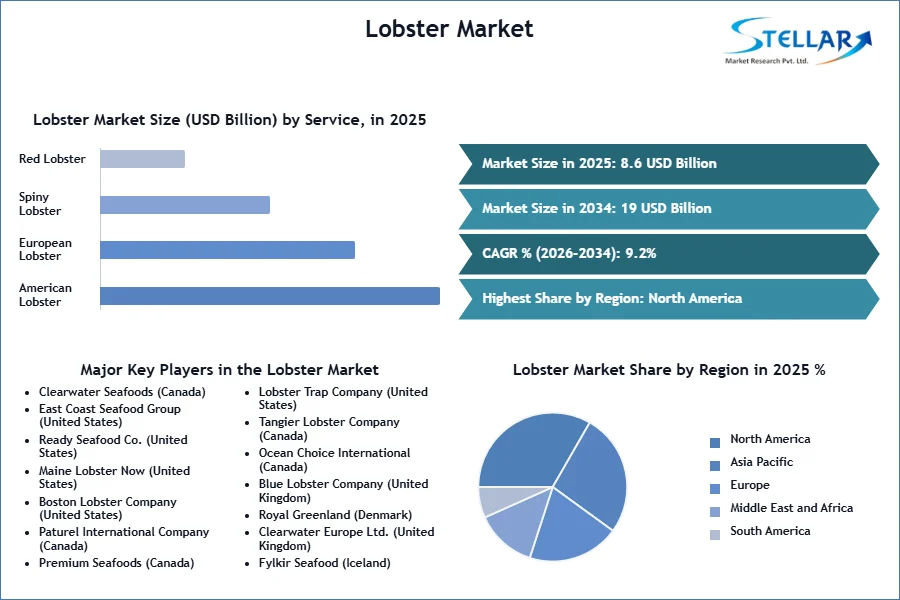
The global Lobster Market is experiencing strong momentum as consumers increasingly seek premium seafood products, restaurants expand luxury dining offerings, and international trade networks become more efficient. According to Stellar Market Research, the market was valued at USD 8.6 billion in 2025 and is projected to reach nearly USD 19 billion by 2034, growing at a CAGR of 9.2% during the forecast period. Rising disposable incomes, expanding cold-chain logistics, and growing demand from Asia-Pacific are transforming the lobster industry into one of the fastest-growing segments of the premium seafood market.
Understanding the Lobster Market
Lobster is one of the world’s most valuable seafood products and is widely regarded as a luxury food item. The market includes live whole lobsters, lobster tails, and processed lobster meat that serve restaurants, hotels, retailers, and foodservice providers worldwide.
Major producing countries such as the United States, Canada, Australia, and several Caribbean nations dominate global supply, while demand continues to rise in North America, Europe, and emerging Asian economies. Improvements in refrigerated transportation and online seafood retail have also made premium lobster products more accessible to consumers across global markets.
𝐃𝐨𝐰𝐧𝐥𝐨𝐚𝐝 𝐅𝐫𝐞𝐞 𝐏𝐃𝐅 𝐁𝐫𝐨𝐜𝐡𝐮𝐫𝐞: https://www.stellarmr.com/report/req_sample/lobster-market/2814
Key Factors Driving Market Growth
Rising Demand for Premium Seafood
Consumers are increasingly willing to spend on high-quality seafood as incomes rise and dining preferences evolve. Lobster has become a preferred choice for celebrations, luxury restaurants, and gourmet meals, particularly in countries such as the United States, Canada, China, Japan, and several European nations.
The hospitality sector continues to account for a significant share of lobster consumption, while premium retail products and ready-to-cook seafood options are expanding rapidly. This growing appetite for luxury seafood remains one of the strongest drivers supporting long-term market growth.
Expansion of International Seafood Trade
Global seafood exports have become increasingly sophisticated through investments in cold-chain logistics, air freight, and digital supply chain management. These improvements allow suppliers to transport live and frozen lobsters across continents while maintaining freshness and product quality.
Export-oriented economies such as Canada and Australia continue strengthening their global market presence by supplying premium lobster products to North America, Europe, and Asia-Pacific. Enhanced logistics capabilities are reducing transit times and expanding access to previously underserved markets.
Growth of E-commerce and Premium Retail
Online seafood retailers are transforming consumer purchasing behavior by offering home delivery of fresh and frozen lobster. Digital platforms provide wider product selection, transparent pricing, and convenient ordering, making premium seafood accessible beyond traditional restaurants and fish markets.
The popularity of ready-to-cook lobster products is also increasing among urban consumers seeking restaurant-quality meals at home, further supporting retail sales worldwide.
Market Segmentation
The Lobster Market is segmented by type, species, distribution channel, and geography.
By Type
Whole Lobster (Live Lobster)
Lobster Tail
Lobster Meat
The whole lobster segment dominated the market in 2025, accounting for approximately 68% of global revenue. Live lobsters remain highly valued due to their freshness, premium quality, and strong demand in fine dining establishments despite the complexities of transportation and storage.
By Species
The market includes:
American Lobster
European Lobster
Spiny Lobster
Red Lobster
Among these, the American lobster continues to lead global production and exports. Fisheries in the United States and Canada supply a substantial portion of worldwide demand, supported by well-established sustainability practices and strong international trade relationships.
By Distribution Channel
The market serves customers through:
Foodservice
Retail
While restaurants remain the largest distribution channel, retail sales continue to grow rapidly due to increasing consumer preference for premium frozen seafood and home cooking.
Regional Market Outlook
North America
North America remains the largest regional market, contributing nearly 47% of global revenue in 2025. The region benefits from abundant lobster resources, established fisheries, advanced seafood processing infrastructure, and strong domestic consumption.
Maine remains one of the world’s most important lobster-producing regions, while Canada’s seafood industry continues to play a critical role in global exports.
Europe
Europe maintains steady demand for lobster through luxury restaurants, premium seafood retailers, and hospitality services. Countries such as France, Spain, Italy, and the United Kingdom continue importing high-quality lobster products to meet growing consumer demand.
Sustainability certifications and traceability standards have become increasingly important purchasing factors across European markets.
Asia-Pacific
Asia-Pacific is expected to witness the fastest growth during the forecast period. Rising disposable incomes, expanding middle-class populations, and changing dietary preferences are increasing lobster consumption throughout China, Japan, South Korea, India, and Southeast Asia.
China remains one of the most promising growth markets due to strong demand for premium seafood during festivals, celebrations, and hospitality events. Improved cold-chain logistics and e-commerce platforms are further supporting regional expansion.
Challenges Affecting the Lobster Industry
Despite its positive outlook, the Lobster Market faces several operational and environmental challenges.
Climate Change
Ocean warming has become one of the industry’s biggest concerns. Rising sea temperatures affect lobster migration, reproduction, molting cycles, and habitat distribution. Traditional fishing areas, particularly in the Gulf of Maine, have experienced declining harvest volumes as lobster populations shift toward colder waters.
Price Volatility
Lobster prices fluctuate considerably due to weather conditions, seasonal harvesting patterns, geopolitical developments, tariffs, and international trade policies. Export restrictions and changing import regulations can significantly impact both producers and buyers, creating uncertainty throughout the supply chain.
Sustainability Concerns
Maintaining healthy lobster populations requires responsible fisheries management, sustainable harvesting practices, and strict environmental regulations. Governments and seafood companies continue investing in traceability systems, certification programs, and conservation initiatives to ensure long-term resource availability.
Competitive Landscape
Competition within the Lobster Market is centered on product quality, sustainable sourcing, processing capabilities, export networks, and supply chain efficiency.
Leading companies continue investing in advanced seafood processing facilities, logistics infrastructure, and international distribution channels to strengthen their market positions.
Major industry participants include:
Clearwater Seafoods
East Coast Seafood Group
Ready Seafood Company
Boston Lobster
High Liner Foods
Thai Union Manufacturing
Tangier Lobster
Supreme Lobster
Strategic partnerships, acquisitions, and investments in cold-chain infrastructure remain key competitive strategies across the industry.
𝐃𝐨𝐰𝐧𝐥𝐨𝐚𝐝 𝐅𝐫𝐞𝐞 𝐏𝐃𝐅 𝐁𝐫𝐨𝐜𝐡𝐮𝐫𝐞: https://www.stellarmr.com/report/req_sample/lobster-market/2814
Future Outlook
The global Lobster Market is expected to maintain robust growth through 2034 as demand for premium seafood continues expanding across developed and emerging economies. Rising consumer spending on luxury foods, improvements in seafood logistics, and increasing online retail penetration will create new opportunities for producers and distributors worldwide.
At the same time, sustainability will become a defining factor for future market success. Companies investing in responsible fishing practices, traceable supply chains, environmentally friendly packaging, and climate-resilient seafood management will be better positioned to meet evolving consumer expectations and regulatory requirements.
As premium dining, international seafood trade, and digital food retail continue to expand, the Lobster Market is set to remain one of the most attractive segments within the global seafood industry, offering significant growth opportunities for producers, exporters, retailers, and investors alike.
Media Contact
Stellar Market Research
Website: Stellar Market Research – Global Research Reports & Consulting
Email: sales@stellarmr.com
