Key Highlights
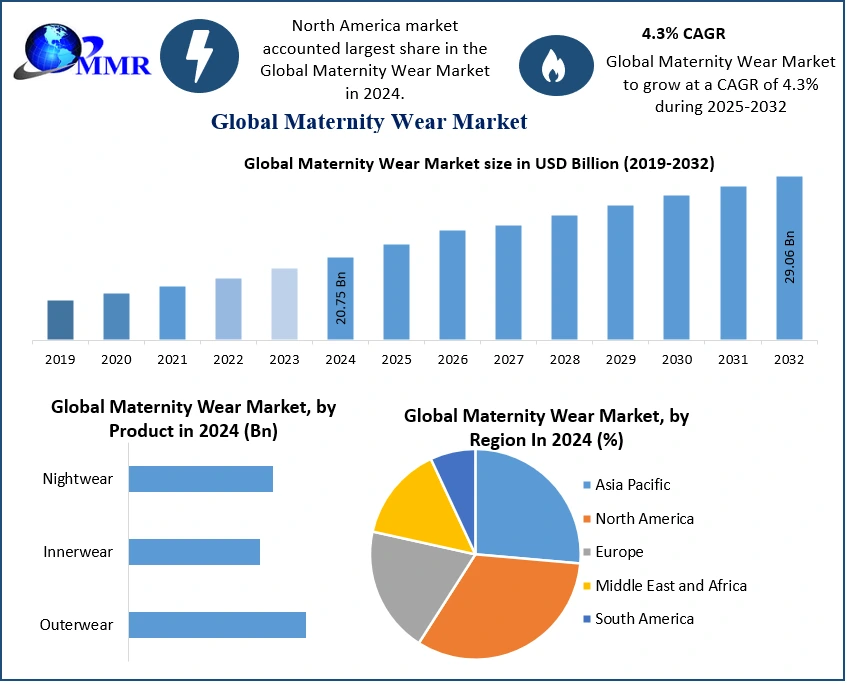
- The Maternity Wear Market was valued at USD 20.75 Billion in 2024.
- The market is expected to reach USD 29.06 Billion by 2032, expanding at a CAGR of 4.3% during 2025–2032.
- Rising awareness of maternal comfort and changing fashion expectations continue to expand demand.
- Digital commerce is transforming product discovery and brand competition.
- Sustainability and premium product positioning are becoming important competitive differentiators.
- Innovation in fabrics, fit, and multifunctional apparel is reshaping purchasing decisions.
Why This Matters Now
Pregnancy apparel has moved beyond being a niche category. Consumers increasingly expect maternity clothing to combine comfort, style, and functionality without compromising fashion standards. That shift is forcing apparel brands to rethink product development, inventory planning, and omnichannel retail strategies.
The Maternity Wear Market, valued at USD 20.75 Billion in 2024, is forecast to reach USD 29.06 Billion by 2032, growing at a 4.3% CAGR. For manufacturers and retailers, that growth signals an opportunity to build higher-margin product portfolios while expanding direct-to-consumer channels and strengthening customer loyalty throughout motherhood.
Market Overview
The maternity apparel industry is undergoing structural transformation. Consumers are purchasing maternity clothing earlier in pregnancy, expanding wardrobe choices, and demanding products suitable for work, casual wear, exercise, and postpartum recovery.
Rather than treating maternity clothing as temporary apparel, brands increasingly position collections as lifestyle products with extended usability. This approach supports premium pricing while improving customer retention beyond pregnancy.
Digital retail has accelerated market accessibility, allowing specialized brands to compete alongside established apparel companies. Online platforms also enable broader product selection, personalized recommendations, and efficient inventory management.
Meanwhile, improvements in fabric technology are helping manufacturers deliver clothing that balances stretch, durability, breathability, and long-term comfort.
Key Trends Driving Growth
Consumer expectations continue to redefine maternity fashion. Modern buyers seek apparel that combines contemporary design with functional performance, encouraging brands to invest in versatile product collections.
Health and wellness trends are also influencing purchasing behavior. Comfortable fabrics, skin-friendly materials, and products designed for changing body shapes are becoming central to product development strategies.
E-commerce continues to reshape competitive dynamics. Digital platforms simplify comparison shopping, expand geographic reach, and reduce barriers for emerging brands entering the market.
Sustainability is becoming an increasingly important purchasing factor. Companies investing in environmentally responsible materials, responsible sourcing, and longer-lasting garments are strengthening brand differentiation in an increasingly competitive marketplace.
Premiumization represents another significant trend. Consumers are increasingly willing to invest in higher-quality maternity apparel that delivers improved comfort, durability, and multifunctionality across pregnancy and postpartum periods.
Segment Insights
Dominant Segment:
The leading segment continues to benefit from broad consumer demand and established purchasing behavior, supporting consistent revenue generation across major retail channels.
Fastest-Growing Segment
Rapid expansion reflects changing consumer preferences, wider product availability, and increasing adoption through both physical and digital retail networks.
Regional Growth Story
Regional growth patterns demonstrate how demographic trends, disposable income, and retail infrastructure influence maternity apparel demand.
Developed markets continue emphasizing premium products, fashion-oriented collections, and sustainability initiatives. Consumers increasingly prioritize quality, comfort, and versatile designs suitable for multiple stages of motherhood.
Emerging economies offer significant long-term opportunities as urbanization, rising middle-class populations, and expanding organized retail increase consumer access to specialized maternity apparel.
Digital commerce is reducing geographic limitations by enabling brands to reach customers beyond traditional retail locations. As logistics networks improve, online-first maternity brands are positioned to expand market share more rapidly.
Competitive Landscape
Competition is shifting from price alone toward product differentiation and customer experience. Brands increasingly compete through innovative fabric technologies, inclusive sizing, fashion-forward collections, and seamless omnichannel shopping experiences.
Companies investing in digital platforms are improving customer acquisition while generating valuable consumer insights for product planning. Personalized recommendations, virtual sizing tools, and direct-to-consumer strategies are becoming competitive advantages rather than optional capabilities.
Sustainability initiatives also carry strategic significance. Businesses incorporating responsible materials and transparent sourcing strengthen brand credibility while preparing for evolving consumer expectations and regulatory scrutiny.
For competitors, these developments signal that future leadership will depend less on product volume and more on brand trust, digital engagement, and continuous product innovation. Over the next 12–24 months, companies unable to modernize their digital retail capabilities or diversify product portfolios risk losing market share to more agile fashion brands.
Recent Developments
- Increased investment in digital retail channels to strengthen direct consumer engagement.
- Greater focus on sustainable materials and environmentally responsible manufacturing.
- Expansion of multifunctional maternity collections designed for pregnancy and postpartum use.
- Continued innovation in fabric technology to improve comfort, flexibility, and durability.
- Broader product offerings addressing diverse consumer preferences across multiple price segments.
Strategic Implications
For apparel manufacturers, maternity wear is becoming a strategic growth category rather than a seasonal product line. Success increasingly depends on integrating fashion, functionality, and sustainability into product development.
Retailers should strengthen omnichannel strategies that combine online convenience with personalized shopping experiences. Better digital engagement improves customer acquisition while creating opportunities for cross-selling related maternal and infant products.
Investors should monitor companies expanding premium product portfolios, strengthening e-commerce capabilities, and investing in sustainable manufacturing practices. These capabilities are becoming increasingly important competitive assets as consumer expectations continue evolving.
Supply chains will also require greater flexibility. Faster product development cycles, responsive inventory management, and data-driven demand forecasting will help brands remain competitive in a market influenced by rapidly changing fashion trends.
Future Outlook
The Maternity Wear Market, valued at USD 20.75 Billion in 2024, is projected to reach USD 29.06 Billion by 2032, expanding at a CAGR of 4.3%. That trajectory highlights sustained demand supported by changing consumer lifestyles, digital retail expansion, and continued product innovation.
Companies capable of combining sustainability, premium product design, and digital customer engagement will be positioned to outperform. Those relying on traditional retail models and undifferentiated product offerings will face increasing competitive pressure as the market becomes more innovation-driven.
In the next decade, winners will redefine maternity fashion as a long-term lifestyle category, while laggards will remain trapped competing on price alone.
Analyst Perspective
“The maternity apparel industry is entering a new phase where product innovation, digital accessibility, and evolving consumer expectations are becoming equally important as market expansion. Companies that successfully integrate comfort, sustainability, and fashion into scalable business models will be best positioned to capture future growth.” — Siddhi Dole, Analyst, Maximize Market Research
About Maximize Market Research
Maximize Market Research Pvt. Ltd. (MMR) is a global market research and consulting company that provides reliable, data-focused, and practical business insights. The firm serves a wide range of industries, including healthcare, pharmaceuticals, technology, automotive, electronics, chemicals, personal care, and consumer goods. Through market forecasts, competitive analysis, strategic consulting, and industry impact assessments, MMR helps organizations understand changing market conditions, identify growth opportunities, and make informed business decisions for long-term success.
2nd Floor, Navale IT Park Phase 3
Pune Banglore Highway, Narhe
Pune, Maharashtra 411041, India
+91 9607365656
sales@maximizemarketresearch.com
