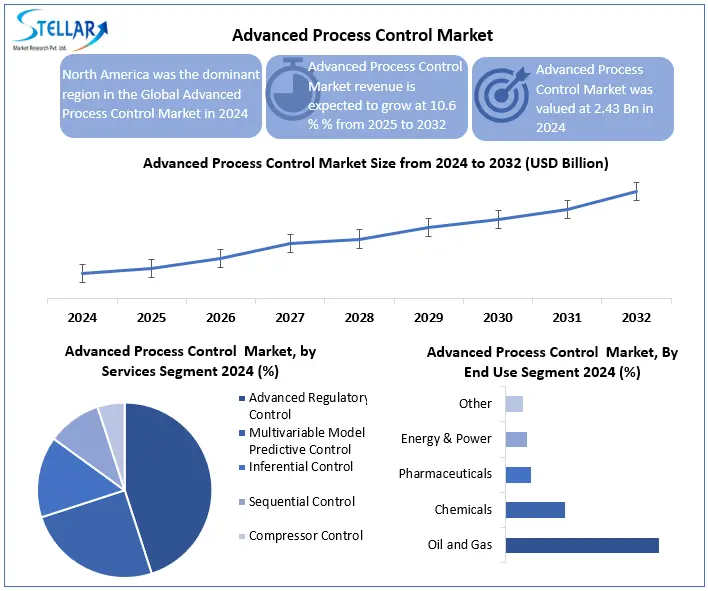
The global Advanced Process Control (APC) Market is experiencing rapid growth as industries increasingly adopt intelligent automation solutions to improve operational efficiency, reduce production costs, and achieve sustainability goals. As manufacturers embrace digital transformation and Industry 4.0 technologies, advanced process control systems have become essential for optimizing complex industrial operations. According to Stellar Market Research, the Advanced Process Control Market was valued at USD 2.43 billion in 2024 and is projected to reach nearly USD 5.44 billion by 2032, growing at a CAGR of 10.6% during the forecast period. The integration of artificial intelligence (AI), Industrial Internet of Things (IIoT), predictive analytics, and cloud computing is accelerating the adoption of APC solutions across industries worldwide.
Understanding the Advanced Process Control Market
Advanced Process Control refers to a combination of software, algorithms, and control strategies that optimize industrial processes beyond traditional automation systems. APC solutions continuously analyze real-time production data, predict operational changes, and automatically adjust process variables to maximize efficiency, product quality, and equipment performance.
Unlike conventional control systems that react to process changes, APC solutions use predictive models to anticipate operational conditions before they occur. This proactive approach minimizes process variability, reduces energy consumption, improves product consistency, and increases plant profitability.
Industries including oil and gas, chemicals, pharmaceuticals, power generation, food and beverage, mining, and pulp and paper are increasingly deploying APC technologies to improve productivity while meeting stringent environmental and regulatory requirements.
𝐃𝐨𝐰𝐧𝐥𝐨𝐚𝐝 𝐅𝐫𝐞𝐞 𝐏𝐃𝐅 𝐁𝐫𝐨𝐜𝐡𝐮𝐫𝐞: https://www.stellarmr.com/report/req_sample/advanced-process-control-market/2822
Key Factors Driving Market Growth
Rapid Industrial Automation
The growing adoption of industrial automation is one of the strongest drivers of the Advanced Process Control Market. Manufacturers are investing heavily in smart factories that combine automation, robotics, AI, and connected devices to improve operational efficiency.
Advanced Process Control plays a central role in these digital manufacturing environments by optimizing production processes, reducing equipment downtime, and improving overall plant performance. As industries seek greater operational resilience and cost efficiency, APC adoption continues to accelerate.
Integration of Artificial Intelligence and IIoT
Artificial intelligence and Industrial Internet of Things technologies are transforming process control capabilities.
Modern APC systems collect large volumes of real-time sensor data from connected equipment and use machine learning algorithms to predict equipment failures, optimize production parameters, and recommend corrective actions before disruptions occur.
AI-driven predictive control enables manufacturers to reduce waste, improve product quality, minimize energy consumption, and enhance asset utilization while supporting continuous process improvement.
Increasing Focus on Sustainability
Industries worldwide face growing pressure to reduce emissions, improve energy efficiency, and comply with stricter environmental regulations.
Advanced Process Control systems help organizations achieve sustainability objectives by optimizing fuel consumption, reducing greenhouse gas emissions, minimizing raw material waste, and improving overall resource utilization.
These environmental benefits make APC an attractive investment for companies pursuing long-term sustainability strategies.
Market Segmentation
The Advanced Process Control Market is segmented based on component, technology, end-use industry, and region.
By Component
The market includes:
Software
Hardware
Services
Software accounts for the largest market share because advanced algorithms, predictive analytics, and real-time optimization platforms form the foundation of modern APC systems.
By Technology
Major technologies include:
Model Predictive Control (MPC)
Advanced Regulatory Control
Inferential Control
Sequential Control
Real-Time Optimization
Among these, Model Predictive Control (MPC) remains the most widely adopted technology due to its ability to manage multiple process variables simultaneously while maintaining optimal operating conditions.
By End-use Industry
Major industries adopting APC include:
Oil and Gas
Chemicals
Power Generation
Pharmaceuticals
Food and Beverage
Pulp and Paper
Mining
Metals and Manufacturing
The oil and gas sector continues to represent one of the largest application areas because of its complex production environments, stringent safety requirements, and continuous process optimization needs.
Technology Innovation Is Reshaping Industrial Operations
Technological innovation is significantly expanding the capabilities of Advanced Process Control systems.
Artificial intelligence enables APC platforms to learn from historical production data and continuously improve operational decisions. Machine learning algorithms identify hidden process relationships that traditional control systems cannot detect, allowing manufacturers to maximize production efficiency.
Cloud computing is making APC solutions more scalable by enabling centralized monitoring of multiple manufacturing facilities. Cloud-based platforms provide engineers with real-time visibility into production performance regardless of plant location.
Digital twins are becoming another important innovation. These virtual models simulate industrial processes, allowing operators to test process changes, predict equipment behavior, and optimize production without interrupting actual operations.
Industrial cybersecurity is also receiving increased attention as connected manufacturing systems become more common. APC vendors continue strengthening cybersecurity capabilities to protect critical industrial infrastructure from cyber threats.
Regional Market Outlook
North America
North America remains the largest Advanced Process Control Market due to widespread adoption of industrial automation, significant investments in digital manufacturing, and the presence of leading automation technology providers.
Manufacturers across the United States and Canada continue implementing AI-powered process optimization solutions to improve competitiveness while meeting sustainability goals.
Europe
Europe continues to experience strong market growth driven by Industry 4.0 initiatives, energy efficiency programs, and strict environmental regulations. Countries including Germany, France, and the United Kingdom are investing heavily in intelligent manufacturing technologies that improve industrial productivity.
Asia-Pacific
Asia-Pacific is expected to witness the fastest growth during the forecast period. Rapid industrialization, expanding manufacturing capacity, and government initiatives supporting smart factories are driving APC adoption across China, India, Japan, and South Korea.
Growing investments in chemical processing, electronics manufacturing, pharmaceuticals, and energy infrastructure continue creating significant opportunities throughout the region.
Challenges Facing the Market
Despite its promising outlook, the Advanced Process Control Market faces several challenges.
High implementation costs remain a significant barrier, particularly for small and medium-sized manufacturers. Integrating APC solutions into existing production systems often requires substantial investment in software, sensors, control infrastructure, and employee training.
Many industrial facilities also operate legacy equipment that may not easily integrate with modern digital control platforms.
Another important challenge is the shortage of professionals with expertise in process engineering, industrial automation, and data analytics. Successful APC implementation requires specialized technical knowledge that remains in limited supply across many industries.
Cybersecurity risks associated with connected manufacturing environments also require continuous investment in secure industrial networks and monitoring systems.
Competitive Landscape
The Advanced Process Control Market remains highly competitive, with leading automation companies focusing on artificial intelligence, cloud-based control systems, industrial analytics, and strategic acquisitions.
Major companies operating in the market include:
ABB
Honeywell International
Siemens
Emerson Electric
Schneider Electric
Yokogawa Electric Corporation
Rockwell Automation
AspenTech
Mitsubishi Electric
General Electric
These companies continue investing in AI-enabled automation platforms, predictive analytics, Industrial IoT integration, and digital twin technologies to strengthen their market positions while supporting customers’ digital transformation initiatives.
𝐃𝐨𝐰𝐧𝐥𝐨𝐚𝐝 𝐅𝐫𝐞𝐞 𝐏𝐃𝐅 𝐁𝐫𝐨𝐜𝐡𝐮𝐫𝐞: https://www.stellarmr.com/report/req_sample/advanced-process-control-market/2822
Future Outlook
The future of the Advanced Process Control Market is closely linked to the continued evolution of smart manufacturing and Industry 4.0. As industries increasingly adopt artificial intelligence, cloud computing, predictive analytics, and Industrial IoT technologies, APC systems will become even more intelligent, autonomous, and data-driven.
Growing emphasis on operational efficiency, energy optimization, carbon reduction, and predictive maintenance will continue driving investment across manufacturing industries. Companies that successfully integrate AI-powered process control with digital manufacturing platforms will gain significant competitive advantages through higher productivity, improved product quality, and lower operating costs.
With continuous innovation in automation technologies and expanding industrial digitalization worldwide, the Advanced Process Control Market is well positioned for sustained growth through 2032, helping manufacturers build smarter, safer, and more sustainable production environments.
Media Contact
Stellar Market Research
Website: Stellar Market Research – Global Research Reports & Consulting
Email: sales@stellarmr.com
