Key Highlights
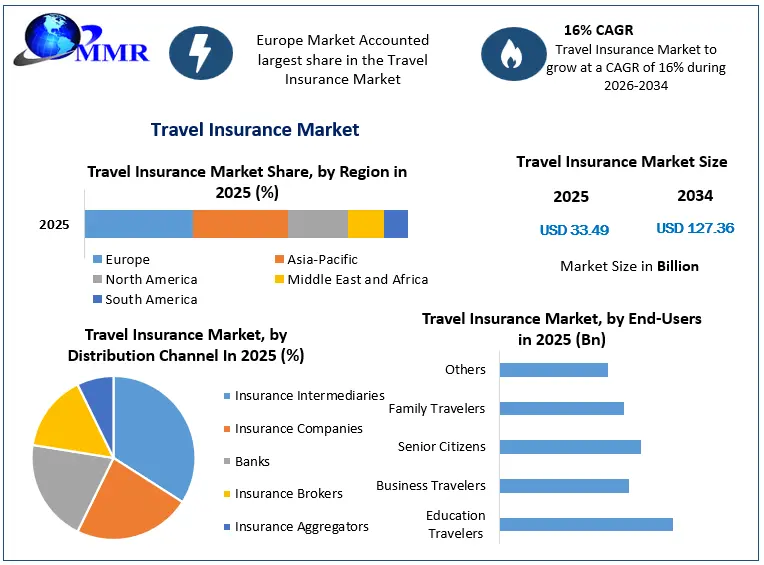
Market Valuation: USD 33.49 billion in 2025, projected to reach USD 127.36 billion by 2034.
Growth Rate: The industry is advancing at a CAGR of 16% through the 2026–2034 forecast period.
Dominant Segment (Insurance Type): Single-trip travel insurance, commanding a 60.1% market share.
Fastest-Growing Segment: Single-trip travel insurance, projected to maintain its leading CAGR of 16%.
Primary Drivers: Increased global tourism, mandatory visa-linked insurance requirements, and rising consumer demand for protection against trip cancellations and medical emergencies.
Why This Matters Now
The travel insurance industry has transitioned from an optional “add-on” to a non-negotiable component of global mobility. With the market set to quadruple in value to over USD 127 billion by 2034, C-suite executives who view insurance as a back-office function are failing to capitalize on a primary consumer touchpoint. The volatility of the post-pandemic era has permanently altered risk perception, creating a high-margin opportunity for insurers who can offer seamless, digital-first protection.
Market Overview
The Valued at USD 33.49 billion in 2025, The Global Travel Insurance Market is currently enjoying a structural tailwind. Governments and regulatory bodies now frequently mandate coverage for visa approvals, while consumers—having weathered the uncertainty of recent years—actively seek mitigation for flight cancellations, luggage loss, and medical emergencies. This is no longer a reactive market; it is a proactive enabler of the multi-billion-dollar global tourism and corporate travel economy.
Key Trends Driving Growth
Visa-Linked Mandates: Stringent government requirements for international travel insurance have created a baseline of guaranteed demand, effectively de-risking the market for providers.
Digital Integration: The shift toward API-led distribution means insurance is increasingly embedded directly into travel booking platforms, airlines, and hospitality apps, capturing the consumer at the point of intent.
Post-Pandemic Risk Awareness: The memory of global health disruptions has driven a permanent increase in medical coverage adoption, with travelers prioritizing policies that include testing, quarantine, and emergency evacuation coverage.
Get a free sample
Segment Insights
Dominant Segment (Insurance Type): Single-Trip Travel Insurance. Accounting for 60.1% of the market, this segment leads because it provides the flexible, “pay-as-you-go” protection required by the vast majority of leisure and business travelers.
Fastest-Growing Segment: Single-Trip Travel Insurance. The segment is not just dominant in size but also in velocity, projected to grow at the fastest CAGR of 16%, driven by the rising frequency of international leisure trips.
Dominant Channel (Distribution): Insurance Companies. In-house distribution via insurance firms holds 34.8% of the revenue share, though the ecosystem is rapidly evolving toward digital aggregators and brokers.
Regional Growth Story
North America and Europe remain the primary revenue centers, benefiting from high disposable income and established regulatory frameworks. However, the Asia-Pacific region is emerging as a critical growth frontier. Rising middle-class incomes, coupled with aggressive tourism promotion by local governments, are expanding the total addressable market. Regional insurers are responding by integrating advanced technologies—including AI-driven underwriting, GPS-based risk tracking, and real-time data analytics—to boost productivity and claims processing speed.
Competitive Landscape
The market is characterized by institutional heavyweights such as American International Group (AIG), Zurich, and Assicurazioni Generali. These firms hold the scale required for massive risk pooling, but they are currently facing disintermediation from agile, tech-native competitors. The next 24 months will likely see a wave of “platform integration” where traditional insurers either acquire or partner with fintech platforms to secure their position in the digital booking flow. Rivals who stick to traditional agent-based distribution will likely see their margins eroded by platforms that offer lower friction and faster, app-based claims processing.
Recent Developments
Tech-Driven Underwriting: Insurers are integrating geolocation and real-time data analytics to refine risk assessment, enabling more competitive and accurate policy pricing.
COVID-19 Resilience: Vendors have successfully pivoted their product portfolios to include specific clauses for pandemic-related disruptions, such as mandatory testing and quarantine expenses.
Distribution Modernization: A shift toward API-driven platforms allows insurance brokers and travel agency partners to embed coverage directly into booking journeys, significantly reducing the “drop-off” rate during checkout.
Strategic Implications
The travel insurance market is currently constrained by a paradox: high demand vs. legacy tech adoption. Insurers who possess the financial resources to integrate AI and real-time data analytics into their platforms are positioning themselves to capture the lion’s share of the projected USD 127 billion market. Those failing to automate their claims and distribution channels will face structural obsolescence as consumers move toward platforms that prioritize self-service and speed.
Future Outlook
Market winners will be the organizations that successfully leverage AI and API-native distribution to make insurance an “invisible” part of the travel experience, while losers will be those chained to manual, high-friction legacy systems that no longer align with modern consumer expectations.
Analyst Perspective
“The travel insurance industry has evolved into a foundational pillar of global mobility. Companies that successfully bridge the gap between complex risk management and seamless, digital-first consumer experiences will define the next decade of travel protection.” — Siddhi Dole, Analyst, Maximize Market Research
About Maximize Market Research
Maximize Market Research Pvt. Ltd. (MMR) is a global market research and consulting company that provides reliable, data-focused, and practical business insights. The firm serves a wide range of industries, including healthcare, pharmaceuticals, technology, automotive, electronics, chemicals, personal care, and consumer goods. Through market forecasts, competitive analysis, strategic consulting, and industry impact assessments, MMR helps organizations understand changing market conditions, identify growth opportunities, and make informed business decisions for long-term success.
2nd Floor, Navale IT Park Phase 3
Pune Banglore Highway, Narhe
Pune, Maharashtra 411041, India
+91 9607365656
sales@maximizemarketresearch.com
