Key Highlights
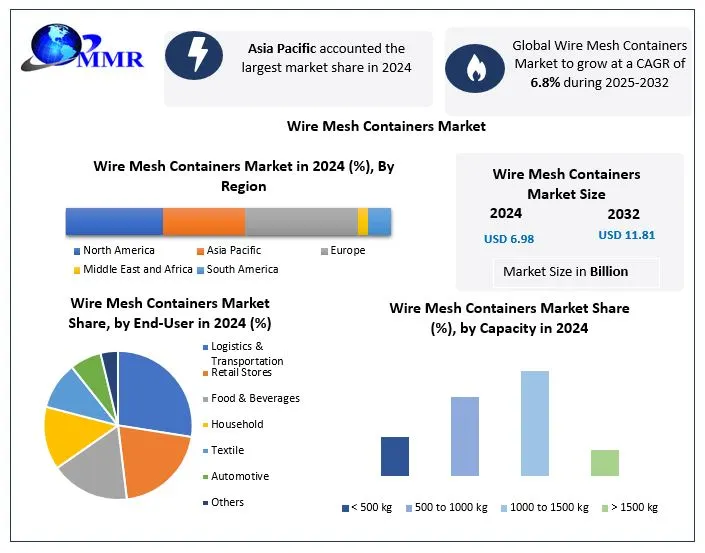
Market valuation stood at USD 6.98 billion in 2024 and is projected to reach USD 11.81 billion by 2032, expanding by a compound annual growth rate (CAGR) of 6.8% over the 2025–2032 forecast window.
Heavy-duty industrial mesh configurations represent the dominant product type, commanding primary volume allocations across manufacturing facilities to maximize vertical storage stacking density.
Collapsible and folding structural architectures constitute the fastest-growing design segment due to immediate freight-cost reductions during empty distribution legs.
E-commerce logistics hubs, automated retail warehouses, and automotive supply chains stand as the primary applications driving large-scale container procurement.
Rising international raw steel prices and strict localized environmental zinc-plating guidelines represent primary structural constraints limiting rapid capital margin expansion.
Why This Matters Now
Supply chain executives and retail logistics managers face immediate capacity bottlenecks if they fail to align material handling footprints with expanding automated sortation networks. Operations directors who ignore the structural migration toward stackable, open-mesh storage assets risk critical workflow friction as old wood or plastic pallets crack under high-velocity fulfillment pressure. This operational transformation redefines basic material handling margins, turning simple metal cages into a core variable for warehouse throughput and warehouse capital optimization.
Market Overview
The global wire mesh containers market is undergoing a calculated infrastructure expansion, growing from an established baseline valuation of USD 6.98 billion in 2024 to a projected revenue target of USD 11.81 billion by 2032. This performance trajectory reflects a steady growth pattern of 6.8% across the designated eight-year forecast window. The historical industrial tracking data from 2019 through 2024 confirms a structural demand baseline for durable material handling units worldwide.
This financial expansion demonstrates that corporate capital is migrating rapidly toward equipment setups that maximize square footage while reducing transit damage risks. Contemporary welding and processing facilities are focusing engineering investments on automated robotic mesh wire alignment, heavy-duty base channel stamping, and high-durability electro-zinc plating to supply rugged substrates directly to bulk distribution networks.
Key Trends Driving Growth
The massive expansion of omnichannel retail, high-velocity distribution centers, and regional automotive assembly zones is forcing a comprehensive restructuring of storage asset purchasing. The primary growth driver remains the rising global requirement for visible, self-cleaning, and fire-resistant storage bins that integrate seamlessly into automated overhead sprinkler fields and robotic retrieval paths. This structural requirement ensures a stable, recurring revenue stream for material processing portfolios capable of supplying standardized steel wire bins directly to national distribution platforms.
Concurrently, systemic focus on lowering operational waste is opening up direct deployment opportunities for collapsible hardware configurations. Standard rigid industrial containers incur massive financial penalties during return freight movements because they occupy fixed cubic volume regardless of internal product weight. Transforming inventory assets into folding wire structures allows fleet managers to load more empty units per standard tractor-trailer, directly lowering transport spending across reverse logistics networks.
Segment Insights
Dominant Structural Type: Heavy-duty rigid mesh containers command the largest share of total manufacturing volume. This clear leadership proves that industrial managers prefer robust, non-yielding steel wire walls to securely support structural stacking tiers without experiencing physical buckling under full payload limits.
Fastest-Growing Product Segment: Collapsible wire mesh containers represent the fastest-growing segment within the configuration matrix, catalyzed by corporate demands to optimize return-freight volumes and reduce empty storage space on warehouse floors.
Primary Application Segment: E-commerce warehouse and automated fulfillment hubs lead the current consumption matrices due to intense daily throughput sorting patterns that require open-mesh product visibility.
Alternative Design Configurations: The broader market maintains structured alignment across specialized custom accessories, including custom drop-gates, specialized heavy-duty caster attachments, crane-lifting lug fixtures, and custom divided storage gates.
Regional Growth Story
The North American regional marketplace held the absolute highest market share in 2024, anchoring the global monetization of automated industrial logistics assets. The region benefits from a highly dense concentration of advanced e-commerce distribution centers, mega-scale retail sorting points, and mature automotive supply hubs across the United States. This structural depth provides the immediate transaction volume required for tier-one manufacturers to sustain automated fabrication lines and meet rigorous safety guidelines.
Concurrently, international market structures across Europe, Asia Pacific, and developing economic trade zones are generating distinct demand profiles. The Asia Pacific marketplace exhibits notable acceleration driven by rapid manufacturing expansion, ascending supply chain modernization, and massive corporate investments in regional trade corridors. This local industrial transition fuels high utilization rates at domestic production sites, driving both local inventory fulfillment and bulk contract exports to Western logistics managers.
Competitive Landscape
The global manufacturing landscape includes prominent material handling corporations and specialized steel fabricators such as Pallet 360, WireCrafters, Net-Fencing, Worldwide Material Handling, Nashville Wire Products, and Cee Kay Supply. This highly specialized arena operates under intense structural demands, where steel gauge thickness, weld shear strength, and anti-corrosion layer depth decide market share retention. Low-tier generic foundries face extreme margin compression as base raw metal prices ascend, allowing capital-rich market leaders to capture high-margin channels via large-scale material contracts and advanced automated robotic welding lines.
To defend their corporate positions, established market players are executing aggressive product line additions and direct integration agreements with global third-party logistics firms. These corporate strategic maneuvers indicate that the next 12 to 24 months will bring portfolio changes, with dominant industrial supply brands acquiring specialized zinc-plating facilities or regional wire drawing operations to secure supply chains against raw material price shocks. Rivals must prepare for a marketplace where basic mechanical storage cages are increasingly judged on their long-term recyclability metrics and asset tracking software compatibility.
Recent Developments
Tier-one industrial container fabricators expanded automated production facilities to manufacture high-capacity collapsible mesh bins, reducing shipping costs for logistics providers.
Material engineering teams updated automated zinc-plating and powder-coating systems, extending the field lifecycle of steel mesh units under humid cold-chain warehouse environments.
Sourcing managers secured direct multi-year steel supply paths to hedge against global metal pricing shifts, ensuring price stability for high-volume warehouse upgrade contracts.
Strategic Implications
Procurement directors and supply chain leads must immediately shift their equipment-sourcing roadmaps to favor standardized collapsible wire containers over aging wooden pallets or rigid plastic bins. Relying on fixed-volume non-collapsible assets introduces severe cost inflation into reverse logistics patterns when empty asset re-positioning consumes high transport budgets. Furthermore, inventory management teams must integrate visible wire-mesh designs to maintain high internal auditing speeds and fulfill local fire-safety compliance regulations.
Product development groups must focus on optimizing corner-post load limits and interlocking foot designs without adding excessive weight to the steel framework. High base material expenses mean fabricators must eliminate excess metal weight while preserving high load-bearing ratings during multi-tier storage stacking. Sourcing operations that fail to incorporate automated robotic resistance welding and certified weight-load validation will find themselves excluded from major corporate multi-site contract options.
Future Outlook
The market will separate into highly profitable material handling brands that control automated robotic fabrication lines and eco-certified collapsible container portfolios, and low-tier rigid container fabricators whose margins will be crushed by rising international reverse-logistics freight costs and raw steel price volatility.
Analyst Perspective
“The rapid operational shift across the global wire mesh containers market reflects a permanent transition toward warehouse footprint optimization, automated visibility, and reverse-logistics cost management,” states Rucha Deshpande, Research Analyst. “As e-commerce fulfillment and automated material distribution channels expand internationally, those material handling enterprises that successfully pair automated high-capacity collapsible container production with traceable steel supply lines will secure dominant market shares across both mature Western logistics networks and the fast-accelerating Asia Pacific industrial corridors.”
About Maximize Market Research
Maximize Market Research Pvt. Ltd. (MMR) is a global market research and consulting company that provides reliable, data-focused, and practical business insights. The firm serves a wide range of industries, including healthcare, pharmaceuticals, technology, automotive, electronics, chemicals, personal care, and consumer goods. Through market forecasts, competitive analysis, strategic consulting, and industry impact assessments, MMR helps organizations understand changing market conditions, identify growth opportunities, and make informed business decisions for long-term success.
2nd Floor, Navale IT Park Phase 3
Pune Banglore Highway, Narhe
Pune, Maharashtra 411041, India
+91 9607365656
sales@maximizemarketresearch.com
