Key Highlights
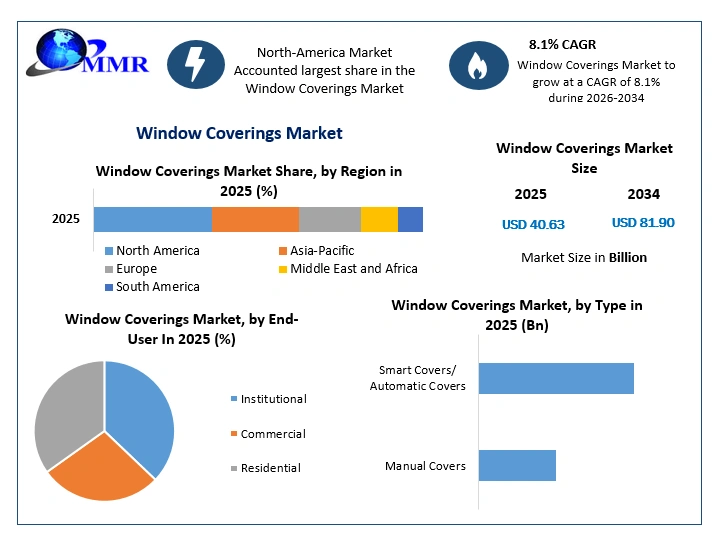
Market valuation stood at USD 40.63 billion in 2025 and is projected to reach USD 81.90 billion by 2034, expanding at a compound annual growth rate (CAGR) of 8.1% across the 2025–2034 forecast matrix.
The blinds product classification represents the dominant product type segment, commanding a verified 40% share of total market revenue allocations.
The residential application framework holds the dominant market position, driven by expanding home renovation, property remodeling, and modern residential construction loops.
The offline distribution channel remains the dominant route-to-market, capturing an overwhelming 87% share of global corporate retail transactions.
Volatile raw material price fluctuations across key inputs—specifically cotton, polyester, aluminum, and PVC—represent the primary structural constraint limiting corporate margin expansion.
Why This Matters Now
Consumer goods groups and traditional home furnishings manufacturers face immediate margin compression if they fail to shift production assets away from static manual products toward energy-efficient, automated shading systems. Corporate retail buyers who ignore the strict consumer transition toward motorized remote-controlled configurations and eco-certified textiles risk holding obsolete inventory as modern residential networks systematically favor smartphone-enabled home infrastructure. This structural marketplace migration transforms everyday textile milling into a highly technical race for thermal insulation, solar management, and strict automated material compliance.
Market Overview
The global window coverings market is undergoing a calculated infrastructure expansion, growing from an established baseline valuation of USD 40.63 billion in 2025 to a projected revenue target of USD 81.90 billion by 2034. This performance trajectory reflects a steady compound annual growth rate of 8.1% across the designated nine-year forecast window. The historical operational data establishes a permanent baseline demand for specialized interior light control and structural privacy systems worldwide.
This financial expansion demonstrates that consumer capital is migrating rapidly toward product configurations that manage interior thermal energy transfer while matching upscale architectural designs. Contemporary assembly plants are focusing heavy capital allocations on automated robotic cutting tables, automated assembly tracks, and specialized low-emission fabric treatments to transfer finished goods—including curtains, drapes, blinds, shades, shutters, and valances—directly to international wholesale networks.
Key Trends Driving Growth
The massive expansion of regional property remodeling, new home building, and corporate building construction serves as the primary driver fueling the scaling of interior accessory distribution lines. Real estate developers and homeowners increasingly demand specialized window installations to manage natural light penetration and restrict internal heat loss, which directly alters residential operating costs. This baseline requirement ensures a highly stable, non-cyclical revenue loop for manufacturing brands capable of securing high-volume supply contracts with major multi-site home decor chains and commercial builders.
Concurrently, rising public awareness regarding home energy consumption is opening up lucrative deployment opportunities for thermal blinds and solar shades. Modern consumers demonstrate a clear willingness to allocate higher upfront capital toward window fixtures made from recycled substrates, organic textiles, and low-emission coatings that actively reduce heating and cooling utility costs. This sustainability pivot encourages tier-one corporate brands to upgrade their material processing, introducing motorized setups controlled remotely via smartphone applications and voice commands.
Segment Insights
Dominant Product Segment: Blinds command the absolute highest revenue generation share, securing a verified 40% of the total market matrix due to widespread consumer reliance on vertical, horizontal, and roller variations for precise room light adjustment.
Dominant Application Segment: The Residential category commands the leading application positioning, anchored by continuous worldwide investments in private home upgrades, multi-family construction projects, and customized living space designs.
Dominant Distribution Channel: Offline brick-and-mortar networks—comprising specialized home decor superstores like Home Center—hold a massive 87% share of the overall transaction matrix, supported by consumer preferences to evaluate material textures and color accuracy in person.
Alternative Design Configurations: The broader manufacturing pipeline tracks distinct revenue tracks across versatile roller shades, traditional fabric curtains, high-durability external shutters, architectural drapes, and specialized cellular shades.
Regional Growth Story
The North American regional marketplace held a major position in global revenue generation, anchoring the worldwide monetization of premium motorized shading systems and high-end interior decorations. The region benefits from a highly mature home improvement culture, well-organized retail distribution hubs, and an affluent buyer base capable of absorbing price increases linked to automated smart-home integrations. This deep consumer penetration provides the stable transactional volume needed for tier-one brands like Springs Window Fashions, Hunter Douglas, and Levolor to sustain automated local factories and expand engineering investments.
Concurrently, international market structures across the Asia Pacific, Europe, South America, and the Middle East & Africa are developing distinct regional demand profiles. The Asia Pacific marketplace exhibits notable growth acceleration driven by rapid urbanization, high-density residential high-rise execution, and rising disposable incomes in key hubs, prompting key regional players like Nien Made Enterprise and Tachikawa Corporation to scale up production capacity. This localized transition fuels high factory utilization rates, driving both domestic consumption loops and large-scale contract exports to Western retail operations.
Competitive Landscape
The global landscape features prominent corporate manufacturers and specialized interior accessory innovators including Hunter Douglas, Springs Window Fashions, Newell Brands, MarTek, Nien Made Enterprise, Tachikawa Corporation, Rollease Acmeda, Insolroll, Skandia Window Fashion, Graber, Levolor, Bali, Comfortex Window Fashions, Al Salam Curtains, and Amoza Curtains. This crowded commercial arena operates under intense price and design pressures, where raw material contract control, fabric durability, and technological integration decide market share retention. Low-tier processing plants face extreme survival friction as international metal and polymer prices fluctuate, leaving dominant market leaders to capture high-margin channels via automated supply tracking and proprietary component longevity developments.
To defend their corporate positions, established market players are executing aggressive technological feature enhancements and expanding premium direct-to-consumer catalogs. These corporate movements indicate that the next 12 to 24 months will bring portfolio realignments, with asset-heavy consumer product conglomerates acquiring eco-certified boutique textile studios or specialized remote-automation firms to add smart-home lines to their core offerings. Rivals must prepare for a retail marketplace where basic manual pull-cord items are systematically phased out due to safety regulations and replaced by modular, motorized shading systems that integrate seamlessly into broader digital facility management architectures.
Recent Developments
Tier-one window covering manufacturers expanded high-precision automated assembly lines to produce motorized roller shades, optimizing connectivity with standard home automation systems.
Material engineering teams updated fabric coating methods, introducing low-emission, recycled polyester lines to satisfy corporate retail sustainability mandates without dropping flame-retardant performance.
Leading corporate brands redesigned internal gear components within premium blinds series, maximizing physical mechanism longevity and reducing field failure rates for high-frequency commercial office users.
Strategic Implications
FMCG category managers and home goods procurement directors must immediately alter their supply chain frameworks to favor high-margin motorized blinds, energy-saving solar shades, and eco-certified textiles over low-tier generic imports. Devoting valuable brick-and-mortar retail display footage or catalog space to basic un-insulated window components represents an operational risk when modern buyers demonstrate a clear preference for thermal management and remote convenience. Furthermore, traditional manufacturing operations must optimize their supply chains to manage sudden price spikes across core sub-components like aluminum, PVC, and natural cotton.
Product engineering and production leads must focus on minimizing component failure rates while preserving strict material safety parameters across all residential collections. High base material expenses mean fabricators must eliminate excess production waste by integrating automated robotic pattern layout tools and high-efficiency ultrasonic welding systems. Sourcing setups that fail to incorporate audited sustainable textile loops and automated load-bearing mechanism testing will find themselves systematically excluded from major corporate multi-site vendor networks.
Future Outlook
The market will separate into highly profitable home automation brands that dominate the high-margin motorized and energy-efficient shading segments through premium offline networks, and legacy component fabricators whose margins will be crushed by raw material price volatility and shifting automated product standards.
Analyst Perspective
“The rapid structural evolution of the global window coverings market points to a permanent transition toward motorized residential functionality, eco-certified thermal fabrics, and automated utility management,” states Rucha Deshpande, Research Analyst. “As property remodeling and modern residential constructions expand internationally, those home accessory enterprises that successfully pair automated high-precision material engineering with a dominant multi-channel offline retail presence will secure dominant market shares across both mature Western economies and the fast-accelerating international real estate corridors.”
About Maximize Market Research
Maximize Market Research Pvt. Ltd. (MMR) is a global market research and consulting company that provides reliable, data-focused, and practical business insights. The firm serves a wide range of industries, including healthcare, pharmaceuticals, technology, automotive, electronics, chemicals, personal care, and consumer goods. Through market forecasts, competitive analysis, strategic consulting, and industry impact assessments, MMR helps organizations understand changing market conditions, identify growth opportunities, and make informed business decisions for long-term success.
2nd Floor, Navale IT Park Phase 3
Pune Banglore Highway, Narhe
Pune, Maharashtra 411041, India
+91 9607365656
sales@maximizemarketresearch.com
