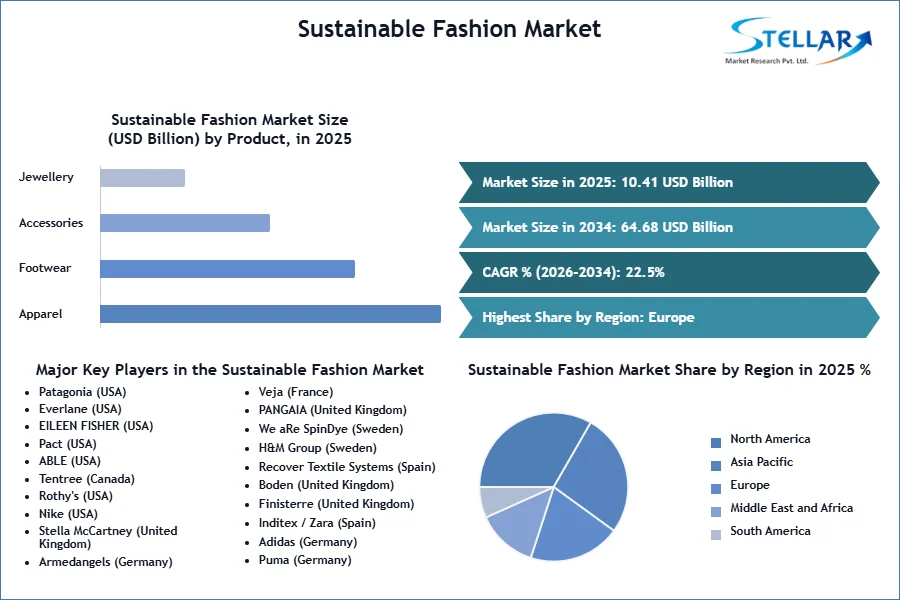
The global Sustainable Fashion Market is entering a high-growth phase as consumers, brands, and governments increasingly prioritize environmentally responsible production, ethical sourcing, and circular fashion models. Growing concerns regarding textile waste, carbon emissions, excessive water consumption, and labor practices are accelerating the shift from traditional fashion models toward sustainable alternatives. According to Stellar Market Research, the Sustainable Fashion Market was valued at USD 10.41 Bn in 2025 and is expected to reach USD 64.68 Bn by 2032, at a CAGR of 22.5% during the forecast period.
The industry is being reshaped by recycled fabrics, organic materials, transparent supply chains, resale platforms, and technology-driven manufacturing practices.
Understanding the Sustainable Fashion Market
Sustainable fashion refers to apparel, footwear, accessories, and related products designed and manufactured with reduced environmental impact while supporting ethical labor practices and responsible resource utilization. Unlike conventional fashion models that often rely on high-volume production and short product lifecycles, sustainable fashion focuses on durability, recyclability, waste reduction, and responsible sourcing.
The concept includes the use of organic fabrics, recycled textiles, regenerated fibers, biodegradable materials, ethical manufacturing processes, and circular business models such as clothing resale, rental services, and recycling programs.
Increasing consumer awareness about the environmental impact of fast fashion is encouraging brands to redesign their production strategies. Fashion companies are now investing in sustainable materials, renewable energy, supply chain transparency, and innovative technologies to meet evolving consumer expectations.
𝐃𝐨𝐰𝐧𝐥𝐨𝐚𝐝 𝐅𝐫𝐞𝐞 𝐏𝐃𝐅 𝐁𝐫𝐨𝐜𝐡𝐮𝐫𝐞: https://www.stellarmr.com/report/req_sample/sustainable-fashion-market/2846
Key Factors Driving Market Growth
Rising Consumer Demand for Eco-Friendly Apparel
Growing environmental awareness among consumers is one of the strongest drivers of the Sustainable Fashion Market. Consumers are increasingly evaluating brands based on sustainability commitments, ethical sourcing practices, and environmental responsibility.
Younger generations, particularly millennials and Gen Z consumers, are showing greater preference for brands that offer transparent supply chains, recycled materials, and responsible manufacturing processes. Social media platforms and sustainability-focused campaigns have further increased awareness about issues such as textile waste and pollution.
This shift in consumer behavior is encouraging fashion companies to introduce sustainable product lines and communicate their environmental initiatives more effectively.
Increasing Adoption of Circular Fashion Models
Circular fashion is becoming a major trend within the apparel industry as companies focus on extending product lifecycles and reducing waste generation.
Brands are adopting strategies such as:
Clothing resale platforms
Rental fashion services
Textile recycling programs
Upcycling initiatives
Repair and reuse models
These approaches help reduce dependence on virgin materials while creating new revenue opportunities for fashion companies.
The growing popularity of second-hand clothing markets is also contributing to the expansion of sustainable fashion by promoting resource efficiency and reducing landfill waste.
Government Regulations and Sustainability Policies
Increasing regulatory pressure regarding textile waste, carbon emissions, and chemical usage is accelerating sustainable transformation across the fashion industry.
Governments and international organizations are introducing policies encouraging responsible production, recycling infrastructure development, and improved supply chain transparency.
Regulations related to sustainable textiles are encouraging manufacturers to adopt environmentally friendly materials and reduce the ecological footprint of their operations. The European Union’s focus on sustainable and circular textiles is influencing global fashion brands to improve sustainability practices.
Market Segmentation
The Sustainable Fashion Market is segmented based on product type, fabric type, end user, and distribution channel.
By Product Type
The market includes:
Apparel
Footwear
Accessories
Jewelry
Bags
Others
The apparel segment dominates the Sustainable Fashion Market due to widespread consumer demand for sustainable clothing products. Clothing represents the largest category within fashion consumption, encouraging brands to introduce organic cotton apparel, recycled garments, and low-impact production methods.
Sustainable footwear and accessories are also gaining traction as companies explore recycled materials, plant-based alternatives, and ethical manufacturing processes.
By Fabric Type
Major sustainable fabric categories include:
Organic Fabrics
Recycled Fabrics
Regenerated Fabrics
Natural Fibers
Alternative Fibers
Organic fabrics hold a leading position due to increasing demand for non-toxic, environmentally friendly materials. Organic cotton remains one of the most widely adopted sustainable textiles because it reduces chemical usage and supports responsible agricultural practices.
Recycled polyester, regenerated cellulose fibers, hemp, bamboo, and other alternative materials are also expanding as brands seek innovative solutions to reduce dependence on traditional textiles.
By Distribution Channel
The market is divided into:
Online
Offline
Online channels are experiencing strong growth due to increasing digital shopping adoption, direct-to-consumer brand strategies, and growing consumer interest in sustainability-focused brands.
E-commerce platforms allow sustainable fashion companies to educate consumers about product origins, material choices, and ethical manufacturing practices.
Technology Innovation Transforming Sustainable Fashion
Technology is playing a critical role in accelerating sustainable transformation within the fashion industry.
Advanced textile technologies are enabling the development of innovative materials such as recycled fibers, bio-based fabrics, and regenerated textiles. Companies are investing in research to create durable materials with lower environmental impact.
Artificial intelligence and digital tools are improving supply chain efficiency by helping brands forecast demand, reduce overproduction, and optimize inventory management.
Blockchain technology is also being explored to enhance supply chain transparency by enabling consumers to track product origins, material sources, and manufacturing processes.
Digital design tools and virtual sampling technologies are helping companies reduce material waste during product development.
Sustainability Trends Reshaping the Fashion Industry
Sustainability is no longer considered a niche trend but a strategic priority for global fashion companies.
Brands are increasingly focusing on:
Carbon footprint reduction
Renewable energy adoption
Sustainable packaging
Ethical labor practices
Water conservation
Textile recycling
Consumers are demanding greater transparency regarding how products are made, where materials are sourced, and what environmental impact they create.
Companies that successfully integrate sustainability into their business models are gaining competitive advantages by improving brand loyalty and meeting evolving customer expectations.
Regional Market Outlook
North America
North America represents a significant market for sustainable fashion due to strong consumer awareness, high purchasing power, and increasing demand for ethical brands.
The United States is witnessing growing adoption of sustainable apparel as consumers increasingly seek environmentally responsible alternatives to conventional fashion products.
The region is also home to several brands investing in recycled materials, ethical manufacturing, and circular business models.
Europe
Europe is one of the leading regions in sustainable fashion adoption due to strong environmental regulations, sustainability initiatives, and consumer preference for responsible products.
Countries including Germany, France, Sweden, Italy, and the United Kingdom are driving demand for organic textiles, recycled materials, and circular fashion solutions.
European fashion brands are increasingly adopting sustainability strategies to comply with regulatory requirements and meet consumer expectations.
Asia-Pacific
Asia-Pacific is expected to experience significant growth during the forecast period due to expanding textile manufacturing capabilities, rising environmental awareness, and increasing adoption of sustainable practices.
Countries such as China, India, Japan, South Korea, and Southeast Asian nations are witnessing growing investments in sustainable textile production and eco-friendly apparel manufacturing.
The region’s strong textile supply chain infrastructure provides opportunities for sustainable material innovation and large-scale production.
Challenges Facing the Market
Despite strong growth prospects, the Sustainable Fashion Market faces several challenges.
Higher production costs associated with organic materials, recycled fibers, and sustainable manufacturing processes remain a major concern for brands. Sustainable raw materials may cost more due to limited availability and complex processing requirements.
Supply chain transformation also requires significant investment in technology, infrastructure, and supplier partnerships.
Additionally, the lack of standardized sustainability certifications and definitions can create challenges in maintaining transparency and preventing misleading environmental claims.
Competitive Landscape
The Sustainable Fashion Market is highly competitive, with companies focusing on sustainable materials, circular models, ethical sourcing, and digital transparency.
Key players operating in the market include:
Patagonia
Stella McCartney
H&M Group
Adidas
Nike
Everlane
Veja
Inditex (Zara)
Puma
Fast Retailing (Uniqlo)
Leading companies are investing in recycled materials, sustainable production technologies, carbon reduction initiatives, and supply chain transparency to strengthen their market positions.
Recent industry developments include:
PUMA (2024): Introduced a clothing product created entirely from textile waste using bio-recycling technology, highlighting advancements in circular fashion innovation.
H&M Group (2024): Implemented advanced dyeing and finishing technologies at a supplier facility in Bangladesh to reduce environmental impact and improve production sustainability.
𝐃𝐨𝐰𝐧𝐥𝐨𝐚𝐝 𝐅𝐫𝐞𝐞 𝐏𝐃𝐅 𝐁𝐫𝐨𝐜𝐡𝐮𝐫𝐞: https://www.stellarmr.com/report/req_sample/sustainable-fashion-market/2846
Future Outlook
The future of the Sustainable Fashion Market is expected to be driven by continued innovation in materials, circular economy adoption, regulatory support, and changing consumer preferences.
As fashion companies move toward responsible production models, demand for recycled textiles, organic fabrics, ethical apparel, and transparent supply chains will continue increasing.
Technology will play a central role in improving sustainability through digital supply chains, AI-driven production optimization, and advanced textile development. Emerging markets will provide significant growth opportunities as awareness of sustainable fashion expands and manufacturing capabilities improve.
With sustainability becoming a core business strategy rather than a temporary trend, the Sustainable Fashion Market is positioned for strong expansion through 2032. Companies that successfully combine environmental responsibility, innovation, affordability, and consumer-focused design will be best positioned to capture opportunities in the evolving global fashion industry.
Media Contact
Stellar Market Research
Website: Stellar Market Research – Global Research Reports & Consulting
Email: sales@stellarmr.com
