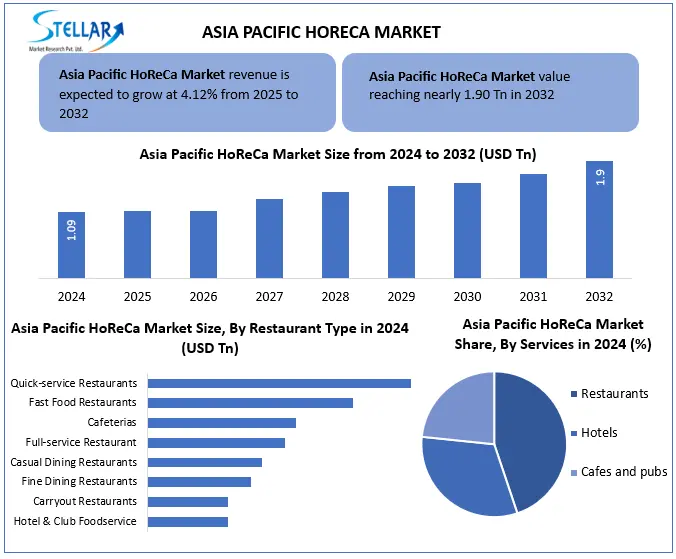
The Asia Pacific HoReCa Market is experiencing robust growth as rising tourism, rapid urbanization, and digital transformation continue to reshape the region’s hospitality and foodservice industry. Hotels, restaurants, cafés, pubs, and catering businesses are investing heavily in technology, personalized customer experiences, and operational efficiency to meet evolving consumer expectations. According to Stellar Market Research, the Asia Pacific HoReCa Market was valued at USD 1.09 trillion in 2024 and is expected to reach USD 1.90 trillion by 2032, growing at a CAGR of 4.12% during the forecast period. Digital ordering, AI-powered restaurant management, contactless payments, and the resurgence of international tourism are creating significant growth opportunities across the industry.
Understanding the Asia Pacific HoReCa Market
The HoReCa (Hotels, Restaurants, and Cafés/Catering) industry forms one of the largest service sectors in Asia Pacific, serving both domestic consumers and international travelers. The market encompasses luxury hotels, business hotels, quick-service restaurants (QSRs), fine dining establishments, cafés, pubs, catering services, and food delivery operations.
Rapid urbanization, a growing middle-class population, increasing disposable income, and changing dining preferences are driving demand for quality hospitality services. Consumers increasingly seek convenience, premium experiences, and digitally enabled services, prompting businesses to modernize operations through smart technologies and customer-centric innovations.
𝐃𝐨𝐰𝐧𝐥𝐨𝐚𝐝 𝐅𝐫𝐞𝐞 𝐏𝐃𝐅 𝐁𝐫𝐨𝐜𝐡𝐮𝐫𝐞: https://www.stellarmr.com/report/req_sample/apac-horeca-market/2861
Key Factors Driving Market Growth
Tourism Recovery Accelerating Hospitality Demand
The recovery of international and domestic tourism is one of the strongest growth drivers for the Asia Pacific HoReCa Market. Countries including Thailand, Singapore, Japan, Indonesia, and India are witnessing increasing tourist arrivals, resulting in higher hotel occupancy rates and stronger restaurant demand.
Government tourism initiatives, international events, and relaxed travel policies continue to stimulate business and leisure travel. As travel volumes increase, hotels, cafés, and restaurants are expanding capacity while investing in premium guest experiences.
Rapid Expansion of Quick-Service Restaurants
The growing popularity of quick-service restaurants is transforming the regional foodservice landscape. Busy urban lifestyles, increasing workforce participation, and rising demand for affordable dining options have encouraged domestic and international QSR brands to expand aggressively.
Mobile ordering, delivery applications, and loyalty programs have further strengthened customer engagement while supporting revenue growth.
Digital Transformation Across Hospitality
Technology has become a major competitive differentiator within the HoReCa industry. Restaurants and hotels are increasingly deploying:
AI-powered demand forecasting
Contactless payment systems
QR-code menus
Self-ordering kiosks
Kitchen automation
IoT-enabled equipment monitoring
These technologies improve operational efficiency, reduce food waste, enhance customer satisfaction, and support better workforce management. According to the Stellar Market Research report, digital menus and contactless payments have become mainstream across the region.
Market Segmentation
The Asia Pacific HoReCa Market is segmented by type, service, and country.
By Type
The market includes:
Single Outlet
HoReCa Chain
Single Outlet Segment Leads the Market
Single-outlet businesses accounted for the largest market share in 2024 due to their personalized customer service, strong local presence, and ability to adapt quickly to changing consumer preferences.
Independent cafés, restaurants, and boutique hospitality businesses continue to attract customers through unique dining experiences and localized offerings. While organized chains continue expanding rapidly, independent operators maintain a competitive advantage through flexibility and community engagement.
By Service
Major service categories include:
Hotels
Restaurants
Quick-Service Restaurants
Fast Food Restaurants
Cafeterias
Full-Service Restaurants
Casual Dining
Fine Dining
Carryout Restaurants
Cafés and Pubs
Restaurants and quick-service establishments continue to generate significant market revenue due to increasing consumer spending on dining experiences and food delivery services.
𝐃𝐨𝐰𝐧𝐥𝐨𝐚𝐝 𝐅𝐫𝐞𝐞 𝐏𝐃𝐅 𝐁𝐫𝐨𝐜𝐡𝐮𝐫𝐞: https://www.stellarmr.com/report/req_sample/apac-horeca-market/2861
Technology Trends Reshaping the Industry
Technology adoption is becoming essential for maintaining competitiveness across the hospitality industry.
Artificial Intelligence
AI-powered inventory management and demand forecasting enable restaurants to optimize purchasing decisions, reduce waste, and improve staffing efficiency.
Smart Restaurant Operations
Kitchen robotics, automated beverage systems, and digital kitchen management solutions help improve service speed, consistency, and labor productivity.
Contactless Customer Experience
Consumers increasingly prefer digital ordering, QR-code menus, online reservations, and mobile payment systems that offer convenience and reduce service times.
Hotels are also deploying AI-powered concierge services, digital check-in systems, and smart room technologies to enhance guest experiences.
Sustainability Trends
Sustainability has become a strategic priority across the Asia Pacific HoReCa industry.
Hotels and restaurants are investing in:
Local ingredient sourcing
Food waste reduction
Energy-efficient kitchens
Sustainable packaging
Water conservation initiatives
Carbon reduction programs
Consumers increasingly favor businesses demonstrating environmental responsibility, encouraging operators to integrate sustainability into everyday operations.
Regional Market Outlook
China
China dominated the Asia Pacific HoReCa Market in 2024 due to its massive consumer base, advanced food delivery ecosystem, and widespread adoption of digital payments.
Platforms such as Meituan and Ele.me have revolutionized food delivery, while government initiatives supporting digital transformation continue to accelerate industry modernization. Rising domestic tourism further supports sustained growth.
India
India is emerging as one of the fastest-growing HoReCa markets due to rapid urbanization, a young population, rising disposable income, and expanding quick-service restaurant chains.
Government tourism campaigns and investments in hospitality infrastructure continue to strengthen market opportunities.
Japan
Japan maintains a strong position through its premium hospitality sector, luxury hotels, and globally recognized culinary industry. International tourism recovery and high service standards continue supporting market expansion.
Southeast Asia
Countries including Thailand, Singapore, Vietnam, Indonesia, and Malaysia continue attracting international visitors, creating opportunities across hotels, restaurants, cafés, and catering services.
Challenges Facing the Market
Despite positive growth prospects, several challenges remain.
The industry continues facing labor shortages, rising operating costs, and supply chain disruptions affecting imported food ingredients and beverages. Smaller independent operators are particularly vulnerable to fluctuations in commodity prices and logistics costs.
Increasing competition from organized restaurant chains and evolving consumer expectations require continuous investment in technology, employee training, and customer experience improvements. (Stellar Market Research)
Competitive Landscape
The Asia Pacific HoReCa Market features intense competition among regional hospitality groups, hotel operators, restaurant chains, and foodservice companies.
Major market participants include:
Shangri-La Group
Taj Hotels
Jollibee Foods Corporation
Minor International
Café de Coral
BreadTalk Group
Yoshinoya Holdings
Zensho Holdings
Haidilao International
The Indian Hotels Company Limited (IHCL)
Leading companies are focusing on digital transformation, expansion into high-growth markets, sustainability initiatives, and customer experience innovation to strengthen their competitive positions. Recent developments include Jollibee Foods Corporation’s acquisition of a majority stake in South Korea’s Compose Coffee and continued hotel development across India, highlighting strong investment activity in the regional hospitality sector.
𝐃𝐨𝐰𝐧𝐥𝐨𝐚𝐝 𝐅𝐫𝐞𝐞 𝐏𝐃𝐅 𝐁𝐫𝐨𝐜𝐡𝐮𝐫𝐞:
Future Outlook
The future of the Asia Pacific HoReCa Market will be driven by continued tourism recovery, digital innovation, premium dining experiences, and expansion of organized foodservice chains.
Artificial intelligence, automation, cloud kitchens, smart hospitality technologies, and omnichannel customer engagement will continue transforming business operations. At the same time, sustainability initiatives and localized culinary experiences will become increasingly important competitive differentiators.
With rising consumer spending, supportive government tourism initiatives, and ongoing investment in hospitality infrastructure, the Asia Pacific HoReCa Market is well positioned for sustained growth through 2032, creating significant opportunities for hotel operators, restaurant chains, technology providers, and investors across the region.
Media Contact
Stellar Market Research
Website: Stellar Market Research – Global Research Reports & Consulting
Email: sales@stellarmr.com
