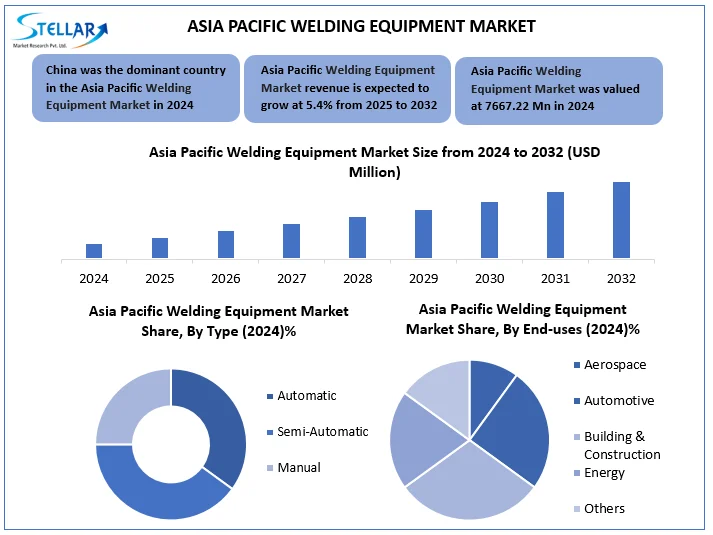
The Asia Pacific Welding Equipment Market is witnessing sustained growth as rapid industrialization, large-scale infrastructure development, and increasing adoption of automated manufacturing technologies boost demand across the region. Industries including automotive, construction, shipbuilding, aerospace, and renewable energy are investing in advanced welding solutions to improve productivity and manufacturing precision. According to Stellar Market Research, the Asia Pacific Welding Equipment Market was valued at USD 7,667.22 million in 2024 and is expected to reach USD 11,677.85 million by 2032, expanding at a CAGR of 5.4% during the forecast period. The market is increasingly driven by robotic welding systems, Industry 4.0 integration, and growing investments in smart manufacturing.
Understanding the Asia Pacific Welding Equipment Market
Welding equipment is used to permanently join metals and thermoplastics through various technologies such as arc welding, resistance welding, laser beam welding, and automated robotic welding. The Asia Pacific market includes welding machines, power sources, robotic welding systems, consumables, and accessories used across diverse industrial applications.
The region has become the world’s largest manufacturing hub, supported by strong industrial bases in China, Japan, South Korea, India, and Southeast Asia. Expanding investments in transportation infrastructure, renewable energy, heavy engineering, and industrial automation continue to create strong demand for modern welding equipment.
𝐃𝐨𝐰𝐧𝐥𝐨𝐚𝐝 𝐅𝐫𝐞𝐞 𝐏𝐃𝐅 𝐁𝐫𝐨𝐜𝐡𝐮𝐫𝐞: https://www.stellarmr.com/report/req_sample/apac-welding-equipment-market/2866
Key Factors Driving Market Growth
Rapid Infrastructure Development
Massive infrastructure investments across Asia Pacific are significantly increasing the demand for welding equipment. Construction of highways, railways, airports, bridges, industrial facilities, and smart cities requires advanced welding technologies capable of delivering high-quality structural fabrication.
China’s infrastructure investments under its Five-Year Plan, India’s expanding transportation projects, and Southeast Asia’s urban development initiatives continue to generate strong market opportunities for welding equipment manufacturers.
Growing Adoption of Industrial Automation
Manufacturers are increasingly replacing manual welding operations with automated and robotic welding systems to improve production efficiency, consistency, and workplace safety.
Industry 4.0 technologies—including artificial intelligence, IoT-enabled monitoring, predictive maintenance, and digital quality inspection—are transforming welding operations throughout automotive, electronics, and heavy manufacturing industries.
Automated welding also helps manufacturers address labor shortages while improving production throughput and weld quality.
Expansion of Renewable Energy Projects
The rapid expansion of renewable energy infrastructure is creating additional demand for welding equipment. Wind turbine towers, solar mounting structures, hydrogen facilities, and energy transmission systems require precision welding solutions capable of handling large-scale fabrication projects.
Government investments in clean energy and decarbonization are expected to continue supporting equipment demand throughout the forecast period.
Market Segmentation
The Asia Pacific Welding Equipment Market is segmented by technology, type, end use, and country.
By Technology
The market includes:
Arc Welding
Resistance Welding
Laser Beam Welding
Others
Arc Welding Dominates the Market
Arc welding accounted for the largest market share in 2024 because of its versatility, affordability, and broad industrial applications. It is extensively used in construction, shipbuilding, automotive manufacturing, heavy engineering, and metal fabrication.
Its ability to weld both ferrous and non-ferrous materials while maintaining cost efficiency makes it the preferred technology across developing and industrialized economies alike.
By Type
Major equipment categories include:
Automatic
Semi-Automatic
Manual
Semi-Automatic Welding Equipment Leads
Semi-automatic welding systems dominate the market because they provide an ideal balance between productivity, operational flexibility, and affordability.
Manufacturers across automotive, construction, and general fabrication industries increasingly prefer semi-automatic systems since they improve production efficiency without requiring the significant investment associated with fully automated robotic systems.
By End Use
Key end-use industries include:
Aerospace
Automotive
Building & Construction
Energy
Others
Building, construction, and automotive industries continue to represent the largest demand centers due to ongoing industrial expansion throughout the region.
Technology Trends Transforming the Industry
Robotic Welding Systems
Industrial robots equipped with advanced welding capabilities are becoming increasingly common across high-volume manufacturing facilities. Robotic welding improves accuracy, reduces material waste, and delivers consistent weld quality while lowering long-term operating costs.
AI and IoT Integration
Artificial intelligence and Internet of Things (IoT) technologies are enabling predictive maintenance, remote equipment monitoring, automated quality inspection, and real-time production optimization.
Smart welding equipment can automatically adjust parameters based on material characteristics, helping manufacturers improve operational efficiency and reduce defects.
Laser Welding Innovation
Laser welding technology is gaining popularity for applications requiring high precision, minimal heat distortion, and faster processing speeds, particularly in electronics, aerospace, and electric vehicle manufacturing.
Sustainability Trends
Sustainability has become an important focus across the welding industry.
Manufacturers are developing energy-efficient welding machines that consume less electricity while maintaining high productivity. Advanced inverter-based power sources reduce power consumption, improve efficiency, and lower operating costs.
Automation also minimizes material waste, while cleaner welding technologies help reduce workplace emissions and improve environmental performance across manufacturing facilities.
Regional Market Outlook
China
China dominates the Asia Pacific Welding Equipment Market due to its massive manufacturing sector, strong industrial infrastructure, and significant investments in transportation, renewable energy, and heavy engineering.
Government initiatives such as “Made in China 2025” continue encouraging advanced manufacturing, industrial automation, and robotics adoption across multiple sectors.
India
India is emerging as one of the fastest-growing markets driven by infrastructure expansion, manufacturing investments, automotive production, and government initiatives including “Make in India.”
Growing investments in railways, metro projects, renewable energy, and industrial corridors continue to increase demand for welding equipment.
Japan and South Korea
Japan and South Korea remain technology leaders, focusing on robotic welding, precision manufacturing, automotive production, shipbuilding, and advanced electronics.
These countries continue investing heavily in smart factories and industrial automation technologies.
Market Challenges
Despite strong growth prospects, several challenges remain.
High capital investment required for robotic welding systems and laser welding equipment remains a major barrier for small and medium-sized enterprises. Equipment maintenance, software integration, and skilled labor requirements also increase implementation costs.
Additionally, shortages of experienced welders and technicians in several developing countries continue affecting productivity and slowing adoption of advanced welding technologies. Global trade policies and steel price volatility may also influence equipment purchasing decisions.
Competitive Landscape
The Asia Pacific Welding Equipment Market is highly competitive, with both regional manufacturers and multinational companies investing in automation, product innovation, and digital manufacturing solutions.
Major market participants include:
Panasonic Welding Systems
Kobe Steel (Kobelco Welding)
Daihen Corporation
Lincoln Electric
Fronius International
ESAB Corporation
Kemppi Oy
OTC Daihen
Ador Welding Ltd.
Miller Electric
Leading companies are expanding robotic welding portfolios, integrating AI-powered monitoring systems, strengthening regional manufacturing capabilities, and investing in energy-efficient welding technologies to enhance their competitive positions.
𝐃𝐨𝐰𝐧𝐥𝐨𝐚𝐝 𝐅𝐫𝐞𝐞 𝐏𝐃𝐅 𝐁𝐫𝐨𝐜𝐡𝐮𝐫𝐞: https://www.stellarmr.com/report/req_sample/apac-welding-equipment-market/2866
Future Outlook
The Asia Pacific Welding Equipment Market is expected to maintain steady growth through 2032 as industrial automation, infrastructure investments, renewable energy development, and advanced manufacturing continue to accelerate across the region.
Growing adoption of robotic welding, AI-enabled quality control, laser welding technologies, and smart factory solutions will improve manufacturing productivity while supporting higher-quality fabrication. Continued expansion of automotive production, shipbuilding, aerospace manufacturing, and construction activities will create sustained demand for advanced welding equipment.
With China, India, Japan, and Southeast Asia leading industrial development, the Asia Pacific Welding Equipment Market is well positioned for long-term growth, offering significant opportunities for equipment manufacturers, automation providers, and industrial technology companies.
Media Contact
Stellar Market Research
Website: Stellar Market Research – Global Research Reports & Consulting
Email: sales@stellarmr.com
