Key Highlights
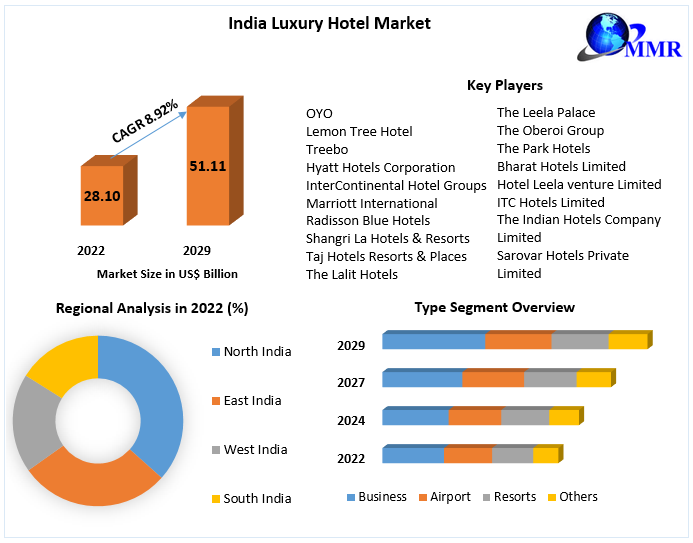
India Luxury Hotel Market was worth US$ 28.1 Bn in 2022 and is forecast to reach almost US$ 51.11 Bn by 2029, growing at 8.92% CAGR, more than doubling the value pool in seven years.
Growth is driven by rising domestic affluence, international tourism recovery, and expansion of luxury inventory across business, leisure and mixed-use destinations.
The market structure in the report spans hotel type, category, booking channel and region, signaling multiple levers for operators and F&B partners to target distinct demand clusters.
Competitive analysis positions India’s leading luxury chains and international brands in an intensifying battle for high-spend guests, with F&B as a key differentiator.
Why This Matters Now
Room revenue in India’s luxury hotels is on track to climb from US$ 28.1 Bn in 2022 to around US$ 51.11 Bn in 2029. That jump does not just reflect more beds; it signals a rapid expansion of high-yield F&B spaces where affluent Indians and international travelers eat, drink and entertain.
For FMCG and food & beverage leaders, this market is the physical stage on which brands are tasted, photographed and shared by top-decile consumers. A failure to build a strategy for India’s luxury hotels over the next five years is, effectively, a decision to cede influence over the country’s most profitable consumption occasions.
Market Overview
The Maximize Market Research report pegs the India Luxury Hotel Market at US$ 28.1 Bn in 2022, with total revenue expected to grow at 8.92% CAGR through 2029, reaching nearly US$ 51.11 Bn. This is a strong, sustained growth path, not a short-lived post-pandemic rebound.
The study frames 2022 as the base year and evaluates trends across the 2023–2029 forecast window, with detailed segment and regional cuts. The core message: luxury hotels in India are moving from a narrow, metro-centric niche to a nationwide platform that serves business executives, high-net-worth families, weddings, MICE, medical tourists and upscale leisure travelers.
Key Trends Driving Growth
Rising disposable incomes and a growing upper-middle and affluent class are feeding demand for premium stays, branded residences and weekend getaways. Luxury hotels capture this spend not only through room rates but through restaurants, bars, bakeries, cafés and banqueting, where F&B margins can be higher than rooms on a per-guest basis.
Domestic tourism and “Bharat traveler” demand are reshaping the market. As more Indians choose luxury hotels for staycations, weddings and celebrations, operators are building deeper portfolios of Indian, regional and fusion cuisines, plus premium beverage programs that reflect local tastes. This gives FMCG and beverage brands fresh entry points for region-specific menus and limited editions.
Digital discovery and booking are accelerating channel shift. Luxury guests now research, compare and book online, with social media and influencer content pushing specific hotels, restaurants and bars into the spotlight. That visibility raises the stakes for F&B concepts within hotels, as every plate and cocktail can become part of a viral narrative.
Request a Free Sample Copy or View Report Summary: https://www.maximizemarketresearch.com/request-sample/127656/
Segment Insights
Dominant Segment — Business and City Luxury Hotels: The report segments the India Luxury Hotel Market by hotel type, with business and city luxury hotels forming the volume backbone. This segment dominates because corporate travel, trade corridors and urban leisure converge there, driving steady F&B demand from breakfast meetings to late‑night bars and room service.
Fastest-Growing Segment — Leisure and Resort Luxury Hotels: Within the type segmentation, resort and leisure luxury hotels are growing fastest as India develops coastal, hill and heritage destinations. These assets generate high-spend F&B occasions—sunset bars, destination restaurants, wellness menus—that attract both in‑house guests and local visitors.
Booking and Channel Segments: The report highlights online booking and digital intermediaries as rapidly growing access points for luxury hotels. For F&B, this means that guests arrive with higher expectations, pre-reading menus and reviews; hotels that connect F&B content to booking journeys will convert more covers and higher checks.
Regional Growth Story
The India Luxury Hotel Market is not confined to metro cores like Mumbai and Delhi; it now includes fast-emerging hubs and tourist circuits. Tier‑1 cities still anchor corporate demand, but Tier‑2 and Tier‑3 locations are seeing new luxury supply as airports, highways and industrial corridors expand.
Regions with strong tourism assets—Rajasthan’s heritage cities, Goa and coastal belts, Himalayan hill stations and temple towns—are drawing investments in upscale and luxury properties. This geographic spread creates new F&B canvases for everything from regional cuisine to destination cocktail bars, shifting innovation beyond the traditional metro hotels.
Competitive Landscape
Maximize Market Research outlines a competitive field that includes domestic giants and international chains, all scaling portfolios and renovating existing assets. As market value targets US$ 51.11 Bn by 2029, competition is less about basic room inventory and more about distinct experiential propositions—where F&B is central.
For rivals, every new luxury opening or repositioning signals a race for prime locations, signature restaurants and bar concepts, celebrity chef tie‑ups and curated beverage lists. Over the next 12–24 months, expect moves in three directions: consolidation of boutique luxury into larger groups, deeper partnerships with F&B brands, and re‑theming of older properties to stay relevant to younger affluent guests.
Recent Developments
Clear growth guidance from US$ 28.1 Bn in 2022 to nearly US$ 51.11 Bn by 2029 at 8.92% CAGR has sharpened boardroom focus on India as a strategic luxury hospitality market, not just an emerging add‑on.
Luxury hotel pipelines and conversions are rising across key Indian cities and tourist destinations, backed by domestic and international capital.
Operators are investing in differentiated F&B—standalone‑style restaurants, specialty regional cuisine, artisanal bakeries and craft cocktail bars—to draw non‑resident guests and local communities.
Technology upgrades, including digital booking, loyalty platforms and data-driven guest profiling, are helping hotels curate more personalized F&B experiences and targeted offers.
Strategic Implications
For FMCG and food & beverage companies, India’s luxury hotels are not just clients; they are laboratories and showrooms. Products listed on hotel menus—premium beverages, plant-based alternatives, artisanal snacks, health-focused desserts—can gain halo effects that influence retail demand and online sales.
Manufacturers and brand owners should treat hotel partnerships as part of a portfolio strategy: flagship placements in iconic properties, regional concepts in resort destinations and co-created menus tied to wellness, provenance or indulgence. Luxury hotels also offer a controlled environment to test new formats, flavors and packaging before scaling to modern trade or quick-service chains.
Future Outlook
By 2029, with the India Luxury Hotel Market projected to reach about US$ 51.11 Bn, luxury properties will be central to how India hosts global business, celebrates milestones and showcases its culinary creativity. F&B will carry ever greater weight in guest satisfaction scores, differentiation and profitability.
In that environment, winners—both hotel operators and their FMCG/F&B partners—will treat every lobby, restaurant, bar and banquet hall as a strategic platform for brand building and innovation, while losers will keep serving generic menus and watch discerning guests—and their spending—migrate to more imaginative competitors.
Related Reports
Global Compostable Packaging Materials Market https://www.maximizemarketresearch.com/market-report/global-compostable-packaging-materials-market/87381/
Global Hermetic Laser Packaging Market https://www.maximizemarketresearch.com/market-report/global-hermetic-laser-packaging-market/102413/
Global Waterproof Headphones Market https://www.maximizemarketresearch.com/market-report/global-waterproof-headphones-market/53538/
Analyst Perspective
“The India Luxury Hotel Market, worth US$ 28.1 Bn in 2022 and expected to reach nearly US$ 51.11 Bn by 2029 at an 8.92% CAGR, shows how fast premium hospitality is scaling with India’s economic rise,” “Players that align room strategy with bold, differentiated F&B concepts will convert this growth into durable pricing power and guest loyalty.”-Siddhi Dole
About Maximize Market Research
Maximize Market Research Pvt. Ltd. (MMR) is a global market research and consulting company that provides reliable, data-focused, and practical business insights. The firm serves a wide range of industries, including healthcare, pharmaceuticals, technology, automotive, electronics, chemicals, personal care, and consumer goods. Through market forecasts, competitive analysis, strategic consulting, and industry impact assessments, MMR helps organizations understand changing market conditions, identify growth opportunities, and make informed business decisions for long-term success.
2nd Floor, Navale IT Park Phase 3
Pune Banglore Highway, Narhe
Pune, Maharashtra 411041, India
+91 9607365656
sales@maximizemarketresearch.com
