The US Zero Trust Security Market is experiencing rapid expansion as organizations move beyond traditional perimeter-based cybersecurity models to adopt more advanced, identity-driven frameworks. Zero Trust operates on the principle of “never trust, always verify,” ensuring that every user, device, and application is continuously authenticated before accessing systems and data.
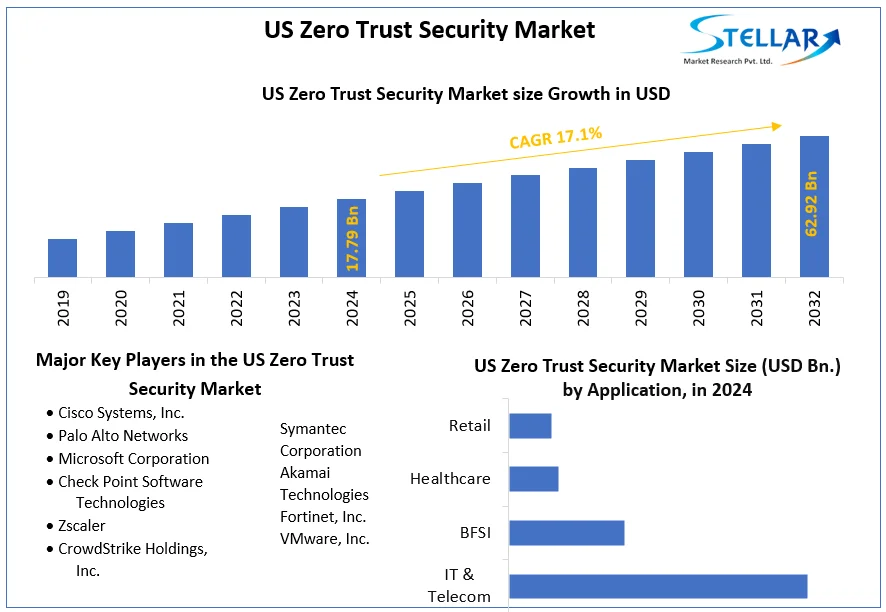
US Zero Trust Security Market size was valued at USD 17.79 Billion in 2024 and the total US Zero Trust Security revenue is expected to grow at a CAGR of 17.1% from 2025 to 2032, reaching nearly USD 62.92 Billion.
With increasing cyber threats, remote work adoption, and cloud transformation, Zero Trust security is becoming a foundational strategy for enterprises across the United States.
A Market Driven by Advanced Cybersecurity Needs
A defining trend in the US Zero Trust security market is the shift toward continuous verification and least-privilege access. Organizations are prioritizing security models that protect data regardless of location—whether on-premises, in the cloud, or across hybrid environments.
This approach is essential in a digital landscape where threats are becoming more sophisticated and widespread.
Key Market Insights
- Zero Trust eliminates reliance on traditional network perimeters.
- Strong adoption across BFSI, healthcare, government, and IT sectors.
- Increased focus on identity and access management (IAM).
- Growth in cloud and hybrid IT environments.
- Rising demand for multi-factor authentication (MFA).
- Expansion of endpoint and network security solutions.
- Integration with advanced analytics and AI technologies.
Market Drivers Accelerating Growth
1. Rising Cybersecurity Threats
Increasing data breaches and cyberattacks are driving demand for robust security.
2. Growth of Cloud Computing and Remote Work
Distributed environments require stronger access control mechanisms.
3. Regulatory and Compliance Requirements
Strict data protection regulations encourage Zero Trust adoption.
Market Challenges and Restraints
1. Complex Implementation Process
Transitioning from legacy systems to Zero Trust frameworks can be challenging.
2. High Cost of Deployment
Advanced security solutions may require significant investment.
Technology and Innovation Trends
Technology is transforming the US Zero Trust security market through advancements in AI-driven threat detection, identity and access management (IAM), secure access service edge (SASE), and zero trust network access (ZTNA).
AI and machine learning are enabling real-time anomaly detection and predictive threat analysis. IAM solutions are ensuring secure authentication and authorization for users and devices.
Cloud-native security platforms are providing scalable protection, while endpoint detection and response (EDR) tools are enhancing device-level security.
Zero Trust is also integrating with network segmentation and encryption technologies to create layered security architectures that minimize risk exposure.
Visual Snapshot: Zero Trust Security in Action
Regional Insights: US Leads Global Cybersecurity Adoption
The United States is a global leader in Zero Trust security adoption:
- Strong presence of advanced IT infrastructure and cybersecurity firms.
- High adoption across large enterprises and government agencies.
- Significant investment in cybersecurity innovation and research.
Major technology hubs such as Silicon Valley, New York, and Washington, D.C. are driving innovation and implementation.
Recent Industry Developments
- Microsoft (2025): Expanded Zero Trust solutions across enterprise cloud platforms.
- Cisco Systems (2024): Strengthened secure access and network protection offerings.
- Palo Alto Networks (2025): Advanced AI-powered Zero Trust platforms.
- IBM (2024): Integrated Zero Trust with hybrid cloud security solutions.
- Cybersecurity and Infrastructure Security Agency (2025): Promoted Zero Trust adoption across federal systems.
Competitive Landscape
The US Zero Trust security market is highly competitive, with leading cybersecurity companies, cloud providers, and technology firms driving innovation.
Companies are focusing on AI integration, cloud security, identity management, and scalable solutions to maintain a competitive edge.
Analyst Perspective
A senior market analyst notes:
“The US Zero Trust security market is at the forefront of cybersecurity transformation. Continuous innovation and integration will define its future.”
Future Outlook
The US Zero Trust Security Market is expected to witness strong growth in the coming years, driven by increasing cyber threats, rapid cloud adoption, and evolving digital ecosystems.
The integration of AI, automation, and advanced analytics will further enhance security capabilities. As organizations prioritize data protection and compliance, Zero Trust will become the standard cybersecurity framework across industries.
Overall, the market presents significant opportunities for cybersecurity providers, technology companies, and investors aiming to secure the future of digital infrastructure.
