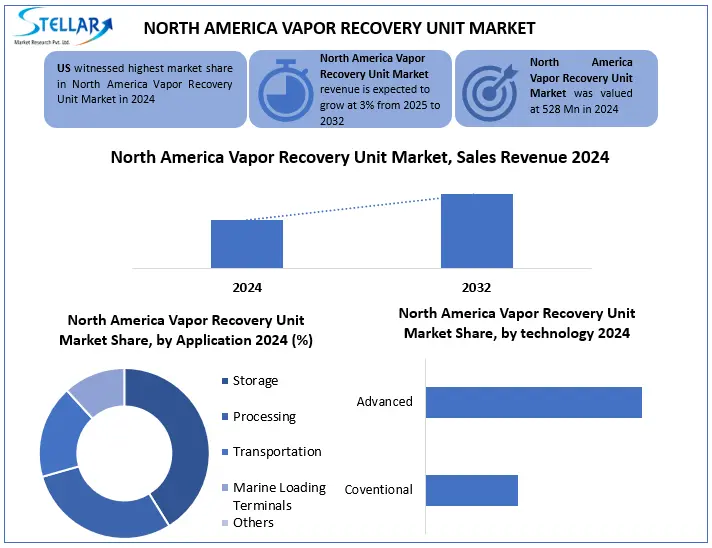
The North America Vapor Recovery Unit Market is witnessing steady growth as stricter environmental regulations, expanding oil and gas infrastructure, and increasing investments in emission control technologies accelerate the adoption of vapor recovery systems. Industries are deploying advanced Vapor Recovery Units (VRUs) to capture volatile organic compounds (VOCs), reduce hydrocarbon emissions, and recover valuable gases for reuse. According to Stellar Market Research, the North America Vapor Recovery Unit Market was valued at USD 528 million in 2024 and is expected to reach USD 668.85 million by 2032, growing at a CAGR of 3% during the forecast period. Rising compliance with EPA regulations and the expansion of LNG infrastructure continue to support market growth.
Understanding the North America Vapor Recovery Unit Market
A Vapor Recovery Unit (VRU) is an environmental control system designed to capture and process volatile organic compounds and hydrocarbon vapors generated during industrial operations such as oil and gas production, fuel storage, refining, transportation, and chemical processing. Instead of allowing these vapors to escape into the atmosphere, VRUs recover them for reuse, helping industries reduce emissions, improve operational efficiency, and recover valuable hydrocarbons.
North America remains one of the world’s largest markets for vapor recovery technologies due to its extensive oil and gas infrastructure, stringent environmental regulations, and growing emphasis on sustainable industrial practices. The United States leads regional demand, particularly across Texas and California, where refining capacity, fuel distribution, and shale production are highly concentrated.
𝐃𝐨𝐰𝐧𝐥𝐨𝐚𝐝 𝐅𝐫𝐞𝐞 𝐏𝐃𝐅 𝐁𝐫𝐨𝐜𝐡𝐮𝐫𝐞: https://www.stellarmr.com/report/req_sample/north-america-vapor-recovery-unit-market/2883
Key Factors Driving Market Growth
Stringent Environmental Regulations
Environmental policies introduced by the U.S. Environmental Protection Agency (EPA) and the California Air Resources Board (CARB) continue to drive widespread adoption of vapor recovery technologies.
Fuel stations, petroleum terminals, refineries, and storage facilities are required to install emission control systems that reduce VOC emissions and improve air quality. Compliance with these regulations remains one of the strongest market drivers.
Growth of Oil and Gas Infrastructure
North America’s upstream, midstream, and downstream oil and gas sectors continue to expand, creating consistent demand for vapor recovery equipment.
Production facilities, pipelines, storage tanks, and refineries rely on VRUs to recover hydrocarbons, minimize product losses, and improve operational safety while meeting environmental standards.
Expansion of LNG and Marine Fueling Facilities
The growing number of LNG bunkering projects and marine fueling terminals is creating new opportunities for vapor recovery technologies.
As ports modernize and LNG infrastructure expands, advanced VRUs are increasingly being installed to manage vapor emissions during loading, storage, and transportation operations.
Market Segmentation
The North America Vapor Recovery Unit Market is segmented by type, technology, application, end-use industry, and country.
By Type
The market includes:
Adsorption
Absorption
Condensation
Membrane Separation
Adsorption Technology Leads the Market
Adsorption-based vapor recovery units accounted for more than 40% of the market share in 2024 due to their high efficiency in removing volatile organic compounds, cost-effectiveness, and broad deployment across fuel stations and oil terminals.
Activated carbon adsorption systems continue to be the preferred choice because they offer reliable performance while meeting stringent EPA emission standards.
By End-Use Industry
Major end-use industries include:
Oil & Gas
Chemicals & Petrochemicals
Pharmaceuticals
Food & Beverage
Others
The oil and gas industry represented over 60% of total market demand in 2024, reflecting widespread implementation across exploration, refining, transportation, and fuel storage operations.
Technology Trends Transforming the Industry
AI-Based Predictive Maintenance
Manufacturers are incorporating artificial intelligence into VRU systems to monitor equipment health, predict maintenance needs, and optimize operational performance.
These digital capabilities reduce downtime, improve reliability, and lower maintenance costs.
Modular Vapor Recovery Systems
Compact, trailer-mounted, and modular VRUs are becoming increasingly popular because they can be rapidly deployed at remote drilling sites, temporary facilities, and LNG terminals.
These flexible systems reduce installation costs while improving operational efficiency.
Advanced Monitoring and Automation
Modern VRUs now feature IoT-enabled monitoring, remote diagnostics, automated process controls, and energy-efficient compressors that enhance hydrocarbon recovery while reducing operating expenses.
Sustainability and Regulatory Landscape
Sustainability continues to play a central role in market expansion.
VRUs help industries reduce greenhouse gas emissions, minimize volatile organic compound releases, improve air quality, and recover valuable hydrocarbons that would otherwise be lost.
Government initiatives promoting cleaner industrial operations, LNG infrastructure, and low-emission ports are expected to create additional opportunities throughout the forecast period.
Regional Market Outlook
United States
The United States dominates the North America Vapor Recovery Unit Market due to its extensive petroleum infrastructure, strict environmental regulations, and leadership in shale oil and gas production.
More than 5,000 petroleum facilities, 1,300+ refineries and storage terminals, and 35,000+ gasoline stations operating under CARB regulations contribute to sustained demand for vapor recovery systems. The country also accounts for nearly 90% of regional VRU manufacturers and 78% of related patents.
Canada
Canada continues to expand its market through investments in oil sands production, LNG export terminals, natural gas processing facilities, and increasingly stringent environmental regulations.
Mexico
Mexico is emerging as an attractive market as refinery modernization, petroleum storage upgrades, and environmental compliance initiatives encourage wider adoption of vapor recovery technologies.
Market Challenges
Despite positive growth prospects, several challenges remain.
VRUs require regular inspections, specialized technicians, and preventive maintenance, increasing lifecycle operating costs. According to the report, over 30% of operators identify maintenance costs as a major adoption barrier, while approximately 15–20% of systems experience annual downtime due to component failures.
Smaller fuel stations and independent operators may face financial challenges when upgrading aging equipment or deploying advanced recovery technologies.
Competitive Landscape
The North America Vapor Recovery Unit Market remains highly competitive, with manufacturers focusing on automation, digital monitoring, energy efficiency, and regulatory compliance.
Major companies include:
John Zink Hamworthy Combustion (Baker Hughes)
Hy-Bon/EDI
Cimarron Energy
AEREON
Polaris Energy Services
Cool Sorption
ClearPower Systems
Progin Mexicana
Tecam Group México
Sistemas de Control Ambiental (SCA)
Leading manufacturers continue investing in AI-powered predictive maintenance, modular VRU systems, advanced adsorption technologies, and strategic partnerships with oil and gas operators to strengthen their market positions.
𝐃𝐨𝐰𝐧𝐥𝐨𝐚𝐝 𝐅𝐫𝐞𝐞 𝐏𝐃𝐅 𝐁𝐫𝐨𝐜𝐡𝐮𝐫𝐞: https://www.stellarmr.com/report/req_sample/north-america-vapor-recovery-unit-market/2883
Future Outlook
The North America Vapor Recovery Unit Market is expected to maintain steady growth through 2032 as industries prioritize environmental compliance, emission reduction, and operational efficiency.
Advancements in AI-enabled monitoring, IoT connectivity, modular equipment design, and high-efficiency vapor recovery technologies will continue improving system performance while lowering operating costs. With increasing investments in LNG infrastructure, refinery modernization, and sustainable industrial operations, vapor recovery units will remain a critical technology for reducing emissions and maximizing hydrocarbon recovery across North America.
Media Contact
Stellar Market Research
Website: Stellar Market Research – Global Research Reports & Consulting
Email: sales@stellarmr.com
