The US 5G Technology Market is at the forefront of next-generation wireless innovation, enabling ultra-fast data speeds, low latency, and massive device connectivity. As the successor to 4G LTE, 5G technology is transforming industries, powering smart cities, autonomous vehicles, IoT ecosystems, and advanced digital services.
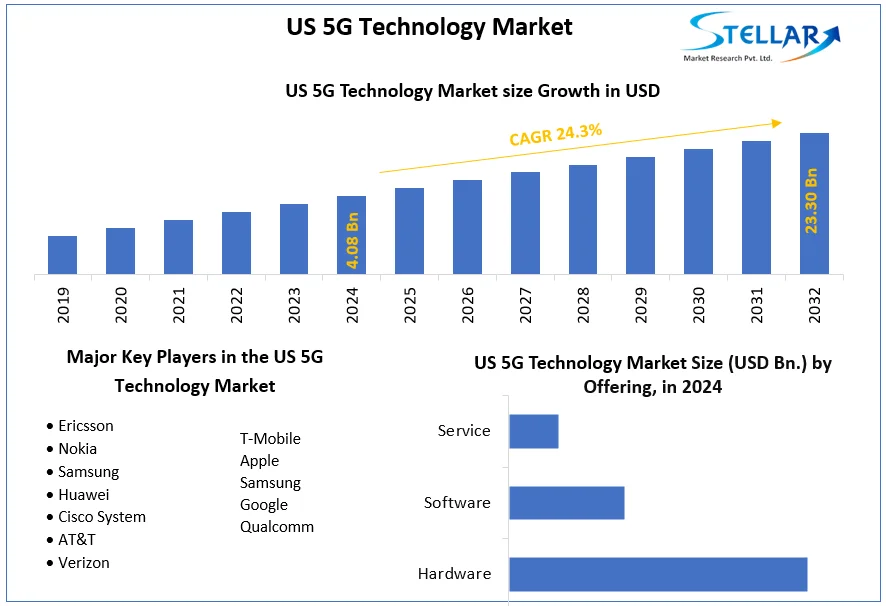
US 5G Technology Market size was valued at USD 4.08 Bn. in 2024 and the total US 5G Technology revenue is expected to grow at a CAGR of 24.3% from 2025 to 2032, reaching nearly USD 23.30 Bn.
With strong investments from telecom operators and rapid infrastructure deployment, the United States is a global leader in 5G adoption and development.
A Market Driven by Speed, Connectivity, and Innovation
A defining trend in the US 5G technology market is the shift toward high-speed, real-time connectivity. 5G is not just about faster internet—it is enabling entirely new applications such as remote healthcare, immersive entertainment, and industrial automation.
The demand for seamless connectivity across devices and platforms is accelerating adoption.
Key Market Insights
- 5G offers higher speed, lower latency, and greater capacity than previous generations.
- Strong demand across telecommunications, healthcare, automotive, and manufacturing sectors.
- Rapid deployment of 5G infrastructure nationwide.
- Increasing adoption of IoT and connected devices.
- Growth of edge computing and cloud integration.
- Expansion of smart city and digital transformation initiatives.
- Rising investment from both public and private sectors.
Market Drivers Accelerating Growth
1. Growing Demand for High-Speed Connectivity
Consumers and businesses require faster and more reliable networks.
2. Expansion of IoT and Smart Devices
5G supports large-scale device connectivity and data exchange.
3. Government and Industry Investments
Significant funding is accelerating infrastructure development.
Market Challenges and Restraints
1. High Infrastructure Costs
Building 5G networks requires significant capital investment.
2. Spectrum Availability and Regulation
Efficient spectrum allocation is essential for network performance.
Technology and Innovation Trends
Technology is at the core of the US 5G market, with advancements in network slicing, edge computing, massive MIMO (Multiple Input Multiple Output), and AI-driven network optimization.
Edge computing is reducing latency by processing data closer to the source, enabling real-time applications such as autonomous driving and remote surgery. AI and machine learning are optimizing network performance and enhancing security.
Private 5G networks are emerging in industries such as manufacturing and logistics, enabling customized and secure connectivity. Integration with cloud platforms is also enabling scalable and flexible network management.
Visual Snapshot: 5G Technology in the US
Regional Insights: Nationwide Deployment with Urban Leadership
The US 5G market is expanding across all regions:
- Urban Areas: Early adoption and high network density.
- Suburban and Rural Areas: Gradual expansion of coverage.
Major cities such as New York, Los Angeles, and Chicago are leading in 5G deployment and innovation.
Recent Industry Developments
- Verizon Communications (2025): Expanded 5G Ultra Wideband network coverage.
- AT&T (2024): Enhanced nationwide 5G services.
- T-Mobile (2025): Accelerated mid-band 5G deployment.
- Qualcomm (2024): Advanced 5G chipset technologies.
- Federal Communications Commission (2025): Allocated additional spectrum for 5G expansion.
Competitive Landscape
The US 5G technology market is highly competitive, with telecom operators, technology providers, and equipment manufacturers driving innovation.
Companies are focusing on network expansion, technological advancements, strategic partnerships, and service differentiation to maintain market leadership.
Analyst Perspective
A senior market analyst notes:
“The US 5G market is a catalyst for digital transformation. Its impact will extend across industries, enabling new business models and services.”
Future Outlook
The US 5G Technology Market is expected to witness strong growth in the coming years, driven by increasing demand for connectivity, expansion of IoT ecosystems, and advancements in network technologies.
The integration of 5G with AI, cloud computing, and edge technologies will further enhance its capabilities. As adoption increases, 5G will play a critical role in shaping the future of communication, industry, and innovation.
Overall, the market presents significant opportunities for telecom operators, technology companies, and investors aiming to lead the next wave of digital transformation.
