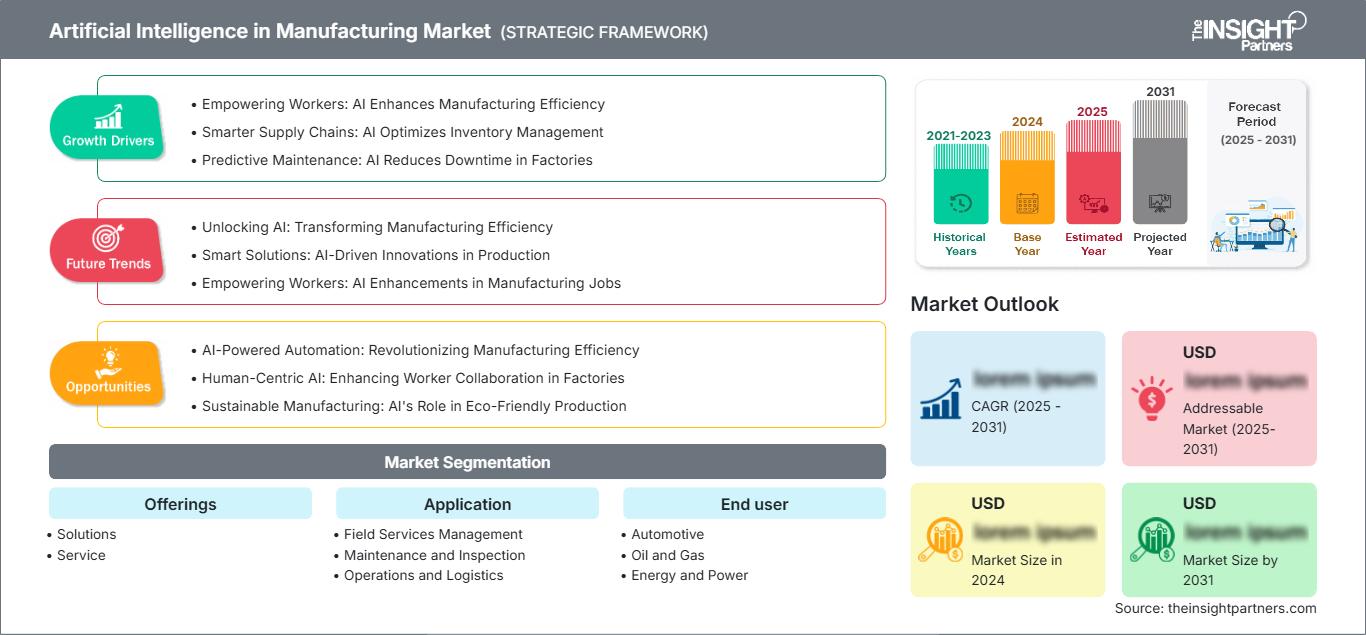
The Artificial Intelligence (AI) is rapidly transforming the global manufacturing industry by enabling smarter production systems, improving operational efficiency, reducing costs, and enhancing decision-making capabilities. Manufacturers across industries are increasingly adopting AI-powered solutions to automate processes, optimize supply chains, predict equipment failures, and improve product quality.
According to The Insight Partners, The Artificial Intelligence in Manufacturing Market is expected to witness significant growth during the forecast period. The market was valued at US$ 8.17 billion in 2024 and is projected to reach US$ 87.44 billion by 2031, expanding at a compound annual growth rate (CAGR) of 40.3% from 2025 to 2031.
Overview of Artificial Intelligence in Manufacturing
Artificial Intelligence in manufacturing refers to the use of advanced computational technologies that allow machines and production systems to analyze data, learn from patterns, make decisions, and perform tasks with minimal human intervention. AI applications are becoming essential components of modern factories, where manufacturers use intelligent systems to monitor production lines, identify defects, forecast demand, and optimize resource utilization.
Traditional manufacturing systems often depend on manual inspections, scheduled maintenance, and fixed production processes. However, AI introduces adaptive and data-driven approaches. Smart manufacturing facilities equipped with AI can continuously collect information from machines, sensors, and enterprise systems to improve productivity and operational performance.
Market Growth Drivers
- Increasing Demand for Smart Factories
The emergence of smart factories is one of the primary factors accelerating the adoption of AI in manufacturing. Companies are investing in digital transformation initiatives to create connected production environments where machines, systems, and employees can work together efficiently.
Smart factories use AI algorithms to analyze real-time production data and improve processes automatically. These capabilities help organizations reduce waste, increase productivity, and maintain consistent product quality.
- Predictive Maintenance Adoption
Predictive maintenance is among the most important applications of AI in manufacturing. Traditional maintenance strategies often involve scheduled servicing or repairing equipment after failures occur. AI-based predictive maintenance allows manufacturers to identify potential machine problems before breakdowns happen.
By analyzing equipment data collected through sensors, AI systems can predict failures, estimate maintenance requirements, and reduce unexpected downtime. This results in improved machine reliability, lower maintenance costs, and increased production efficiency.
- Automation and Workforce Enhancement
Manufacturers worldwide are adopting AI-powered automation to improve operational efficiency and address challenges related to production complexity and labor shortages. AI does not simply replace human involvement; instead, it enhances worker capabilities by providing better insights, automated assistance, and improved safety measures.
Collaborative robots, AI-based monitoring systems, and intelligent workflow management tools enable employees to focus on more complex and strategic tasks while machines handle repetitive activities.
- Optimization of Supply Chains
Supply chain disruptions have highlighted the importance of intelligent planning and risk management. AI enables manufacturers to improve inventory management, demand forecasting, logistics planning, and supplier coordination.
AI-based systems can analyze historical sales data, market trends, and operational information to predict future demand and optimize production schedules. This helps companies reduce excess inventory, avoid shortages, and improve supply chain resilience.
Get Sample PDF of the report @ https://www.theinsightpartners.com/sample/TIPRE00005011
Market Segmentation Analysis
The Insight Partners report analyzes the Artificial Intelligence in Manufacturing Market based on offerings, applications, end users, and geographical regions.
By Offering
Solutions
AI solutions represent a major segment of the market. These solutions include AI software platforms, machine learning applications, computer vision systems, and analytics tools designed specifically for industrial environments.
Manufacturers use AI solutions to automate inspection processes, improve production planning, monitor equipment performance, and enhance operational decision-making.
Services
AI-related services include consulting, implementation, integration, maintenance, and support services. As organizations move toward AI adoption, service providers play an important role in helping manufacturers deploy and manage AI technologies effectively.
By Application
Field Services Management
AI improves field service operations by enabling predictive analysis, automated scheduling, and remote monitoring. Manufacturing companies can use AI tools to manage service requests efficiently and improve customer support.
Maintenance and Inspection
Maintenance and inspection represent one of the fastest-growing applications of AI in manufacturing. Computer vision technology allows machines to inspect products automatically, detect defects, and maintain quality standards.
AI-based inspection systems provide faster and more accurate results compared with traditional manual inspection methods, especially in industries requiring high precision.
Operations and Logistics
AI enhances manufacturing operations by optimizing production planning, resource allocation, and logistics management. Intelligent systems analyze production data and recommend improvements to maximize efficiency.
By End User
Automotive Industry
The automotive sector is one of the largest adopters of AI technologies. Automobile manufacturers use AI for robotic assembly, autonomous quality inspection, predictive maintenance, and supply chain optimization.
With increasing demand for electric vehicles and advanced automotive technologies, AI adoption in this sector is expected to continue expanding.
Oil and Gas Industry
AI helps oil and gas manufacturers improve equipment monitoring, safety management, and operational efficiency. Predictive analytics allows companies to identify equipment issues and optimize industrial processes.
Energy and Power Sector
Power generation and energy companies are using AI for asset monitoring, predictive maintenance, and energy management. AI solutions help improve reliability and reduce operational expenses.
Electronics and Semiconductor Industry
The electronics and semiconductor sectors rely heavily on AI for precision manufacturing, defect detection, and process optimization. As semiconductor demand increases globally, AI adoption is becoming increasingly important for maintaining production efficiency.
Get the Premium Research Report @ https://www.theinsightpartners.com/buy/TIPRE00005011
Regional Market Outlook
The Artificial Intelligence in Manufacturing Market is analyzed across regions including North America, Europe, Asia Pacific, and South and Central America.
North America
North America is expected to remain a significant market due to strong investments in automation, advanced manufacturing technologies, and industrial digital transformation. The presence of technology companies and advanced manufacturing infrastructure supports AI adoption in the region.
Europe
European countries are focusing on Industry 4.0 initiatives, sustainable manufacturing, and automation. AI technologies are being adopted to improve energy efficiency, reduce waste, and enhance manufacturing competitiveness.
Asia Pacific
Asia Pacific is expected to experience substantial growth due to rapid industrialization, expanding manufacturing capabilities, and increasing investments in smart factory technologies. Countries such as China, Japan, South Korea, and India are actively adopting AI solutions across manufacturing sectors.
South and Central America
Manufacturers in South and Central America are gradually adopting AI technologies to improve productivity and modernize industrial operations. Increasing awareness of digital transformation is expected to support future market growth.
Key Challenges in AI Adoption
Despite strong growth opportunities, several challenges may limit widespread AI adoption in manufacturing.
- High Implementation Costs:-Deploying AI systems requires significant investment in software, hardware, infrastructure, and skilled professionals. Small and medium-sized manufacturers may face difficulties in adopting advanced AI technologies due to financial limitations.
- Data Management Issues:-AI systems depend on large volumes of high-quality data. Many manufacturing organizations still operate with outdated systems, making data collection, integration, and management challenging.
- Lack of Skilled Workforce:-Successful AI implementation requires professionals with expertise in artificial intelligence, data analytics, automation, and industrial processes. The shortage of skilled personnel remains a major challenge for many manufacturers.
- Cybersecurity Risks:-As factories become more connected, cybersecurity threats become increasingly important. AI-enabled manufacturing systems must include strong security measures to protect sensitive operational data.
Competitive Landscape
- Cisco Systems Inc.
- General Electric Company
- IBM Corporation
- Intel Corporation
- Mitsubishi Electric Corporation
- NVIDIA Corporation
- Robert Bosch GmbH
- Rockwell Automation
- Siemens AG
- Ubtech Robotics
Organizations investing in AI capabilities are expected to gain competitive advantages through improved productivity, faster decision-making, and more flexible manufacturing operations.
Future Outlook
The Artificial Intelligence in Manufacturing Market is entering a period of rapid expansion as industries worldwide embrace automation, smart factories, and data-driven production systems. AI technologies are transforming manufacturing by improving efficiency, reducing operational costs, enhancing quality control, and enabling predictive decision-making.
About The Insight Partners
The Insight Partners is a global leader in market research, delivering comprehensive analysis and actionable insights across diverse industries. The company empowers decision-makers with data-driven intelligence to navigate evolving markets and accelerate growth.
Contact Us:
- Contact Person: Ankit Mathur
- E-mail: ankit.mathur@theinsightpartners.com
- Phone: +1-646-491-9876
Also Available in :
Korean German Japanese French Chinese Italian Spanish

- Hydraulic Pumps Market Growth Driven - 2026-07-17
- Automotive Emission Analyzer Market Growth, Trends - 2026-07-17
- Overhead Cranes Market Share Expands as Smart Manufacturing - 2026-07-17