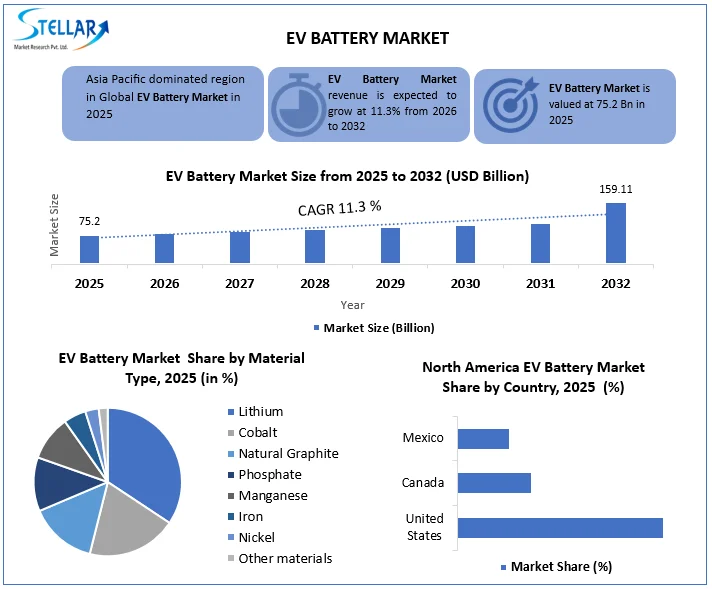
EV Battery Market to reach USD 159.11 Bn by 2032 from USD 75.2 Bn in 2025 at a CAGR of 11.3%.
The Electric Vehicle Battery Market is witnessing rapid transformation as automakers, governments, and technology companies accelerate investments in battery innovation, manufacturing capacity, and sustainable energy solutions. The rising adoption of electric vehicles (EVs), declining battery costs, advancements in lithium-ion technology, and increasing demand for longer-range vehicles are driving significant market expansion. According to Stellar Market Research, the Electric Vehicle Battery Market is expected to grow substantially during the forecast period, supported by electrification targets, battery technology improvements, and expanding EV production worldwide. Global EV battery deployment reached approximately 1.2 TWh in 2025, demonstrating strong momentum as electric mobility adoption continues accelerating.
Understanding the Electric Vehicle Battery Market
Electric vehicle batteries are rechargeable energy storage systems that power electric cars, buses, trucks, and two-wheelers. These batteries determine key vehicle performance factors, including driving range, charging speed, efficiency, durability, and overall cost.
Lithium-ion batteries currently dominate the EV battery landscape due to their high energy density, longer lifespan, and established manufacturing ecosystem. However, emerging technologies such as solid-state batteries, sodium-ion batteries, and advanced lithium chemistries are gaining attention as manufacturers seek improved safety, faster charging capabilities, and reduced dependence on critical raw materials.
The increasing transition from internal combustion engines to electric mobility has positioned batteries as the most critical component of the EV value chain. Battery performance improvements and cost reductions are expected to determine the pace of global vehicle electrification over the next decade.
𝐃𝐨𝐰𝐧𝐥𝐨𝐚𝐝 𝐅𝐫𝐞𝐞 𝐏𝐃𝐅 𝐁𝐫𝐨𝐜𝐡𝐮𝐫𝐞: https://www.stellarmr.com/report/req_sample/electric-vehicle-battery-market/2899
Key Factors Driving Market Growth
Rising Electric Vehicle Adoption Worldwide
The rapid growth of electric vehicle sales is the primary factor supporting demand for EV batteries.
Governments worldwide are introducing emission reduction targets, fuel economy regulations, and incentives to encourage electric vehicle adoption. Automakers are also expanding their EV portfolios by launching electric passenger cars, commercial vehicles, and electric two-wheelers.
Electric cars remain the largest contributor to battery demand, while electric trucks and commercial vehicles are emerging as high-growth segments due to increasing fleet electrification initiatives. In 2024, EV battery demand exceeded 950 GWh, driven mainly by electric passenger vehicles.
Expansion of Battery Manufacturing Capacity
Battery manufacturers are investing heavily in gigafactories to meet increasing EV demand and strengthen regional supply chains.
Companies across Asia Pacific, Europe, and North America are expanding production facilities to reduce dependence on imported batteries and secure critical material supply. Global lithium-ion battery manufacturing capacity has continued expanding, with significant investments outside traditional manufacturing hubs.
Localization of battery production is becoming a strategic priority as governments focus on energy security, domestic manufacturing, and clean technology competitiveness.
Advancements in Battery Technology
Continuous innovation in battery chemistry is improving EV performance and reducing ownership costs.
Key technological developments include:
Higher energy-density lithium-ion batteries
Lithium iron phosphate (LFP) batteries
Solid-state batteries
Sodium-ion battery technologies
Faster charging solutions
Battery management systems
Solid-state batteries are gaining attention because they can potentially offer higher energy density and improved safety compared with conventional lithium-ion technologies.
Market Segmentation
The Electric Vehicle Battery Market is segmented based on battery type, vehicle type, propulsion type, capacity, and region.
By Battery Type
The market includes:
Lithium-Ion Batteries
Lead-Acid Batteries
Nickel Metal Hydride Batteries
Solid-State Batteries
Others
Lithium-Ion Batteries Dominate the Market
Lithium-ion batteries currently account for the largest market share due to their superior energy density, lightweight structure, and widespread adoption across passenger EVs and commercial vehicles.
Lithium iron phosphate (LFP) batteries are gaining popularity because of their improved safety, longer cycle life, and lower cost compared with nickel-based battery chemistries.
By Vehicle Type
Major vehicle categories include:
Passenger Cars
Commercial Vehicles
Buses
Two-Wheelers
Three-Wheelers
Passenger electric vehicles represent the largest demand segment, while electric buses, trucks, and commercial fleets are expected to experience strong growth as transportation companies pursue carbon reduction goals.
Technology Trends Reshaping the Industry
Battery Recycling and Circular Economy
Battery recycling is becoming a crucial part of the EV ecosystem as the number of retired batteries increases.
Recycling technologies enable recovery of valuable materials such as lithium, nickel, cobalt, and graphite, reducing dependence on mining activities while improving supply chain resilience. The development of efficient recycling infrastructure is expected to become increasingly important for long-term battery sustainability.
Artificial Intelligence in Battery Management
Artificial intelligence and machine learning are improving battery performance through advanced monitoring systems.
AI-based battery management systems help optimize charging cycles, predict battery health, improve safety, and extend battery lifespan.
Faster Charging Technologies
Battery manufacturers are investing in technologies that reduce charging times while maintaining safety and performance.
Ultra-fast charging solutions are becoming increasingly important as consumers demand EVs with convenience similar to conventional fuel-powered vehicles.
Sustainability and Regulatory Landscape
Environmental regulations and sustainability goals are significantly influencing the EV battery industry.
Governments are implementing policies related to:
Battery recycling requirements
Responsible mineral sourcing
Carbon reduction targets
Domestic battery manufacturing incentives
Supply chain transparency
Sustainable battery production is becoming a competitive advantage as automakers and consumers increasingly prioritize environmentally responsible mobility solutions.
Regional Market Outlook
Asia Pacific
Asia Pacific dominates the Electric Vehicle Battery Market due to strong EV adoption, extensive manufacturing capabilities, and the presence of major battery producers.
China remains the leading market, supported by large-scale EV production, advanced battery supply chains, and significant investments in battery manufacturing. Companies headquartered in China, Japan, and South Korea continue playing major roles in global battery production.
Europe
Europe is witnessing strong growth due to strict carbon emission regulations, government support for EV adoption, and investments in domestic battery manufacturing.
Countries such as Germany, France, and Sweden are expanding battery production capabilities to strengthen regional electric vehicle supply chains.
North America
North America is experiencing increasing investment in EV battery manufacturing driven by government incentives, automaker partnerships, and growing electric vehicle demand.
The United States is focusing on developing domestic battery supply chains and reducing reliance on imported battery components.
Market Challenges
Despite strong growth opportunities, the Electric Vehicle Battery Market faces several challenges.
Major concerns include:
Fluctuating prices of lithium, nickel, and cobalt
Supply chain risks
High initial manufacturing costs
Battery recycling complexity
Limited charging infrastructure
Raw material availability remains a critical issue as demand for lithium and other battery minerals continues increasing.
Competitive Landscape
The Electric Vehicle Battery Market is highly competitive, with companies focusing on manufacturing expansion, technology development, strategic partnerships, and supply chain integration.
Major players include:
Contemporary Amperex Technology Co. Limited (CATL)
BYD Company Limited
LG Energy Solution
Panasonic Energy
Samsung SDI
SK Innovation
Northvolt
Tesla
Toyota
EVE Energy
Leading companies are investing in gigafactories, next-generation battery technologies, recycling capabilities, and strategic collaborations with automotive manufacturers to strengthen their market positions.
𝐃𝐨𝐰𝐧𝐥𝐨𝐚𝐝 𝐅𝐫𝐞𝐞 𝐏𝐃𝐅 𝐁𝐫𝐨𝐜𝐡𝐮𝐫𝐞: https://www.stellarmr.com/report/req_sample/electric-vehicle-battery-market/2899
Future Outlook
The Electric Vehicle Battery Market is expected to experience strong growth through the forecast period as global transportation shifts toward electrification. Increasing EV adoption, battery cost reductions, manufacturing expansion, and technological advancements will continue shaping industry development.
Future growth will depend on innovations in solid-state batteries, sustainable production methods, recycling technologies, and regional supply chain development. As governments and industries accelerate their transition toward clean transportation, EV batteries will remain a central technology driving the future of mobility.
Media Contact
Stellar Market Research
Website: Stellar Market Research – Global Research Reports & Consulting
Email: sales@stellarmr.com
