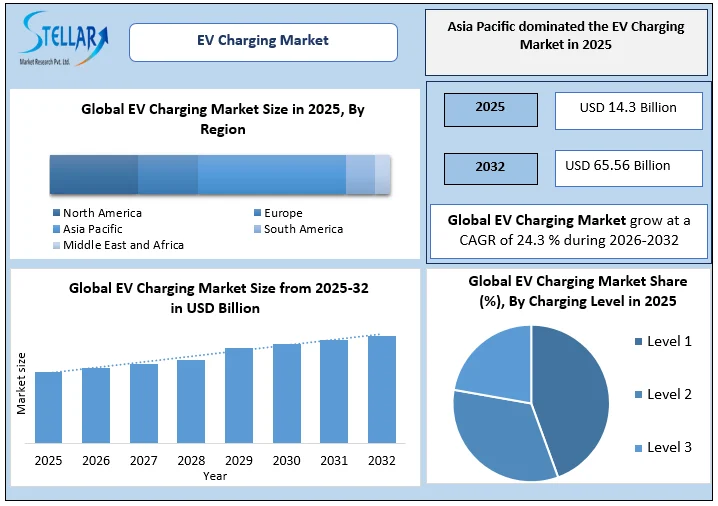
The EV Charging Market was valued at USD 14.3 billion in 2025 and is projected to reach USD 65.56 billion by 2032, growing at a CAGR of 24.3 % during the forecast period.
The EV Charging Market is witnessing rapid expansion as governments, automotive manufacturers, energy companies, and technology providers accelerate investments in charging infrastructure to support the global shift toward electric mobility. Growing electric vehicle adoption, rising demand for fast-charging solutions, renewable energy integration, and smart grid connectivity are reshaping the transportation ecosystem. According to Stellar Market Research, the EV Charging Market is positioned for significant growth as charging networks become a critical component of future mobility infrastructure. Global public charging infrastructure continues expanding, with more than 5 million public charging points available worldwide, highlighting the increasing focus on building accessible EV ecosystems.
Understanding the EV Charging Market
The EV Charging Market includes hardware, software, and services designed to recharge electric vehicles, including battery electric vehicles (BEVs) and plug-in hybrid electric vehicles (PHEVs). Charging solutions range from residential AC chargers to high-power DC fast-charging stations deployed across highways, commercial locations, workplaces, and urban mobility hubs.
The market has evolved from basic charging equipment into a connected infrastructure ecosystem supported by cloud platforms, mobile applications, digital payments, energy management systems, and real-time monitoring technologies. As electric vehicle ownership increases globally, reliable charging accessibility has become one of the most important factors influencing consumer adoption.
Public charging expansion has accelerated significantly in recent years. In 2024, more than 1.3 million public charging points were added globally, representing over 30% annual growth, while fast-charging networks continued expanding to support long-distance EV travel.
𝐃𝐨𝐰𝐧𝐥𝐨𝐚𝐝 𝐅𝐫𝐞𝐞 𝐏𝐃𝐅 𝐁𝐫𝐨𝐜𝐡𝐮𝐫𝐞: https://www.stellarmr.com/report/req_sample/ev-charging-market/2901
Key Factors Driving EV Charging Market Growth
Increasing Electric Vehicle Adoption
The rapid growth of electric vehicles is the primary driver of charging infrastructure demand.
Automakers are expanding EV portfolios across passenger vehicles, commercial fleets, buses, and two-wheelers as governments introduce emission reduction targets and clean transportation policies. As EV ownership increases, the need for convenient and widespread charging networks continues to rise.
Consumers and fleet operators increasingly prioritize charging availability, charging speed, and network reliability when selecting electric vehicles, making charging infrastructure a strategic requirement for transportation electrification.
Government Support and Electrification Policies
Government initiatives are playing a major role in accelerating EV charging deployment.
Countries across North America, Europe, and Asia Pacific are implementing incentives, infrastructure funding programs, and zero-emission transportation strategies to encourage charging network development.
Public-private partnerships are becoming increasingly important as governments collaborate with utilities, automotive companies, and charging providers to expand charging accessibility. For example, multiple regions are investing in highway charging corridors and urban charging hubs to reduce range anxiety and support mass EV adoption.
Growing Demand for Fast Charging Solutions
Fast charging technology is transforming the EV ownership experience by significantly reducing charging times.
DC fast chargers and ultra-fast chargers are gaining popularity among commercial fleet operators, logistics companies, and highway users. These systems allow EV drivers to recharge quickly, making electric vehicles more practical for long-distance transportation.
The global stock of fast chargers has expanded rapidly, with ultra-fast charging solutions becoming increasingly common due to falling equipment costs and improved battery compatibility.
EV Charging Market Segmentation
The EV Charging Market is segmented by charger type, charging mode, application, installation type, connector type, and region.
By Charger Type
The market includes:
AC Chargers
DC Fast Chargers
Wireless Chargers
DC Fast Chargers Gain Momentum
DC fast chargers are expected to witness strong growth due to increasing demand for rapid charging infrastructure.
Unlike conventional AC chargers, DC chargers directly supply power to vehicle batteries, reducing charging time and improving suitability for highways, commercial fleets, and public charging stations.
By Application
Major application areas include:
Residential Charging
Commercial Charging
Public Charging
Fleet Charging
Public Charging Infrastructure Expands Rapidly
Public charging stations are becoming increasingly important as EV adoption moves beyond early adopters.
Urban areas, shopping centers, parking facilities, and transportation hubs are emerging as major deployment locations. Public chargers support users without private parking facilities and enable convenient charging during daily activities.
Technology Trends Reshaping the EV Charging Industry
Smart Charging and Energy Management
Smart charging technologies are improving charging efficiency by using real-time data, artificial intelligence, and automated energy management systems.
These solutions help balance electricity demand, reduce grid pressure, and optimize charging schedules based on energy availability and pricing.
Vehicle-to-Grid Technology
Vehicle-to-grid (V2G) technology is emerging as a major innovation within the EV charging ecosystem.
V2G systems allow electric vehicles to supply stored electricity back to the grid during peak demand periods. This technology can improve grid stability while creating additional value for EV owners.
Wireless Charging Innovation
Wireless EV charging technology is gaining attention due to its convenience and potential applications in autonomous vehicles, commercial fleets, and premium electric cars.
By eliminating physical connectors, wireless charging systems can provide seamless charging experiences in parking areas and dedicated charging zones.
Renewable Energy Integration
Charging infrastructure providers are increasingly integrating solar power, battery storage systems, and renewable electricity sources.
Renewable-powered charging stations help reduce carbon emissions and support sustainability goals while improving energy independence.
Sustainability and Regulatory Landscape
Sustainability is one of the strongest drivers shaping the EV Charging Market.
Governments are promoting electric mobility as part of broader climate strategies aimed at reducing transportation emissions. Charging infrastructure development is closely linked with renewable energy expansion, smart grid modernization, and carbon neutrality initiatives.
Regulatory focus is also increasing around charging standards, interoperability, cybersecurity, and consumer protection. Standardized charging systems help improve compatibility between vehicles and charging networks, creating a more efficient global EV ecosystem.
Regional Market Outlook
Asia Pacific
Asia Pacific dominates the EV Charging Market due to strong electric vehicle adoption, large-scale manufacturing capabilities, and extensive government support.
China remains the leading market for EV charging infrastructure, supported by a large EV user base and significant investments in public charging networks. The country accounted for a major share of global charging expansion, adding hundreds of thousands of public charging points annually.
Japan, South Korea, and India are also increasing investments in charging infrastructure to support growing electric mobility demand.
Europe
Europe is experiencing strong growth due to ambitious carbon reduction targets, strict emission regulations, and increasing EV adoption.
Countries including Germany, France, Norway, and the Netherlands continue expanding public charging networks while encouraging private and commercial charging installations.
North America
North America is witnessing increasing investments from automakers, utilities, and charging network operators.
The United States is expanding charging infrastructure through federal and state-level initiatives focused on creating nationwide fast-charging corridors and supporting EV adoption.
Market Challenges
Despite strong growth opportunities, the EV Charging Market faces several challenges:
High installation and maintenance costs
Grid capacity limitations
Uneven charging availability in rural areas
Lack of universal charging standards
Infrastructure deployment delays
Power grid upgrades and efficient site planning remain critical factors for successful charging network expansion.
Competitive Landscape
The EV Charging Market is highly competitive, with companies focusing on network expansion, charging technology innovation, strategic partnerships, and digital platforms.
Major companies operating in the market include:
Tesla
ChargePoint
ABB
Siemens
Schneider Electric
BP Pulse
Shell Recharge
EVgo
Blink Charging
Delta Electronics
These companies are investing in fast-charging networks, cloud-based charging platforms, renewable energy integration, and fleet charging solutions to strengthen their market positions.
𝐃𝐨𝐰𝐧𝐥𝐨𝐚𝐝 𝐅𝐫𝐞𝐞 𝐏𝐃𝐅 𝐁𝐫𝐨𝐜𝐡𝐮𝐫𝐞: https://www.stellarmr.com/report/req_sample/ev-charging-market/2901
Future Outlook
The EV Charging Market is expected to experience strong growth through the forecast period as electric vehicle adoption accelerates globally. The future of the industry will be shaped by ultra-fast charging technology, smart energy management, renewable integration, and digital connectivity.
As governments and businesses continue investing in sustainable transportation infrastructure, EV charging networks will become a fundamental component of the global mobility ecosystem. The transition from traditional fuel-based transportation toward electric mobility will create significant opportunities for charging operators, technology providers, utilities, and automotive companies worldwide.
Media Contact
Stellar Market Research
Website: Stellar Market Research – Global Research Reports & Consulting
Email: sales@stellarmr.com
