Asia Pacific Building Insulation Materials Market: Industry Trends, Growth Drivers, and Future Outlook (2025–2032)
The Asia Pacific Building Insulation Materials Market is witnessing consistent growth as governments, builders, and property owners increasingly focus on energy efficiency, sustainable construction, and occupant comfort. Rapid urbanization, expanding infrastructure projects, and stricter building energy regulations are driving demand for advanced insulation materials across residential, commercial, and industrial sectors.
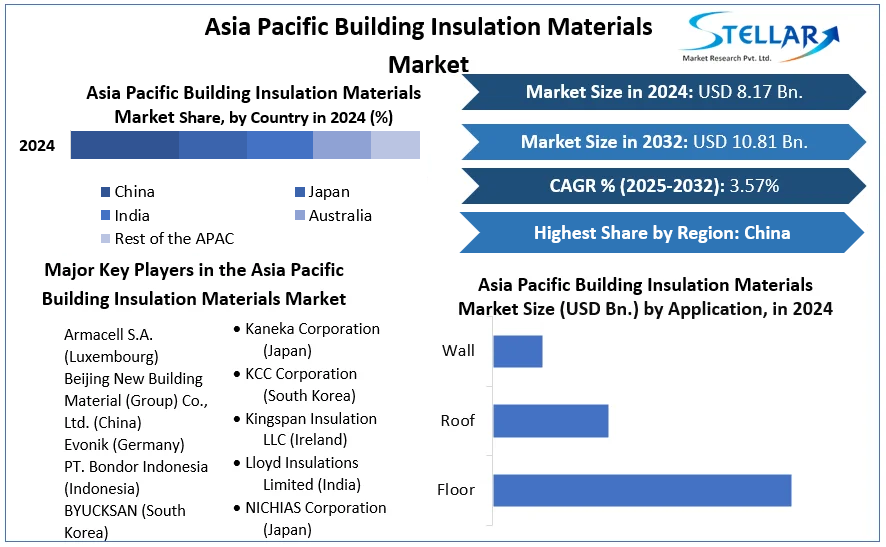
According to Stellar Market Research, the Asia Pacific Building Insulation Materials Market was valued at USD 8.17 billion in 2024 and is expected to reach USD 10.81 billion by 2032, growing at a CAGR of 3.57% during the forecast period.
What Are Building Insulation Materials?
Building insulation materials are designed to reduce heat transfer, improve energy efficiency, and enhance indoor comfort in residential and commercial structures. These materials help maintain desired temperatures throughout the year, reducing energy consumption associated with heating and cooling systems.
Common insulation materials include:
Expanded Polystyrene (EPS)
Extruded Polystyrene (XPS)
Mineral Wool
Polyurethane Foam (PU)
Polyisocyanurate (PIR)
Fiberglass
These products are widely used in walls, roofs, floors, ceilings, and building envelopes to improve thermal performance and energy conservation.
𝐃𝐨𝐰𝐧𝐥𝐨𝐚𝐝 𝐅𝐫𝐞𝐞 𝐏𝐃𝐅 𝐁𝐫𝐨𝐜𝐡𝐮𝐫𝐞: https://www.stellarmr.com/report/req_sample/Asia-Pacific-Building-Insulation-Materials-Market/1244
Key Market Drivers
Rapid Urbanization and Construction Growth
Asia Pacific remains one of the world’s fastest-growing construction markets. Countries such as China, India, Indonesia, Vietnam, and Thailand are investing heavily in residential housing, commercial buildings, transportation infrastructure, and industrial facilities. This growth is creating substantial demand for building insulation materials.
Rising Focus on Energy Efficiency
Buildings account for a significant share of global energy consumption. Governments across Asia Pacific are implementing stricter energy-efficiency standards and green building regulations to reduce carbon emissions and energy costs. Insulation materials play a critical role in meeting these objectives.
Growing Awareness of Sustainable Construction
Developers and consumers are increasingly recognizing the long-term benefits of energy-efficient buildings, including lower utility bills, improved comfort, and reduced environmental impact. This trend continues to support market expansion across the region.
Emerging Market Trends
Increasing Adoption of EPS and XPS Insulation
Expanded Polystyrene (EPS) and Extruded Polystyrene (XPS) remain among the most widely used insulation materials due to their lightweight structure, excellent thermal performance, moisture resistance, and cost-effectiveness. EPS accounted for the largest market share in 2024.
Growth of Green Building Projects
The rise of LEED-certified and environmentally sustainable construction projects is encouraging the adoption of advanced insulation systems that contribute to energy savings and improved building performance.
Technological Advancements
Manufacturers are developing insulation products with enhanced fire resistance, acoustic performance, moisture protection, and environmental sustainability. These innovations are expanding application opportunities across various building types.
Market Segmentation
By Product
The market is segmented into:
Expanded Polystyrene (EPS)
Extruded Polystyrene (XPS)
Mineral Wool
Others
Among these, Expanded Polystyrene (EPS) dominated the market with a share of approximately 47.6% in 2024 due to its excellent thermal insulation properties, lightweight design, and cost efficiency.
By Application
Major application segments include:
Wall Insulation
Roof Insulation
Floor Insulation
The wall insulation segment accounted for the largest market share in 2024, supported by increasing demand for energy-efficient residential and commercial buildings throughout Asia Pacific.
Regional Outlook
China
China dominates the Asia Pacific market due to its massive construction industry, urban development projects, and strong government support for energy-efficient building practices. Continuous investments in residential and commercial infrastructure further support market growth.
India
India is expected to witness significant growth driven by rapid urbanization, smart city initiatives, affordable housing programs, and increasing awareness regarding sustainable construction practices.
Japan and South Korea
These countries continue to invest in advanced construction technologies, energy-efficient buildings, and renovation projects that require high-performance insulation materials.
ASEAN Countries
Southeast Asian nations are emerging as attractive markets due to rising infrastructure spending, population growth, and increasing demand for residential and commercial construction.
Competitive Landscape
Key companies operating in the Asia Pacific Building Insulation Materials Market include:
Armacell S.A.
Beijing New Building Material (Group) Co., Ltd.
Evonik
Kaneka Corporation
KCC Corporation
Kingspan Insulation LLC
Lloyd Insulations Limited
ROCKWOOL International A/S
NICHIAS Corporation
Johns Manville
These companies focus on product innovation, sustainable manufacturing, strategic partnerships, and capacity expansion to strengthen their market positions.
𝐃𝐨𝐰𝐧𝐥𝐨𝐚𝐝 𝐅𝐫𝐞𝐞 𝐏𝐃𝐅 𝐁𝐫𝐨𝐜𝐡𝐮𝐫𝐞: https://www.stellarmr.com/report/req_sample/Asia-Pacific-Building-Insulation-Materials-Market/1244
Future Opportunities
The market is expected to benefit from several long-term growth opportunities:
Expansion of green building initiatives
Rising energy efficiency regulations
Increasing residential construction activity
Growth of smart city projects
Adoption of sustainable insulation materials
Infrastructure development across emerging economies
Technological advancements in thermal insulation solutions
Manufacturers investing in environmentally friendly products and advanced insulation technologies are expected to gain a competitive advantage in the coming years.
Conclusion
The Asia Pacific Building Insulation Materials Market is poised for stable growth as governments and industry stakeholders increasingly prioritize energy conservation, sustainable construction, and occupant comfort. Rising urbanization, infrastructure investments, and stricter energy standards are creating favorable conditions for market expansion.
With the market projected to grow from USD 8.17 billion in 2024 to USD 10.81 billion by 2032, companies that focus on innovation, sustainability, and high-performance insulation solutions will be well-positioned to capitalize on the region’s evolving construction landscape.
