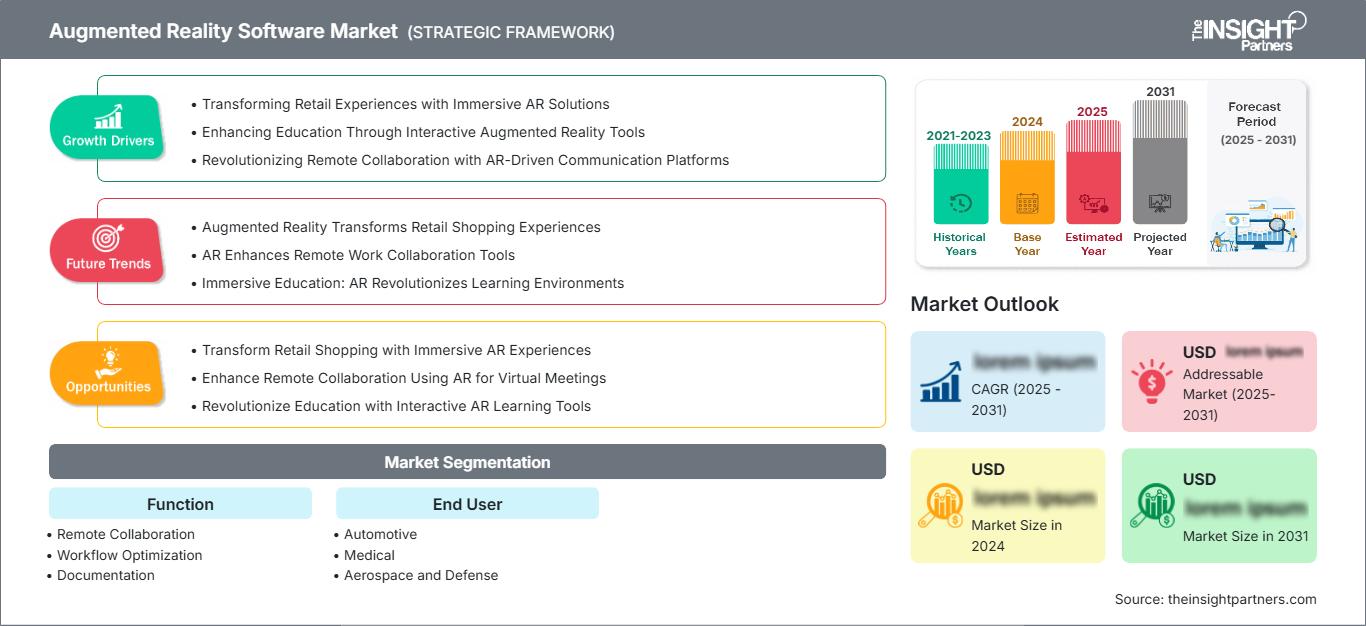
The global Augmented Reality (AR) software market is entering a transformative era, shifting from a niche novelty to a foundational pillar of modern enterprise and consumer ecosystems. As we look toward 2034, the integration of digital information with the physical environment is becoming more seamless, driven by rapid advancements in spatial computing, high speed connectivity, and sophisticated sensor technologies.
Augmented Reality software Industry serves as the engine that enables devices to overlay graphics, haptic feedback, and audio onto the real world. Unlike virtual reality, which creates a completely synthetic environment, AR enhances the user’s current reality. This unique value proposition has made it indispensable across various sectors including retail, healthcare, manufacturing, and defense.
Augmented Reality Software market is expected to register a CAGR of 32.49% from 2026 to 2034, with the market size expanding from US$ 20.32 Billion in 2025 to US$ 255.62 Billion by 2034.
Market Dynamics and Growth Drivers
The trajectory of the AR software market through 2034 is fueled by the miniaturization of hardware and the democratization of development tools. In the coming decade, the primary growth driver is the transition from smartphone based AR to wearable AR. While mobile applications currently dominate the market, the next ten years will see a massive shift toward AR glasses and head mounted displays that offer hands free operation.
Industrial sectors are adopting AR software for “connected worker” strategies. In manufacturing, AR software provides real time overlays for assembly instructions and remote maintenance, significantly reducing error rates and downtime. In the healthcare sector, surgeons use AR software to visualize internal anatomy during procedures, enhancing precision and patient outcomes.
Furthermore, the rollout of 6G technology toward the end of the decade will provide the ultra low latency required for complex AR rendering. This will enable cloud based AR, where the heavy processing is handled by remote servers, allowing AR wearable devices to become lighter, more fashionable, and more comfortable for all day wear.
Download Sample PDF Report@ https://www.theinsightpartners.com/sample/TIPRE00008784
Segmentation and Regional Analysis
The AR software market is segmented by function, vertical, and region. By 2034, the enterprise segment is expected to hold a significant market share, though the consumer gaming and social media segments remain high volume drivers.
From a regional perspective, North America continues to lead in terms of research and development and early adoption, housing many of the world’s primary software innovators. However, the Asia Pacific region is projected to experience the fastest growth rate through 2034. This is due to massive investments in smart city infrastructure in China and India, alongside a robust electronics manufacturing ecosystem in South Korea and Japan. Europe also maintains a strong position, particularly in the integration of AR software within the automotive and aerospace industries.
Top Players Shaping the AR Software Landscape
The competitive landscape of the AR software market is characterized by a mix of established technology giants and specialized software developers. As of the current market evolution, the following companies are leading the charge:
- Google LLC: A pioneer in AR development kits and enterprise solutions.
- Microsoft Corporation: Leveraging the Mesh platform and HoloLens ecosystem for industrial applications.
- Apple Inc.: Driving consumer adoption through ARKit and the expansion of spatial computing.
- PTC Inc.: A leader in industrial AR with its Vuforia platform.
- Unity Technologies: Providing the foundational engine for a majority of AR applications.
- Niantic, Inc.: Pushing the boundaries of location based AR and consumer engagement.
- Adobe Inc.: Focusing on creative tools for AR content design and marketing.
Get Full Copy of This Report @ https://www.theinsightpartners.com/buy/TIPRE00008784
Future Outlook: The Road to 2034
The future of the Augmented Reality software market is defined by the convergence of Artificial Intelligence and spatial awareness. By 2034, AR software will not just overlay data but will “understand” the environment it is in. AI driven AR will be able to identify objects, predict user needs, and provide proactive information without manual triggers.
We anticipate a move toward a “Metaverse” of interconnected AR experiences, where digital assets persist in physical locations across different platforms. The distinction between the digital and physical worlds will continue to blur, leading to a society where digital interfaces are as common as physical signage. The next decade will see AR software becoming a standard utility, similar to how the internet or mobile telephony is viewed today.
About The Insight Partners
The Insight Partners provides comprehensive syndicated and tailored market research services in the healthcare, technology, and industrial domains. Renowned for delivering strategic intelligence and practical insights, the firm empowers businesses to remain competitive in ever-evolving global markets.
Contact Information
- Email: sales@theinsightpartners.com
- Website: theinsightpartners.com
- Phone: +1-646-491-9876

- Automotive Axle and Propeller Market to Reach US$ 46.00 Billion by 2034, Growing at a 3.33% CAGR - 2026-07-17
- Automotive Acoustic Engineering Services Market Size Worth USD 11.26 Billion by 2034, CAGR of 7.43% - 2026-07-17
- Ambulatory Infusion Therapy Services Market to Reach US$ 54.73 Billion by 2034 - 2026-07-17