Middle East & Africa Building Insulation Materials Market Growth Driven by Energy Efficiency and Sustainable Construction Trends
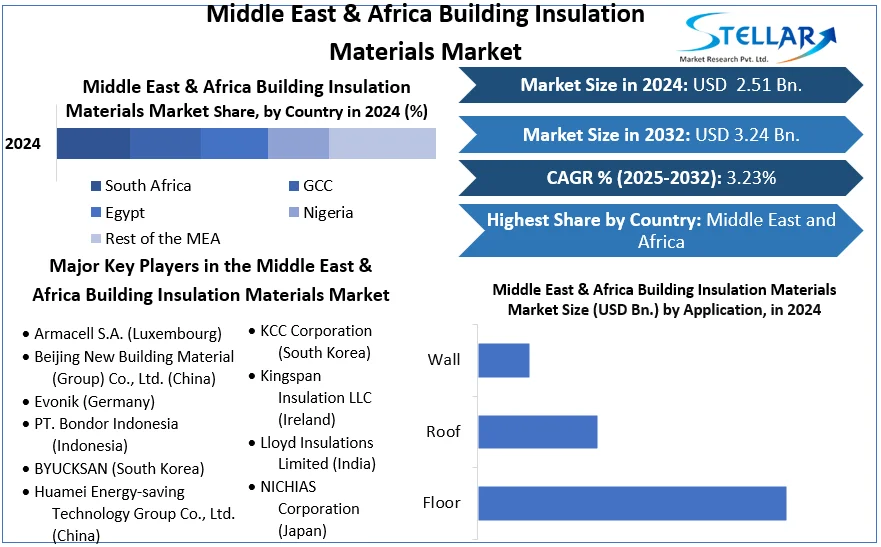
The Middle East & Africa Building Insulation Materials Market is experiencing steady growth as rising temperatures, increasing construction activities, and growing demand for energy-efficient buildings drive the adoption of advanced insulation solutions. Governments and developers across the region are focusing on sustainable construction practices, reducing energy consumption, and improving indoor comfort, creating strong opportunities for insulation material manufacturers. According to Stellar Market Research, the Middle East & Africa Building Insulation Materials Market was valued at USD 2.51 billion in 2024 and is projected to reach USD 3.24 billion by 2032, growing at a CAGR of 3.23% during the forecast period.
What Are Building Insulation Materials?
Building insulation materials are specialized construction materials designed to reduce heat transfer, control indoor temperatures, and improve energy efficiency in buildings. These materials act as thermal barriers, helping reduce heat gain in hot climates and heat loss in colder regions.
Common insulation materials include:
Expanded Polystyrene (EPS)
Extruded Polystyrene (XPS)
Mineral Wool
Polyurethane Foam (PU)
Polyisocyanurate (PIR)
These materials are widely used in residential, commercial, and industrial buildings to improve thermal performance, reduce energy costs, and enhance occupant comfort.
𝐃𝐨𝐰𝐧𝐥𝐨𝐚𝐝 𝐅𝐫𝐞𝐞 𝐏𝐃𝐅 𝐁𝐫𝐨𝐜𝐡𝐮𝐫𝐞: https://www.stellarmr.com/report/req_sample/MEA-Building-Insulation-Materials-Market/1264
Market Drivers
Rising Demand for Energy-Efficient Buildings
The Middle East and Africa region experiences extreme climatic conditions, particularly high temperatures in many Middle Eastern countries. This has increased the demand for insulation materials that help reduce cooling requirements and improve building energy efficiency.
Insulation solutions enable buildings to maintain stable indoor temperatures while lowering electricity consumption from heating, ventilation, and air conditioning (HVAC) systems. The growing focus on sustainable buildings and energy conservation initiatives is supporting market expansion.
Growth in Construction and Infrastructure Development
Rapid urbanization, population growth, and large-scale infrastructure projects are creating significant demand for building insulation materials. Countries across the GCC region, including Saudi Arabia, the UAE, and Qatar, are investing heavily in residential developments, commercial buildings, smart cities, and tourism infrastructure.
The increasing construction of energy-efficient buildings is encouraging developers to adopt advanced insulation technologies to meet modern building standards.
Increasing Adoption of Green Building Practices
Sustainability has become an important focus in the construction sector across the Middle East and Africa. Green building certifications, environmental regulations, and government initiatives are encouraging the use of insulation materials that reduce carbon emissions and improve long-term energy performance.
Manufacturers are increasingly developing recyclable and environmentally friendly insulation solutions to meet changing market requirements.
Market Segmentation
By Product
The market is segmented into:
Expanded Polystyrene (EPS)
Extruded Polystyrene (XPS)
Mineral Wool
Others
The Expanded Polystyrene (EPS) segment holds a dominant position due to its lightweight properties, thermal insulation performance, cost-effectiveness, and wide usage in construction applications. EPS is commonly used for walls, roofs, and pipe insulation projects across the region.
Extruded Polystyrene (XPS) is also gaining popularity because of its moisture resistance, durability, and ability to reduce heat transfer in demanding environments. Mineral wool continues to see demand due to its fire resistance and sound insulation capabilities.
By Application
The market is divided into:
Wall
Roof
Floor
The wall insulation segment dominates the market due to the importance of reducing heat transfer through building envelopes in hot climatic conditions. Effective wall insulation helps maintain indoor comfort and reduce cooling expenses.
Roof insulation is also witnessing strong demand as rooftops receive significant solar heat exposure, particularly in desert climates. Floor insulation is increasingly adopted in industrial and specialized building applications.
Regional Outlook
GCC Countries
The GCC region represents a major market opportunity due to rapid urban development, infrastructure investments, and strong emphasis on energy-efficient construction. Countries such as Saudi Arabia, UAE, and Qatar are increasingly implementing sustainability standards in new building projects.
South Africa
South Africa is witnessing demand growth due to residential development, commercial construction, and increasing awareness of energy-saving building solutions.
Egypt and Nigeria
Egypt and Nigeria are emerging markets supported by urban expansion, infrastructure development, and rising demand for modern construction materials. Increasing investments in housing and commercial projects are expected to create new opportunities for insulation manufacturers.
Competitive Landscape
The Middle East & Africa Building Insulation Materials Market includes global and regional manufacturers focusing on innovation, sustainability, and expanding product portfolios.
Key market players include:
Armacell S.A.
Johns Manville
Kingspan Insulation LLC
ROCKWOOL International A/S
Saint-Gobain
BASF SE
GAF
Kaneka Corporation
KCC Corporation
NICHIAS Corporation
Companies are investing in advanced insulation technologies, sustainable materials, and regional expansion strategies to strengthen their market presence.
Future Outlook
The future of the Middle East & Africa Building Insulation Materials Market remains positive as construction industries increasingly prioritize energy efficiency, sustainability, and improved building performance.
Growing adoption of smart buildings, rising HVAC energy costs, government sustainability programs, and increasing demand for green construction materials are expected to create long-term growth opportunities. Manufacturers developing high-performance, durable, and environmentally friendly insulation solutions are likely to benefit from evolving market trends.
𝐃𝐨𝐰𝐧𝐥𝐨𝐚𝐝 𝐅𝐫𝐞𝐞 𝐏𝐃𝐅 𝐁𝐫𝐨𝐜𝐡𝐮𝐫𝐞: https://www.stellarmr.com/report/req_sample/MEA-Building-Insulation-Materials-Market/1264
Conclusion
The Middle East & Africa Building Insulation Materials Market is positioned for steady expansion, supported by rising construction activities, extreme climate conditions, and increasing focus on energy-efficient infrastructure. With the market projected to grow from USD 2.51 billion in 2024 to USD 3.24 billion by 2032, insulation manufacturers, construction companies, and investors have significant opportunities across the region.
As the Middle East and Africa continue moving toward sustainable and energy-efficient buildings, advanced insulation materials will play a crucial role in reducing energy consumption, improving comfort, and supporting future construction development.
