Europe Renewable Chemicals Market: Industry Growth, Trends, Opportunities, and Forecast (2025-2032)
The Europe renewable chemicals market is experiencing significant growth as industries increasingly shift toward sustainable alternatives to traditional petroleum-based chemicals. Renewable chemicals, also known as bio-based chemicals, are produced from renewable sources such as biomass, agricultural waste, organic waste, microorganisms, and plant-based feedstocks. These chemicals help reduce carbon emissions and support the transition toward a circular economy.
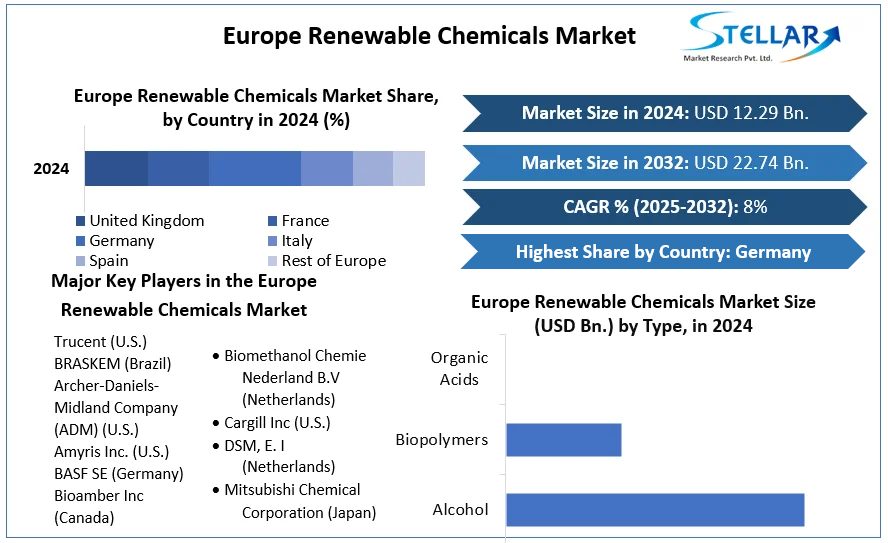
The Europe Renewable Chemicals Market was valued at USD 12.29 Billion in 2024 and is projected to reach USD 22.74 Billion by 2032, growing at a CAGR of 8% during the forecast period 2025-2032. Increasing demand for sustainable materials, government initiatives supporting green technologies, and rising adoption of bio-based products across industries are expected to drive market expansion in Europe.
Growing Focus on Sustainable Chemical Production
The increasing environmental impact of conventional petrochemical production is encouraging industries to adopt renewable chemical solutions. European governments and organizations are implementing sustainability initiatives aimed at reducing greenhouse gas emissions and promoting low-carbon manufacturing processes.
Renewable chemicals provide an alternative by utilizing renewable feedstocks instead of fossil resources. They are increasingly being used in industries such as packaging, pharmaceuticals, automotive, agriculture, and consumer products.
Rising Demand for Bio-Based Polymers and Materials
Bio-based polymers are becoming one of the fastest-growing segments of the renewable chemicals market. Companies are developing sustainable alternatives to conventional plastics to address concerns related to plastic waste and carbon emissions.
Renewable polymers are used in applications such as:
- Sustainable packaging
- Consumer goods
- Automotive components
- Industrial materials
- Food and beverage packaging
The increasing demand for environmentally friendly packaging solutions is creating new opportunities for renewable chemical manufacturers across Europe.
Expansion of Renewable Chemicals in Packaging Industry
The packaging sector is a major contributor to renewable chemical adoption. Growing consumer awareness about sustainable packaging and increasing regulatory pressure to reduce plastic waste are encouraging companies to adopt bio-based materials.
Renewable chemicals are used to manufacture:
- Biodegradable plastics
- Bio-based coatings
- Sustainable films
- Compostable packaging materials
The shift toward circular economy models is expected to accelerate the adoption of renewable chemical solutions in packaging applications.
𝐃𝐨𝐰𝐧𝐥𝐨𝐚𝐝 𝐅𝐫𝐞𝐞 𝐏𝐃𝐅 𝐁𝐫𝐨𝐜𝐡𝐮𝐫𝐞: https://www.stellarmr.com/report/req_sample/Europe-Renewable-Chemicals-Market/1330
Increasing Applications in Pharmaceutical Industry
The pharmaceutical sector is creating new opportunities for renewable chemicals due to increasing demand for sustainable ingredients and environmentally responsible manufacturing processes.
Renewable chemicals are used in:
- Pharmaceutical intermediates
- Solvents
- Specialty chemicals
- Bio-based ingredients
The growing pharmaceutical manufacturing base in Europe and increasing focus on sustainable production methods are supporting market development.
Automotive Industry Driving Market Opportunities
The automotive industry is increasingly adopting renewable chemicals to manufacture lightweight, sustainable, and high-performance materials.
Applications include:
- Bio-based polymers
- Interior components
- Coatings
- Adhesives
- Composite materials
The growth of electric vehicles and increasing focus on reducing vehicle carbon footprints are encouraging automotive manufacturers to explore renewable materials.
Advancements in Biomass and Feedstock Technologies
Technological advancements in biomass processing are improving the availability and efficiency of renewable chemicals. Companies are investing in advanced fermentation technologies, waste conversion methods, and bio-refining processes.
Common renewable feedstocks include:
- Corn
- Sugarcane
- Biomass
- Algae
- Organic waste materials
The availability of diverse feedstock sources is helping manufacturers develop a wider range of sustainable chemical products.
Market Segmentation Analysis
The Europe renewable chemicals market is segmented based on type, application, feedstock, and country.
By Type
- Alcohol
- Biopolymers
- Organic Acids
- Ketones
- Others
The biopolymers and organic chemicals segments are gaining importance due to increasing demand for sustainable alternatives across industries.
By Application
- Petrochemicals
- Pharmaceuticals
- Packaging Products
- Automotive
- Others
The packaging industry is expected to witness strong growth due to increasing demand for eco-friendly materials and sustainable product solutions.
By Feedstock
- Corn
- Sugarcane
- Biomass
- Algae
- Others
Biomass-based feedstocks are becoming increasingly important due to their availability and compatibility with renewable chemical production.
By Country
- Germany
- France
- United Kingdom
- Italy
- Russia
- Rest of Europe
Germany Leading the Europe Renewable Chemicals Market
Germany is expected to hold a significant share of the Europe renewable chemicals market due to its advanced chemical industry, strong research capabilities, and commitment toward sustainable manufacturing.
The country has been actively investing in bio-based materials, renewable energy integration, and circular economy initiatives, supporting the development of renewable chemical technologies.
Other European countries, including France, the United Kingdom, Italy, and the Netherlands, are also contributing to market growth through investments in sustainable chemistry and green manufacturing.
Key Market Drivers
Increasing Environmental Regulations
Strict environmental regulations and carbon reduction targets are encouraging industries to replace fossil-based chemicals with renewable alternatives.
Growing Demand for Sustainable Products
Consumers and businesses are increasingly preferring environmentally friendly products, increasing demand for bio-based materials.
Expansion of Circular Economy Initiatives
European industries are adopting circular economy strategies to reduce waste and improve resource efficiency.
Rising Investment in Biotechnology
Advancements in biotechnology and bio-processing are improving renewable chemical production efficiency.
Market Challenges
Despite strong growth opportunities, the Europe renewable chemicals market faces several challenges:
- High production costs compared with conventional chemicals
- Limited availability of renewable feedstocks
- Complex manufacturing processes
- Need for advanced infrastructure
- Competition from traditional petrochemical products
The chemical industry continues to face challenges in scaling renewable technologies due to high investment requirements and energy costs.
𝐃𝐨𝐰𝐧𝐥𝐨𝐚𝐝 𝐅𝐫𝐞𝐞 𝐏𝐃𝐅 𝐁𝐫𝐨𝐜𝐡𝐮𝐫𝐞: https://www.stellarmr.com/report/req_sample/Europe-Renewable-Chemicals-Market/1330
Competitive Landscape
The Europe renewable chemicals market includes global chemical manufacturers, biotechnology companies, and sustainable material producers focusing on innovation and expansion strategies.
Key players operating in the market include:
- Trucent
- BRASKEM
- Archer-Daniels-Midland Company (ADM)
- Amyris Inc.
- BASF SE
- BioAmber Inc.
- Biomethanol Chemie Nederland B.V.
- Cargill Inc.
- DSM
- Mitsubishi Chemical Corporation
Companies are focusing on bio-based product development, strategic partnerships, sustainable production technologies, and expansion of renewable chemical portfolios.
Future Outlook of Europe Renewable Chemicals Market
The Europe renewable chemicals market is expected to grow significantly during 2025-2032 as industries continue transitioning toward sustainable and low-carbon solutions.
Increasing adoption of bio-based polymers, sustainable packaging materials, renewable feedstocks, and environmentally friendly manufacturing processes will shape future market growth.
With strong regulatory support, technological advancements, and rising demand for sustainable products, renewable chemicals are expected to become a critical component of Europe’s transition toward a greener chemical industry.
