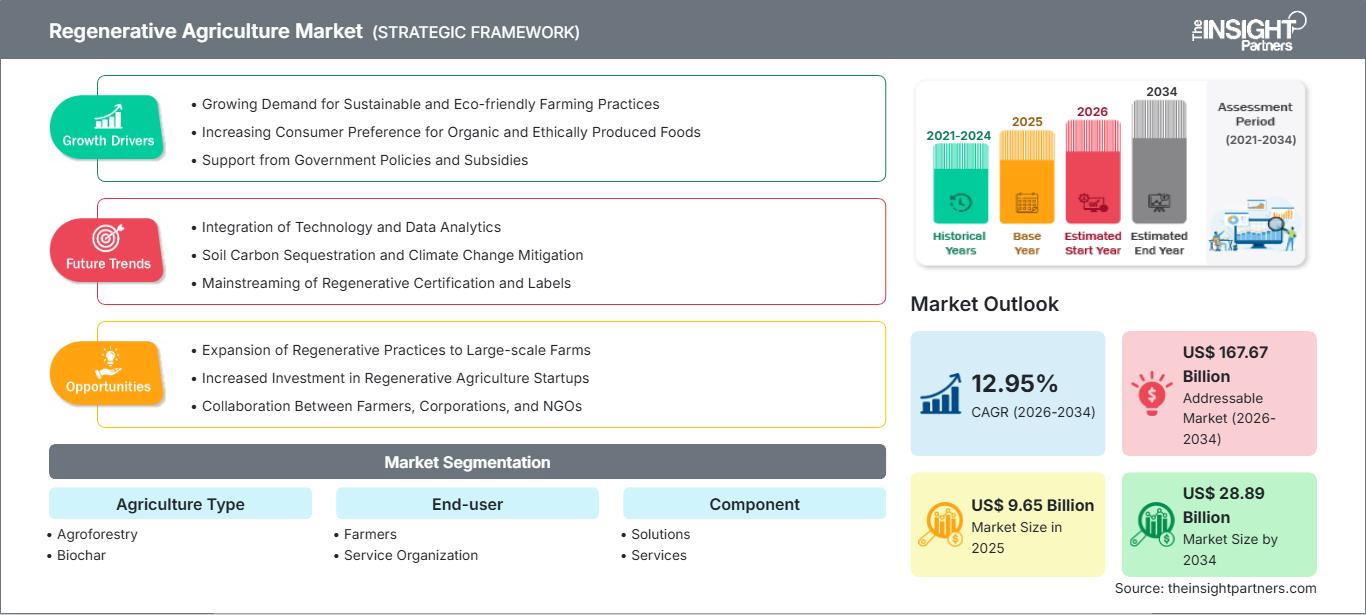
The global Regenerative Agriculture Market is experiencing strong expansion due to increasing focus on sustainable farming practices, rising concerns regarding soil degradation, and growing demand for environmentally responsible food production systems. The market size is projected to reach US$ 28.89 Billion by 2034, growing from US$ 9.65 Billion in 2025, and is expected to register a CAGR of 12.95% during 2026–2034. This significant growth highlights the increasing adoption of regenerative farming practices aimed at improving soil health, enhancing biodiversity, and supporting long-term agricultural sustainability.
The Regenerative Agriculture Market is expanding rapidly as farmers, governments, and food companies prioritize climate-smart agriculture solutions. Growing awareness about carbon sequestration, sustainable land management, and the need to improve agricultural productivity while reducing environmental impact are further accelerating market demand.
Market Analysis and Overview
The regenerative agriculture industry plays a vital role in transforming traditional farming systems by focusing on restoring soil fertility, improving ecosystem health, and promoting sustainable agricultural practices. Regenerative agriculture includes techniques such as cover cropping, crop rotation, reduced tillage, composting, and agroforestry to enhance productivity and environmental resilience.
Key Market Drivers:
• Increasing adoption of sustainable and climate-resilient farming practices
• Growing concerns regarding soil degradation and declining agricultural productivity
• Rising demand for organic and sustainably produced food products
• Government initiatives promoting regenerative and sustainable agriculture
• Increasing investments by food companies in sustainable supply chains
Market Restraints:
• High transition costs associated with adopting regenerative farming practices
• Limited awareness among farmers in developing regions
• Lack of standardized measurement systems for regenerative outcomes
• Challenges related to technology adoption and farm management changes
Market Opportunities:
• Growing demand for carbon farming and carbon credit programs
• Expansion of sustainable agriculture initiatives worldwide
• Increasing adoption of precision farming technologies
• Rising partnerships between farmers, food companies, and environmental organizations
Key Market Trends:
• Growth of soil health improvement practices
• Increasing adoption of regenerative organic farming methods
• Rising integration of digital agriculture and data-driven farming solutions
• Expansion of corporate sustainability commitments across the food industry
Get Sample PDF – https://www.theinsightpartners.com/sample/TIPRE00040464
Market Segmentation Insights
The Regenerative Agriculture Market is segmented based on practice type, application, and geography.
By Practice Type:
• Agroforestry
• Cover Cropping
• Crop Rotation
• Conservation Tillage
• Composting and Soil Management
• Others
Cover cropping and soil management practices account for significant adoption due to their effectiveness in improving soil fertility and reducing erosion.
By Application:
• Crop Production
• Livestock Farming
• Soil Management
• Carbon Sequestration
• Others
Crop production represents a major application segment due to increasing efforts to improve agricultural productivity through sustainable methods.
By Farm Size:
• Small and Medium Farms
• Large Commercial Farms
Large commercial farms are increasingly adopting regenerative practices due to growing sustainability commitments and supply chain requirements.
Regional Market Insights
- North America: Leading market driven by strong sustainability initiatives, carbon farming programs, and increasing adoption of regenerative practices among farmers
• Europe: Significant growth supported by environmental regulations, sustainable agriculture policies, and demand for eco-friendly food production
• Asia-Pacific: Fastest-growing region due to rising food demand, agricultural modernization, and increasing awareness of sustainable farming methods
• Latin America: Expanding market supported by large agricultural landscapes and growing adoption of soil restoration practices
• Middle East & Africa: Emerging market driven by the need for climate-resilient agriculture and improved food security solutions
Top Players in the Regenerative Agriculture Market
The global regenerative agriculture market is highly competitive with participation from agricultural companies, technology providers, and sustainability-focused organizations. Key players include:
- General Mills, Inc.
• Patagonia Provisions
• Cargill, Incorporated
• Nestlé S.A.
• Unilever PLC
• PepsiCo, Inc.
• Indigo Ag, Inc.
These companies are actively investing in sustainable agriculture programs, farmer partnerships, technology development, and regenerative supply chains to strengthen their global presence.
Competitive Landscape Overview
The regenerative agriculture industry is evolving rapidly, with companies focusing on:
- Development of sustainable farming solutions
• Expansion of carbon farming and soil restoration programs
• Investment in digital agriculture and monitoring technologies
• Building partnerships with farmers for regenerative practices
• Development of sustainable food supply chains
Sustainability has become a key competitive factor, with leading companies investing in regenerative farming initiatives to reduce environmental impact and improve agricultural resilience.
Get the Premium Research Report @ https://www.theinsightpartners.com/buy/TIPRE00040464
Future Outlook
The future of the Regenerative Agriculture Market is expected to remain strong, supported by increasing environmental awareness, rising demand for sustainable food production, and global efforts to combat climate change. With a projected CAGR of 12.95% from 2026 to 2034, the market will continue expanding across both developed and emerging regions.
Key future developments include:
- Expansion of carbon farming and soil restoration initiatives
• Growth of sustainable and regenerative food supply chains
• Increasing adoption of artificial intelligence and precision agriculture technologies
• Rising investments in climate-smart farming solutions
• Strong penetration across developing agricultural economies
As global agriculture faces challenges related to climate change, soil degradation, and food security, regenerative agriculture will continue to play a vital role in creating sustainable and resilient farming systems worldwide.
Frequently Asked Questions (FAQs)
- What is the size of the Regenerative Agriculture Market?
The Regenerative Agriculture Market is expected to reach US$ 28.89 Billion by 2034, growing from US$ 9.65 Billion in 2025. - What is the CAGR of the Regenerative Agriculture Market?
The market is projected to grow at a CAGR of 12.95% during 2026–2034. - What are the major practices used in regenerative agriculture?
The major practices include cover cropping, crop rotation, conservation tillage, agroforestry, composting, and soil management. - Which region is expected to grow fastest in the Regenerative Agriculture Market?
The Asia-Pacific region is expected to grow fastest due to increasing agricultural demand, rising sustainability awareness, and adoption of modern farming practices.
Trending Report –
About The Insight Partners
The Insight Partners is a global leader in market research, delivering comprehensive analysis and actionable insights across diverse industries. The company empowers decision-makers with data-driven intelligence to navigate evolving markets and accelerate growth.
Contact Us:
- Contact Person: Ankit Mathur
- E-mail: ankit.mathur@theinsightpartners.com
- Phone: +1-646-491-9876

- Fifth Wheel Coupling Market Size - 2026-07-20
- Penetration Testing as a Service Market - 2026-07-20
- Aerospace PCB Market Growth - 2026-07-20