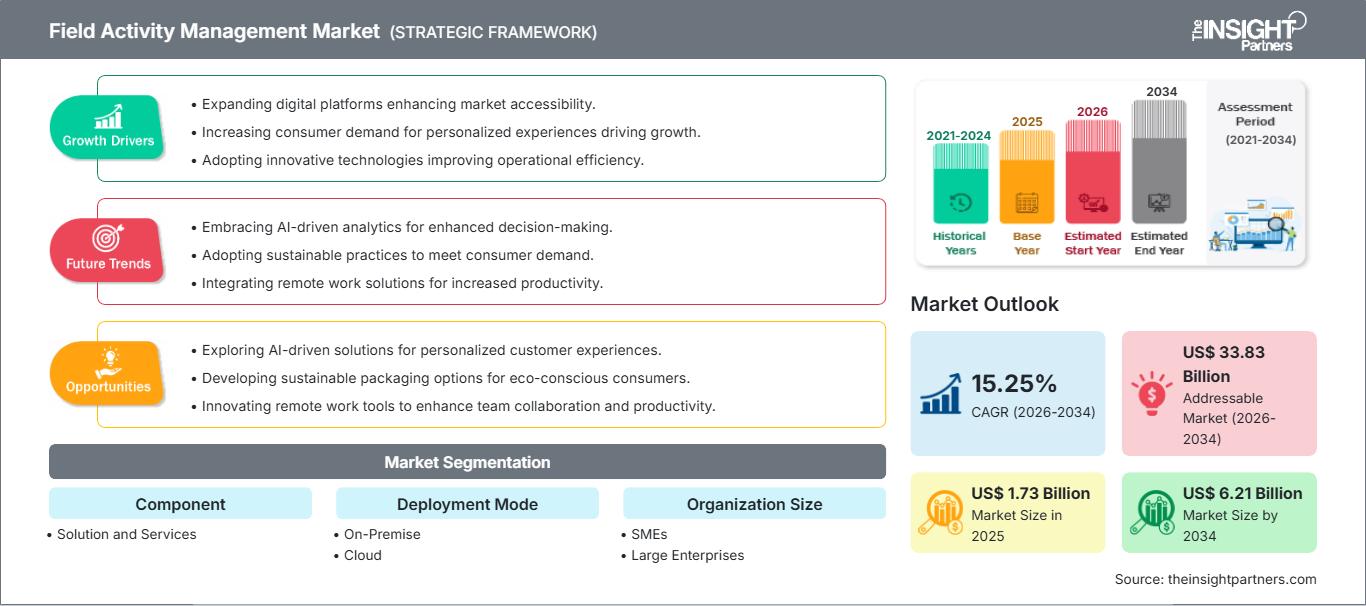
The Field Activity Management (FAM) has become an essential part of modern enterprise operations, enabling organizations to efficiently manage field personnel, automate workflows, optimize scheduling, and improve customer service. As businesses increasingly rely on mobile workforces across industries such as telecommunications, utilities, manufacturing, construction, government, and energy, the demand for advanced field activity management solutions continues to grow. Digital transformation, cloud computing, artificial intelligence (AI), Internet of Things (IoT), and mobile technologies are reshaping the market by providing organizations with real-time visibility into field operations.
According to The Insight Partners, The global field activity management market size is projected to reach US$ 6.21 billion by 2034 from US$ 1.73 billion in 2025. The market is anticipated to register a CAGR of 15.25% during the forecast period 2026-2034.
Market Overview
Field Activity Management refers to software and services designed to coordinate and monitor employees working outside traditional office environments. These solutions allow businesses to assign tasks, optimize routes, monitor employee locations, collect field data, manage customer interactions, and generate performance analytics.
The growing complexity of field operations has made manual management increasingly ineffective. Businesses now require automated systems capable of handling thousands of daily field activities while maintaining high productivity and customer satisfaction.
Key Market Drivers
Growing Demand for Operational Efficiency
One of the primary factors driving the Field Activity Management market is the increasing need for operational efficiency. Organizations seek solutions that reduce manual intervention, eliminate scheduling conflicts, improve technician productivity, and minimize travel time.
Automated scheduling, intelligent dispatching, and route optimization significantly reduce operational costs while ensuring that the right technician reaches the right location at the appropriate time. This improves service quality while maximizing workforce utilization.
Rising Need for Real-Time Monitoring
Modern businesses require continuous visibility into field operations. GPS-enabled tracking, mobile applications, and cloud connectivity allow managers to monitor workforce activities in real time.
Real-time monitoring helps organizations:
- Track technician locations
- Monitor job completion status
- Ensure compliance with service-level agreements (SLAs)
- Improve customer communication
- Respond quickly to operational issues
These capabilities have become essential across industries that depend on distributed field teams.
Increasing Mobile Workforce
The expansion of remote and mobile workforces has accelerated demand for field management software. Organizations operating across multiple locations require centralized platforms that enable seamless communication between field employees and office staff.
Mobile applications empower technicians to receive assignments, update work orders, capture digital signatures, upload images, and access customer histories directly from smartphones and tablets.
Get Sample PDF of the report @ https://www.theinsightpartners.com/sample/TIPRE00039431
Emerging Market Trends
Integration with IoT
The integration of IoT devices is transforming field operations. Connected sensors installed on equipment continuously transmit operational data, enabling predictive maintenance and reducing unexpected equipment failures.
By combining IoT with Field Activity Management software, organizations can automatically generate work orders whenever equipment performance declines beyond predefined thresholds.
Industries such as utilities, manufacturing, oil & gas, and telecommunications particularly benefit from IoT-enabled field management solutions.
Cloud-Based Deployment
Cloud deployment has become one of the strongest trends in the market. Cloud platforms offer scalability, flexibility, lower infrastructure costs, and easier software updates compared to traditional on-premise systems.
Cloud-based Field Activity Management solutions also enable organizations to:
- Access data remotely
- Scale operations quickly
- Improve collaboration
- Reduce IT maintenance costs
- Enhance business continuity
As organizations continue digital transformation initiatives, cloud adoption is expected to remain a major growth driver.
Artificial Intelligence and Analytics
Artificial intelligence is increasingly being integrated into field management platforms to improve scheduling, predict maintenance requirements, optimize workforce allocation, and enhance decision-making.
Advanced analytics provide managers with insights into:
- Technician productivity
- Customer satisfaction
- Equipment performance
- Resource utilization
- Operational bottlenecks
These insights help organizations improve long-term planning and operational efficiency.
Get the Premium Research Report @ https://www.theinsightpartners.com/buy/TIPRE00039431
Market Segmentation
The Field Activity Management market can be segmented across several categories.
By Component
- Solutions
- Services
Software solutions account for the largest market share as organizations prioritize automation and digital workflow management. Professional services such as implementation, consulting, integration, and maintenance also contribute significantly to market growth.
By Deployment Mode
- Cloud
- On-Premise
Cloud deployment continues to experience stronger growth due to its flexibility, cost-effectiveness, and ease of implementation.
By Organization Size
- Small and Medium Enterprises (SMEs)
- Large Enterprises
Large enterprises currently dominate adoption because of their complex field operations and higher IT investments. However, SMEs are increasingly adopting cloud-based subscription models due to their affordability.
By Industry Vertical
Major industries utilizing Field Activity Management include:
- Telecommunications
- Energy and Utilities
- Construction and Real Estate
- Manufacturing
- Government
Each of these sectors relies heavily on field workers responsible for inspections, maintenance, installations, repairs, and customer support.
Regional Analysis
North America
North America remains one of the leading markets due to widespread digital transformation, high technology adoption, mature IT infrastructure, and significant investments in workforce automation.
The region has strong demand from utilities, telecommunications, healthcare, and government sectors.
Europe
European organizations increasingly invest in Field Activity Management solutions to improve operational efficiency, comply with regulatory requirements, and support sustainable business operations.
Smart city initiatives and infrastructure modernization further contribute to market expansion.
Asia-Pacific
Asia-Pacific is expected to witness substantial growth due to rapid industrialization, urbanization, expanding telecommunications networks, and increasing cloud adoption.
Countries including China, India, Japan, South Korea, and Australia are investing heavily in digital infrastructure and workforce automation.
Middle East & Africa
Infrastructure development, energy projects, and smart government initiatives are creating new opportunities for Field Activity Management vendors throughout the region.
South America
Growing investments in utilities, construction, and telecommunications are supporting gradual market expansion across South America.
Competitive Landscape
- ESRI
- SAP
- Fielda
- Fulcrum
- ProntoForms
- OnSource
- SafetyCulture
- Field Safe Solutions
- GoCanvas
- Repsly
Vendors continue enhancing user experience through automation, predictive analytics, and seamless integration with enterprise software systems.
Challenges
Despite strong market growth, several challenges remain.
Organizations often encounter:
- High implementation costs
- Integration complexities with legacy systems
- Cybersecurity concerns
- Data privacy regulations
- Employee training requirements
- Resistance to digital transformation
However, cloud-native architectures, managed services, and AI-powered automation are gradually reducing these barriers.
Future Outlook
The future of the Field Activity Management market appears highly promising as businesses continue prioritizing workforce optimization and digital operations. Emerging technologies such as AI, machine learning, IoT, augmented reality (AR), and predictive analytics will further enhance field service capabilities.
About The Insight Partners
The Insight Partners is a global leader in market research, delivering comprehensive analysis and actionable insights across diverse industries. The company empowers decision-makers with data-driven intelligence to navigate evolving markets and accelerate growth.
Contact Us:
- Contact Person: Ankit Mathur
- E-mail: ankit.mathur@theinsightpartners.com
- Phone: +1-646-491-9876
Also Available in :
Korean German Japanese French Chinese Italian Spanish
