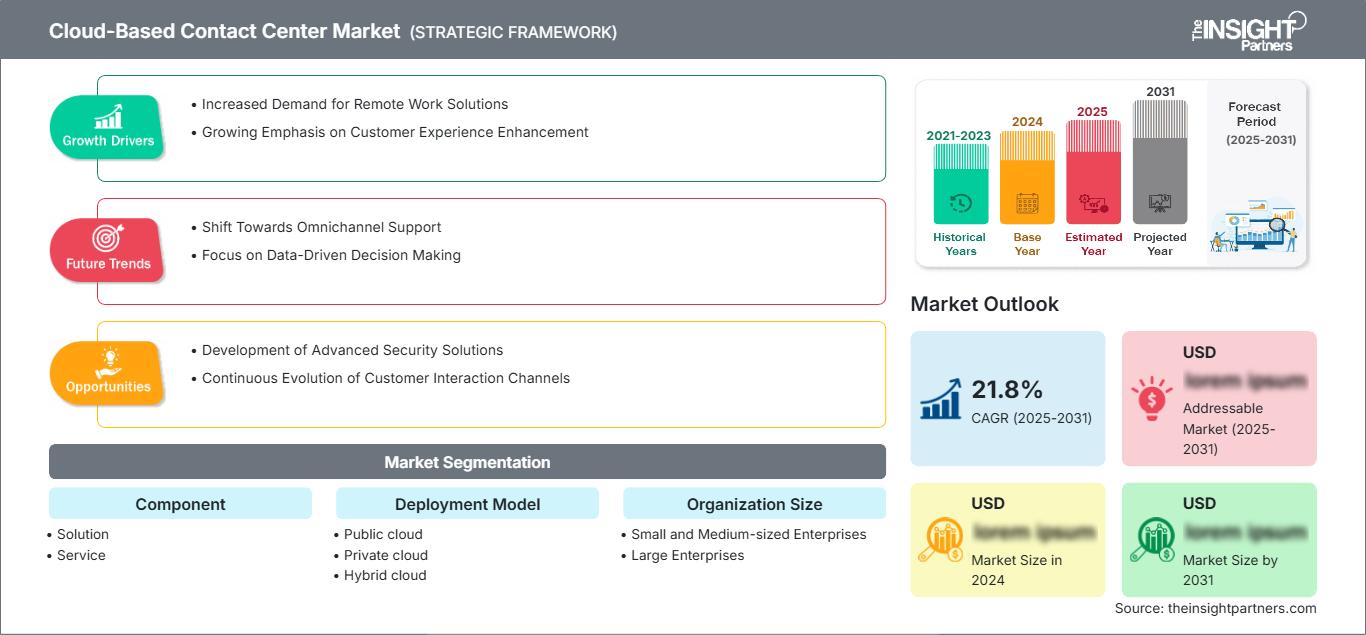
The global Cloud-Based Contact Center Market is experiencing significant growth as businesses increasingly adopt cloud technologies to improve customer engagement, reduce operational costs, and provide seamless communication experiences.
According to The Insight Partners, The Cloud-Based Contact Center market is expected to register a CAGR of 21.29% from 2026 to 2034, with the market size expanding from US$ 39.82 Billion in 2025 to US$ 226.25 Billion by 2034.
Overview of the Cloud-Based Contact Center Market
Traditional contact centers require significant investments in hardware, maintenance, infrastructure, and IT resources. However, cloud-based contact centers provide a more scalable and cost-effective alternative by allowing organizations to access customer service tools through internet-based platforms.
Businesses are shifting toward cloud solutions because they offer faster deployment, improved flexibility, and easier integration with existing business applications such as customer relationship management (CRM) systems and enterprise software. Cloud contact centers also allow companies to support remote agents, making them highly valuable in today’s digital-first business environment.
Key Market Growth Drivers
- Rising Demand for Omnichannel Customer Support
One of the primary factors driving the cloud-based contact center market is the increasing demand for omnichannel customer service. Modern customers expect businesses to provide quick and consistent support across multiple communication channels, including phone calls, websites, mobile applications, messaging platforms, and social media.
Cloud-based platforms enable companies to integrate different communication channels into a single interface. This allows customer service representatives to access complete customer interaction histories and deliver personalized support experiences.
- Cost Efficiency and Scalability
Cost reduction is another major factor contributing to market growth. Traditional contact centers require large investments in servers, infrastructure, software licenses, and maintenance. Cloud-based systems eliminate many of these expenses by offering subscription-based pricing models.
Organizations can increase or decrease their contact center capacity according to business requirements. This scalability is particularly beneficial for small and medium-sized enterprises (SMEs) that need advanced customer support capabilities without large capital investments.
The flexibility of cloud solutions allows companies to manage seasonal demand fluctuations, expand operations quickly, and improve resource utilization.
- Growth of Remote and Hybrid Work Models
The expansion of remote and hybrid work environments has increased the demand for cloud-based contact centers. Cloud platforms allow agents to work from different locations while maintaining secure access to customer service applications.
Businesses can build distributed customer support teams without requiring employees to operate from centralized offices. This capability improves workforce flexibility and helps organizations maintain business continuity during unexpected disruptions.
- Integration of Artificial Intelligence and Automation
Artificial intelligence (AI), machine learning, chatbots, and automation technologies are transforming the contact center industry. Cloud platforms increasingly incorporate AI-powered features such as automated customer responses, sentiment analysis, predictive analytics, and intelligent call routing.
AI-driven solutions help reduce response times, improve agent productivity, and provide deeper insights into customer behavior. As businesses focus on delivering faster and more personalized customer experiences, AI integration is expected to remain a major growth opportunity for cloud contact center providers.
Get Sample PDF of the report @ https://www.theinsightpartners.com/sample/TIPRE00010986
Market Segmentation Analysis
According to The Insight Partners, the cloud-based contact center market can be analyzed through several key segments.
By Component
The cloud-based contact center market is divided into:
- Solutions
- Services
Solutions include software platforms and applications that support customer interaction management, while services include implementation, consulting, maintenance, and support activities.
By Deployment Model
Cloud-based contact centers are categorized into:
- Public Cloud
- Private Cloud
- Hybrid Cloud
Public cloud solutions are widely adopted due to affordability and ease of deployment. Private and hybrid cloud models are preferred by organizations requiring enhanced security, customization, and regulatory compliance.
By Organization Size
The cloud-based contact center market serves:
- Small and Medium-Sized Enterprises (SMEs)
- Large Enterprises
Large enterprises are adopting cloud contact centers to manage complex customer operations, while SMEs are increasingly using these solutions because of their affordability and scalability.
By Application
Major applications include:
- Call routing and queuing
- Data integration and recording
- Chat quality monitoring
- Real-time decision-making
- Workforce optimization
These applications help businesses improve operational efficiency and enhance customer service quality.
By Industry Vertical
Cloud-based contact center solutions are used across multiple industries, including:
- Banking, Financial Services, and Insurance (BFSI)
- Retail and consumer goods
- Healthcare and life sciences
- Telecommunications and IT services
- Government and public sector
- Manufacturing
- Media and entertainment
Industries with high customer interaction volumes are among the largest adopters of cloud contact center technologies.
Get the Premium Research Report @ https://www.theinsightpartners.com/buy/TIPRE00010986
Regional Market Insights
The cloud-based contact center market is expanding globally, with significant growth opportunities across North America, Europe, Asia Pacific, and South and Central America.
North America
North America represents a major market due to the presence of advanced technology providers, strong cloud adoption, and increasing investments in customer experience solutions. Organizations in the region are rapidly implementing AI-enabled contact centers to improve service efficiency.
Europe
European businesses are adopting cloud contact centers to enhance digital customer engagement and comply with evolving data security requirements. The demand for secure and flexible communication platforms continues to support market expansion.
Asia Pacific
The Asia Pacific region is expected to witness strong growth due to increasing digital transformation initiatives, expanding e-commerce activities, and rising adoption of cloud technologies among enterprises.
Countries such as India, China, Japan, and Southeast Asian economies are investing in modern customer support infrastructure to serve growing digital customer bases.
Competitive Landscape
- 3CLogic
- 8×8, Inc.
- Aspect Software, Inc.
- Cisco Systems, Inc.
- Five9, Inc.
- Genesys
- NewVoiceMedia
- NICE Ltd.
- Oracle
- RingCentral, Inc.
Major companies operating in this market include providers of customer experience platforms, communication solutions, and enterprise cloud services. These companies are focusing on AI integration, automation capabilities, security improvements, and advanced analytics to strengthen their competitive position.
Continuous innovation in cloud technologies is expected to increase competition among vendors while creating more advanced solutions for businesses.
Challenges Facing the Market
Despite strong growth prospects, the cloud-based contact center market faces several challenges.
Data Security and Privacy Concerns
Since customer information is stored and processed through cloud platforms, organizations must ensure strong cybersecurity measures. Compliance with regional data protection regulations remains a critical consideration.
Integration Challenges
Some businesses face difficulties integrating cloud contact center platforms with existing legacy systems. Successful implementation requires proper planning, technical expertise, and effective change management.
Dependence on Internet Connectivity
Cloud contact centers rely heavily on reliable internet infrastructure. Connectivity issues can affect service quality and customer experience, especially in regions with limited network availability.
Future Outlook of the Cloud-Based Contact Center Market
The future of the cloud-based contact center market appears promising as businesses continue prioritizing digital transformation and customer experience improvement. The increasing adoption of AI, automation, analytics, and cloud computing will further reshape contact center operations.
About The Insight Partners
The Insight Partners is a global leader in market research, delivering comprehensive analysis and actionable insights across diverse industries. The company empowers decision-makers with data-driven intelligence to navigate evolving markets and accelerate growth.
Contact Us:
- Contact Person: Ankit Mathur
- E-mail: ankit.mathur@theinsightpartners.com
- Phone: +1-646-491-9876
Also Available in :
Korean German Japanese French Chinese Italian Spanish

- Fifth Wheel Coupling Market Size - 2026-07-20
- Penetration Testing as a Service Market - 2026-07-20
- Aerospace PCB Market Growth - 2026-07-20