Security automation has emerged as a crucial technology that enables organizations to detect, analyze, and respond to threats faster and more efficiently. By integrating technologies such as artificial intelligence (AI), machine learning (ML), predictive analytics, robotic process automation (RPA), and security orchestration tools, security automation solutions help reduce human intervention while improving overall cybersecurity performance.
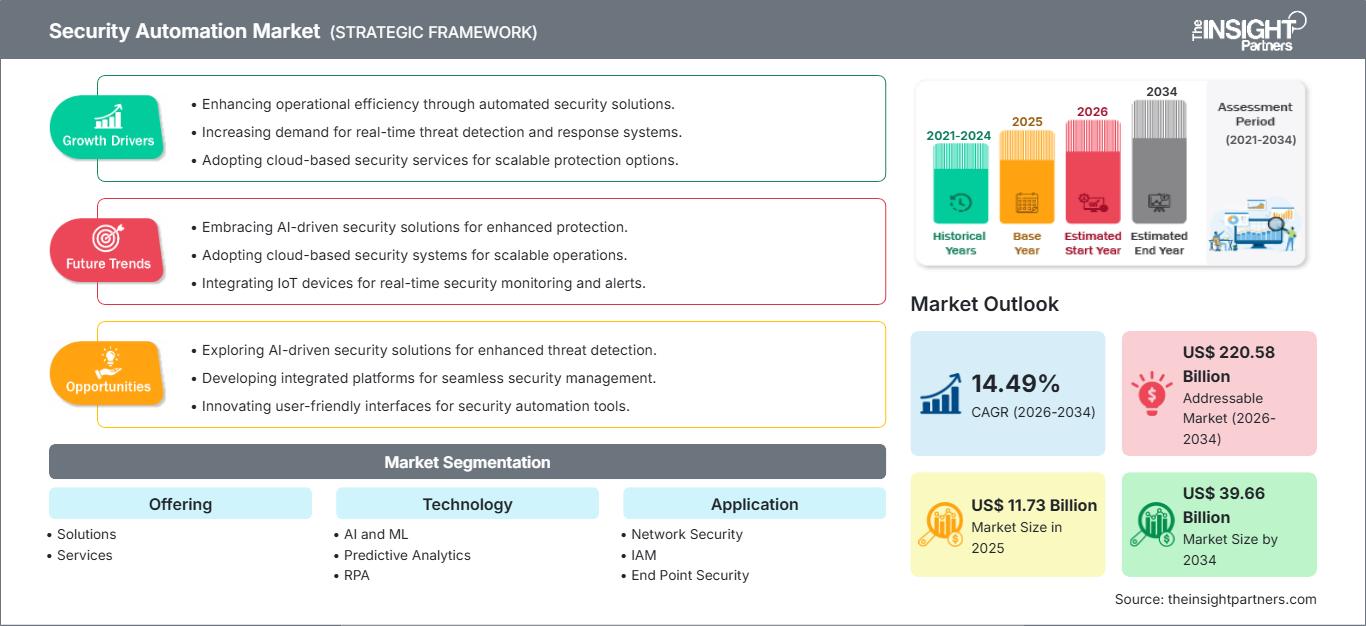
According to The Insight Partners, The global security automation market size is projected to reach US$ 39.66 billion by 2034 from US$ 11.73 billion in 2025. The market is anticipated to register a CAGR of 14.49% during the forecast period 2026-2034.
Overview of the Security Automation Market
The Security Automation Market to the use of automated technologies and intelligent systems to perform cybersecurity tasks such as threat monitoring, vulnerability assessment, incident detection, response management, and compliance monitoring. These solutions allow security teams to manage large volumes of security alerts while improving accuracy and reducing response times.
Modern enterprises generate enormous amounts of security data from endpoints, networks, applications, and cloud environments. Manual analysis of this data is time-consuming and increases the possibility of delayed responses. Security automation platforms address these challenges by continuously analyzing information, identifying suspicious activities, and initiating predefined responses.
Key Factors Driving Market Growth
- Increasing Cybersecurity Threats
The rising frequency and sophistication of cyberattacks are among the strongest drivers of the security automation market. Cybercriminals are using advanced techniques, including artificial intelligence-based attacks, ransomware, and automated exploitation methods, making traditional security approaches less effective.
Organizations across sectors such as banking, healthcare, manufacturing, government, and retail are investing heavily in automated security solutions to protect sensitive information and critical infrastructure.
Security automation enables faster threat identification and automated responses, helping organizations minimize potential damage caused by security incidents.
- Growing Adoption of Artificial Intelligence and Machine Learning
Artificial intelligence and machine learning are transforming cybersecurity operations. AI-powered security automation tools can analyze large datasets, identify abnormal behavior patterns, and predict potential threats before they become major incidents.
Machine learning algorithms continuously improve by learning from previous attacks and security events. This capability allows organizations to detect new and evolving threats more effectively.
- Shortage of Skilled Cybersecurity Professionals
A global shortage of cybersecurity experts has created challenges for organizations attempting to manage increasing security workloads. Security automation helps address this issue by reducing repetitive manual tasks and allowing security professionals to focus on strategic activities.
Automated solutions can handle tasks such as alert prioritization, threat investigation, compliance reporting, and incident response workflows. This improves operational efficiency and enables security teams to manage complex environments more effectively.
Get Sample PDF of the report @ https://www.theinsightpartners.com/sample/TIPRE00039616
Market Segmentation Analysis
According to The Insight Partners, the security automation market can be segmented based on offering, technology, application, and industry vertical.
By Offering
The market is divided into:
Solutions
Security automation solutions include platforms and software designed for threat detection, security orchestration, vulnerability management, and automated incident response.
Organizations are increasingly adopting integrated security platforms that provide centralized visibility across networks, endpoints, and cloud environments.
Services
Security automation services include consulting, implementation, maintenance, and managed security services. Many organizations rely on external security providers to deploy and manage automated cybersecurity systems.
By Technology
The major technologies supporting security automation include:
Artificial Intelligence and Machine Learning
AI and ML solutions analyze security data, detect anomalies, and automate decision-making processes.
Predictive Analytics
Predictive analytics helps organizations identify potential vulnerabilities and anticipate cyber threats before attacks occur.
Robotic Process Automation (RPA)
RPA automates repetitive security tasks, improving efficiency and reducing operational workload.
User and Entity Behavior Analytics (UEBA)
UEBA technology identifies unusual user activities and detects potential insider threats or compromised accounts.
By Application
Security automation solutions are widely used in:
Network Security
Automated network security tools monitor traffic, detect suspicious activities, and prevent unauthorized access.
Identity and Access Management (IAM)
Automation improves identity verification, access control, and user authentication processes.
Endpoint Security
Automated endpoint protection helps secure computers, mobile devices, and connected systems against malware and cyber threats.
Incident Response Management
Automated incident response tools accelerate threat investigation and remediation processes.
Industry Adoption of Security Automation
Security automation is being adopted across multiple industries due to increasing dependence on digital technologies.
Banking, Financial Services, and Insurance (BFSI)
The BFSI sector is one of the largest adopters of security automation because financial institutions handle valuable customer data and are frequent targets of cyberattacks.
Automated security systems help banks detect fraud, monitor transactions, manage access controls, and respond quickly to threats.
Manufacturing
Manufacturers are adopting security automation to protect industrial systems, connected devices, and operational technology environments. The expansion of Industry 4.0 and smart manufacturing has increased the need for automated cybersecurity protection.
Healthcare
Healthcare organizations use security automation to protect patient information, secure medical devices, and maintain regulatory compliance.
Retail and E-commerce
With increasing online transactions and digital payment adoption, retailers are implementing automated cybersecurity solutions to prevent fraud and protect customer information.
Get the Premium Research Report @ https://www.theinsightpartners.com/buy/TIPRE00039616
Regional Market Insights
The security automation market is expanding globally, with strong growth expected across North America, Europe, Asia Pacific, South and Central America, and the Middle East and Africa.
North America
North America represents a significant market due to high cybersecurity spending, advanced technology adoption, and the presence of major cybersecurity companies. Organizations in the region are increasingly investing in AI-powered security automation platforms.
Europe
European countries are focusing on cybersecurity regulations, data protection requirements, and advanced security frameworks. Increased compliance requirements are encouraging organizations to adopt automated security solutions.
Asia Pacific
The Asia Pacific region is expected to experience strong growth due to rapid digitalization, expanding cloud adoption, and increasing cybersecurity awareness among businesses and governments.
Countries such as India, China, Japan, and Australia are investing in cybersecurity infrastructure to protect growing digital ecosystems.
Competitive Landscape
The security automation market includes several major technology companies offering advanced cybersecurity platforms and services. Key players identified by The Insight Partners include:
- Palo Alto Networks
- Splunk
- CyberArk
- Check Point
- CrowdStrike
- Red Hat
- Cisco
- Carbon Black
- Trellix
- IBM
- Secureworks
- Tenable
- Microsoft
- Swimlane
- Tufin
These companies are focusing on product innovation, AI integration, partnerships, and acquisitions to strengthen their market position.
Emerging Trends in the Security Automation Market
AI-Driven Autonomous Security
The future of security automation will be strongly influenced by autonomous cybersecurity systems capable of detecting and responding to threats with minimal human involvement.
Cloud-Based Security Automation
As organizations migrate workloads to cloud platforms, demand for cloud-native security automation solutions is increasing.
Integration with Security Operations Centers
Security automation platforms are becoming essential components of modern SOC environments by improving visibility, reducing alert fatigue, and accelerating response times.
Zero Trust Security Adoption
The increasing adoption of zero-trust security models is expected to create new opportunities for automation solutions that continuously verify users, devices, and applications.
Challenges in the Security Automation Market
Despite strong growth opportunities, the market faces several challenges. High implementation costs, integration complexity, and concerns regarding false positives in automated systems can limit adoption among smaller organizations.
Organizations must also ensure that automated systems are properly configured and monitored to prevent incorrect responses to security events.
Additionally, cybersecurity teams need proper training to effectively manage advanced automation technologies.
Future Outlook
The security automation market is expected to experience continued expansion as businesses prioritize cybersecurity resilience. Increasing cyber threats, digital transformation initiatives, and advancements in artificial intelligence will continue to drive demand for automated security solutions.
About The Insight Partners
The Insight Partners is a global leader in market research, delivering comprehensive analysis and actionable insights across diverse industries. The company empowers decision-makers with data-driven intelligence to navigate evolving markets and accelerate growth.
Contact Us:
- Contact Person: Ankit Mathur
- E-mail: ankit.mathur@theinsightpartners.com
- Phone: +1-646-491-9876
Also Available in :
Korean German Japanese French Chinese Italian Spanish
