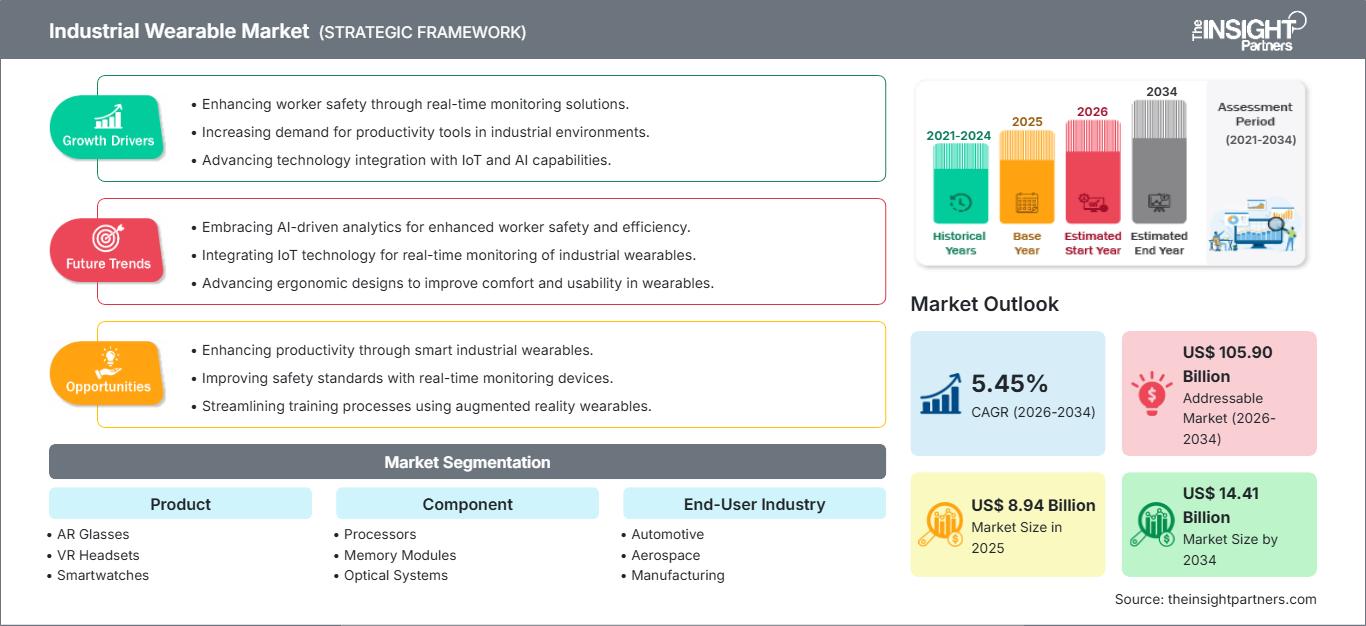
The global industrial landscape is undergoing a significant transformation as companies increasingly adopt smart technologies to improve workforce safety, productivity, and operational efficiency. Industrial wearable solutions are becoming an essential part of modern workplaces by enabling real-time communication, data monitoring, remote assistance, and advanced safety management across manufacturing, logistics, construction, healthcare, and energy sectors.
The growing focus on connected workplaces and digital transformation is accelerating the adoption of advanced wearable technologies. Organizations are investing in smart glasses, wearable scanners, smart helmets, exoskeletons, sensors, and other connected devices that help employees perform tasks more efficiently while reducing workplace risks. The Industrial Wearable Market is gaining momentum as industries recognize the importance of integrating human capabilities with intelligent digital solutions.
Get a sample PDF of the Report: https://www.theinsightpartners.com/sample/TIPRE00008352
Industrial wearable technologies combine hardware, software, sensors, artificial intelligence, and cloud-based platforms to provide real-time insights into workforce activities and industrial processes. These solutions are helping businesses improve decision-making, reduce downtime, enhance employee safety, and optimize workflow management. The increasing implementation of Industry 4.0 initiatives, automation, and industrial IoT ecosystems is expected to create new opportunities for technology providers and end users worldwide.
Industrial Wearable Market Key Highlights, Trends, Analysis, and Forecast by 2031
- Increasing adoption of smart wearable devices across manufacturing, logistics, automotive, aerospace, and energy industries is driving technology expansion.
- Rising demand for workplace safety solutions is encouraging companies to deploy connected helmets, smart glasses, and wearable monitoring systems.
- Integration of artificial intelligence, augmented reality (AR), and IoT is transforming industrial operations through real-time data accessibility.
- Growing focus on employee productivity and operational accuracy is increasing demand for hands-free wearable technologies.
- Advancements in lightweight materials, battery efficiency, and sensor technology are improving the usability of industrial wearable devices.
- Expansion of automation and digital factories is creating new applications for wearable solutions in industrial environments.
- Increasing investments in remote assistance and virtual collaboration technologies are supporting market development through 2031.
- The future of industrial workplaces is expected to rely heavily on connected wearable ecosystems that combine safety, intelligence, and efficiency.
Global Industrial Wearable Market Analysis
The global industrial wearable sector is witnessing strong growth due to increasing industrial automation and the need for safer working environments. Manufacturing companies are adopting wearable technologies to streamline production processes, monitor employee performance, and reduce operational challenges. In industries such as automotive and aerospace, smart glasses and wearable scanners are improving assembly accuracy and enabling technicians to access digital instructions without interrupting workflow.
The logistics and warehousing sectors are also emerging as major adopters of wearable solutions. Companies are using wearable scanners, smart devices, and location-based technologies to improve inventory management, order fulfillment, and employee coordination. As e-commerce continues to expand globally, businesses are focusing on technologies that enhance supply chain efficiency.
The healthcare and energy sectors are further contributing to the expansion of the Industrial Wearable Market. Wearable monitoring devices are helping workers operate in challenging environments while providing valuable safety insights. In industries involving hazardous conditions, connected wearables are supporting emergency response, worker tracking, and preventive safety measures.
Regional Analysis
North America:
North America remains a significant region for industrial wearable adoption due to advanced manufacturing infrastructure, early technology adoption, and strong investment in automation. The presence of major technology companies and increasing demand for workplace safety solutions are supporting regional growth. Industries across the United States and Canada are integrating wearable technologies to improve productivity and workforce protection.
Europe:
Europe is experiencing steady growth driven by strict workplace safety regulations, industrial modernization, and Industry 4.0 initiatives. Countries such as Germany, the United Kingdom, and France are focusing on smart manufacturing solutions, creating opportunities for industrial wearable providers.
Asia Pacific:
Asia Pacific is expected to witness strong adoption due to rapid industrialization, expanding manufacturing facilities, and increasing digital transformation efforts. Countries including China, Japan, South Korea, and India are investing in smart factories and connected industrial ecosystems, accelerating demand for wearable technologies.
Middle East & Africa:
The Middle East and Africa region is gradually adopting industrial wearable solutions, particularly in energy, construction, and infrastructure projects. Growing investments in industrial safety and modernization initiatives are creating new opportunities.
Latin America:
Latin America is witnessing increasing interest in industrial digitalization, with industries exploring wearable technologies to enhance operational performance and improve worker safety.
Latest Industry Trends and Developments
The industrial wearable industry is experiencing continuous innovation as companies focus on creating smarter, more reliable, and user-friendly solutions. The integration of artificial intelligence and machine learning is enabling wearable devices to analyze workplace conditions, predict risks, and provide actionable recommendations.
Augmented reality-based wearable devices are becoming increasingly popular for training, maintenance, and remote support applications. Technicians can access digital instructions, receive expert guidance, and complete complex tasks with improved accuracy.
Another major trend shaping the industry is the development of advanced exoskeleton technologies. These wearable systems are designed to reduce physical strain on workers involved in repetitive or heavy-duty operations. Companies are also focusing on improving device comfort, durability, connectivity, and battery performance to support long-term industrial use.
Recent collaborations between technology providers, automation companies, and industrial organizations are further strengthening innovation within the sector. Businesses are increasingly exploring wearable solutions as part of broader digital transformation strategies.
Key Players in Industrial Wearable Market
Leading companies contributing to industrial wearable technology development include:
- ✅ Microsoft Corporation
- ✅ RealWear, Inc.
- ✅ Honeywell International Inc.
- ✅ Zebra Technologies Corporation
- ✅ Vuzix Corporation
- ✅ Google LLC
- ✅ Sony Corporation
- ✅ Epson America, Inc.
- ✅ Seiko Epson Corporation
- ✅ Garmin Ltd.
- ✅ Motorola Solutions, Inc.
- ✅ TeamViewer AG
These companies are focusing on product innovation, strategic partnerships, software integration, and advanced connectivity solutions to strengthen their position in the evolving industrial technology landscape.
Get the Premium Research Report @ https://www.theinsightpartners.com/buy/TIPRE00008352
Future Outlook
The future outlook of the Industrial Wearable Market remains promising as industries continue moving toward smarter, safer, and more connected operations. The increasing adoption of automation, artificial intelligence, augmented reality, and industrial IoT will continue shaping the next generation of workplace technologies. By 2031, industrial wearable solutions are expected to become a critical component of digital factories and intelligent workplaces, helping organizations improve efficiency, enhance employee safety, and achieve greater operational excellence.
As businesses worldwide prioritize workforce optimization and real-time decision-making, industrial wearable technologies will play a vital role in creating more responsive, productive, and sustainable industrial environments.
Home Energy Management System Market Regional Share, Trend, and Growth Opportunity
Vision Transformers Market Regional Share, Trend, and Growth Opportunity
Differential-Pressure Mass Flow Controller Market Regional Share, Trend, and Growth Opportunity
About The Insight Partners
The Insight Partners is a leading market research and consulting firm delivering actionable insights through in-depth industry analysis and strategic intelligence. The firm supports clients across various industries in making informed business decisions by providing comprehensive market forecasts, competitive assessments, and growth opportunities.
Contact Us:
If you have any queries about this report or if you would like further information, please contact us:
Contact Person: Ankit Mathur
E-mail: sales@theinsightpartners.com
Phone: +1-646-491-9876
Also Available in :
Korean | German | Japanese | French | Chinese | Italian | Spanish
