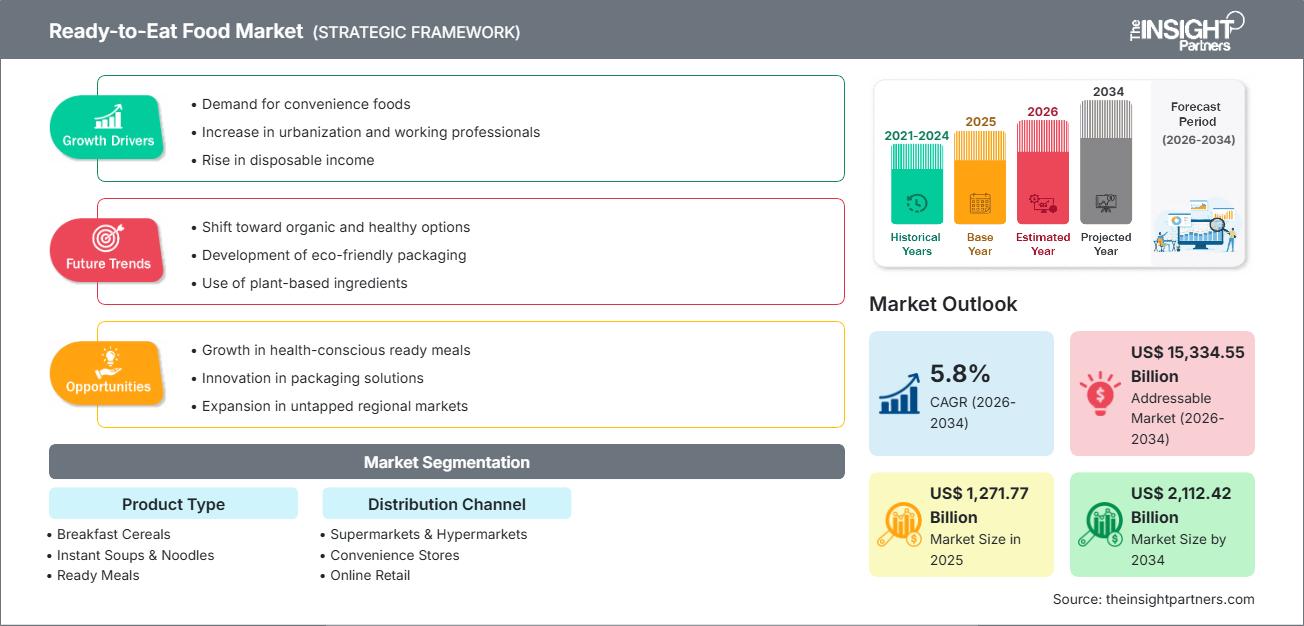
The global Ready-to-Eat Food Market is experiencing steady growth due to increasing consumer demand for convenient meal solutions, changing lifestyles, rising urbanization, and the growing working population. The market size is projected to reach US$ 2,112.42 Billion by 2034, growing from US$ 1,271.77 Billion in 2025, and is anticipated to register a CAGR of 5.8% during the forecast period 2026–2034. This consistent growth highlights the increasing importance of ready-to-eat food products in meeting the evolving dietary preferences and convenience needs of consumers across developed and emerging economies.
The Ready-to-Eat Food Market is expanding as consumers increasingly seek quick, nutritious, and easy-to-prepare meal options. Rising disposable incomes, busy work schedules, growing demand for packaged foods, expansion of organized retail, and continuous product innovation are further accelerating market demand.
Market Analysis and Overview
The ready-to-eat food industry plays a vital role in the global food and beverage sector by providing consumers with convenient meal options that require little to no preparation. Manufacturers are focusing on developing healthier formulations, clean-label products, plant-based alternatives, and sustainable packaging to address changing consumer preferences. The market continues to evolve with innovations in food preservation technologies, packaging solutions, and premium product offerings.
Key Market Drivers:
- Rising consumer preference for convenient and time-saving meal solutions
- Increasing urbanization and growth of the working population
- Expansion of supermarkets, hypermarkets, and online grocery platforms
- Growing demand for packaged and processed food products
- Continuous innovation in ready-to-eat food formulations and packaging
Market Restraints:
- Growing consumer concerns regarding preservatives and processed foods
- High competition from freshly prepared meal alternatives
- Fluctuating raw material prices affecting production costs
- Stringent food safety and quality regulations
Market Opportunities:
- Increasing demand for healthy, organic, and clean-label ready-to-eat meals
- Expansion of plant-based and vegan food product portfolios
- Rising penetration of e-commerce and food delivery platforms
- Growing demand in emerging economies due to changing lifestyles
Key Market Trends:
- Rising popularity of plant-based ready-to-eat meals
- Increasing demand for clean-label and preservative-free food products
- Growth in sustainable and eco-friendly food packaging
- Expansion of premium, functional, and protein-rich ready-to-eat food offerings
Get Sample PDF – https://www.theinsightpartners.com/sample/TIPRE00029384
Market Segmentation Insights
The Ready-to-Eat Food Market is segmented based on product type, distribution channel, and geography.
By Product Type:
- Ready Meals
- Frozen Foods
- Snacks
- Bakery Products
- Meat & Seafood Products
- Others
Ready meals account for a significant market share due to increasing demand for convenient meal solutions among busy consumers.
By Distribution Channel:
- Supermarkets & Hypermarkets
- Convenience Stores
- Online Retail
- Specialty Stores
Supermarkets and hypermarkets dominate the market owing to extensive product availability and strong consumer footfall.
By End Use:
- Household Consumers
- Foodservice Industry
- Institutional Buyers
Household consumption remains the largest end-use segment due to increasing adoption of ready-to-eat meals for everyday convenience.
Regional Market Insights
- North America: Mature market driven by high demand for convenience foods, advanced retail infrastructure, and continuous product innovation.
- Europe: Growth supported by increasing preference for healthy ready-to-eat meals and sustainable food packaging.
- Asia-Pacific: Fastest-growing region due to rapid urbanization, rising disposable incomes, expanding retail networks, and changing dietary habits.
- Latin America: Growing market fueled by increasing demand for packaged food products and expanding supermarket chains.
- Middle East & Africa: Market growth supported by rising urban populations, growing modern retail infrastructure, and increasing consumption of convenience foods.
Top Players in the Ready-to-Eat Food Market
The global ready-to-eat food market is highly competitive with participation from leading food manufacturers. Key players include:
- Nestlé S.A.
- Conagra Brands, Inc.
- General Mills, Inc.
- Kraft Heinz Company
- Unilever PLC
- Tyson Foods, Inc.
- Nomad Foods Limited
- McCain Foods Limited
These companies are actively investing in healthier product formulations, sustainable packaging, research and development, and global distribution expansion to strengthen their market presence.
Competitive Landscape Overview
The ready-to-eat food industry is highly competitive, with companies focusing on:
- Development of healthier and clean-label ready-to-eat products
- Expansion of plant-based and organic food portfolios
- Investment in sustainable packaging technologies
- Strategic partnerships with retailers and e-commerce platforms
- Continuous product innovation and flavor diversification
Innovation, convenience, and nutritional enhancement have become key competitive factors, with leading manufacturers focusing on improving product quality while addressing evolving consumer preferences.
Get the Premium Research Report @ https://www.theinsightpartners.com/buy/TIPRE00029384
Future Outlook
The future of the Ready-to-Eat Food Market is expected to remain positive, supported by increasing consumer demand for convenient meal solutions, expanding urban populations, and ongoing product innovation. With a projected CAGR of 5.8% from 2026 to 2034, the market will continue expanding across developed and emerging regions.
Key future developments include:
- Expansion of healthy and functional ready-to-eat meal options
- Growing adoption of sustainable and recyclable packaging solutions
- Increasing demand for plant-based and organic food products
- Rising investments in food preservation and packaging technologies
- Strong growth of online grocery and direct-to-consumer food distribution channels
As consumer lifestyles continue to evolve and demand for convenience foods increases worldwide, ready-to-eat food products will remain a critical segment of the global food and beverage industry.
Frequently Asked Questions (FAQs)
- What is the size of the Ready-to-Eat Food Market?
The Ready-to-Eat Food Market is projected to reach US$ 2,112.42 Billion by 2034, growing from US$ 1,271.77 Billion in 2025. - What is the CAGR of the Ready-to-Eat Food Market?
The market is anticipated to register a CAGR of 5.8% during the forecast period 2026–2034. - What are the major applications of ready-to-eat food?
The major applications include household consumption, foodservice, institutional catering, and on-the-go meal consumption. - Which region is expected to grow fastest in the Ready-to-Eat Food Market?
The Asia-Pacific region is expected to grow fastest due to rapid urbanization, rising disposable incomes, increasing demand for convenience foods, and expanding retail infrastructure.
Trending Report –
Organic Soy Protein Isolates Market
Soybean Food & Beverage Products Market
About The Insight Partners
The Insight Partners is a global leader in market research, delivering comprehensive analysis and actionable insights across diverse industries. The company empowers decision-makers with data-driven intelligence to navigate evolving markets and accelerate growth.
Contact Us:
- Contact Person: Ankit Mathur
- E-mail: ankit.mathur@theinsightpartners.com
- Phone: +1-646-491-9876
Also Available in : Korean | German | Japanese | French | Chinese | Italian | Spanish
