Shore power, also known as cold ironing or onshore power supply, enables ships to connect to the local electrical grid while docked at ports, allowing onboard diesel generators to be switched off. This technology significantly reduces greenhouse gas emissions, air pollutants, noise levels, and fuel consumption during vessel berthing. Shore power systems are increasingly being deployed across container terminals, cruise ports, ferry terminals, Ro-Ro facilities, naval bases, and multipurpose ports as governments and port authorities accelerate maritime decarbonization and environmental compliance initiatives.
Market Overview
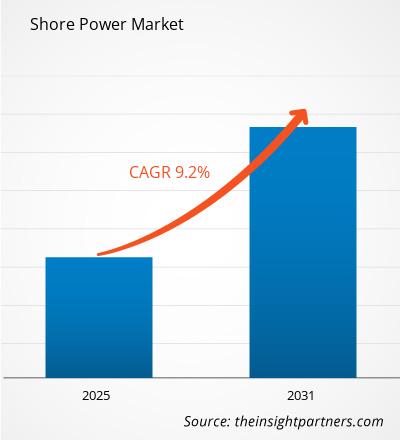
The Shore Power Market is projected to grow from US$ 2.51 Billion in 2025 to US$ 5.83 Billion by 2034, registering a CAGR of 9.82% during the forecast period 2026–2034. Market expansion is driven by increasing investments in port electrification, stricter emissions regulations, government funding for sustainable port infrastructure, and growing adoption of grid-powered berths to reduce emissions from docked vessels.
Key Market Insights
- Market Size (2025): US$ 2.51 Billion
- Forecast Market Size (2034): US$ 5.83 Billion
- CAGR (2026–2034): 9.82%
- Key Growth Driver: Rising investments in port electrification and maritime emissions reduction
- Major Trend: Expansion of shore power infrastructure across commercial and cruise ports
- Forecast Period: 2026–2034
Get a Sample PDF of the Report: https://www.theinsightpartners.com/sample/TIPRE00009077
Market Drivers
Increasing Port Electrification Initiatives
Port authorities worldwide are investing in grid-powered berth infrastructure to reduce vessel emissions, improve air quality, and comply with environmental regulations.
Stringent Maritime Emission Regulations
Governments and international regulatory bodies are introducing stricter emissions standards that encourage the adoption of shore power systems across commercial and passenger ports.
Growing Government Funding
Public funding programs supporting sustainable transportation infrastructure and port modernization are accelerating investments in shore power installations.
Expansion of Cruise and Container Ports
The continuous growth of global cruise tourism and container shipping is creating strong demand for shore power infrastructure capable of supporting larger vessels and higher port traffic.
Market Trends
Port Decarbonization Programs
Ports are integrating shore power with renewable energy sources, smart grids, and energy management systems to support long-term carbon reduction goals.
Retrofitting Existing Port Infrastructure
Existing ports and vessels are increasingly being upgraded with shore power compatibility to meet regulatory compliance requirements and sustainability targets.
Digital Energy Management
Advanced monitoring platforms are enabling port operators to optimize electricity distribution, improve operational efficiency, and reduce energy costs.
Smart Port Development
Smart port initiatives are integrating shore power with digital infrastructure, automation systems, and intelligent asset management to enhance operational performance.
Get the Premium Research Report @ https://www.theinsightpartners.com/buy/TIPRE00009077
Regional Analysis
North America
North America accounted for approximately 27%–30% of the global market in 2025 and is projected to grow at a CAGR of 8.8%–9.6% during 2026–2034. Market growth is supported by berth electrification, government grants, cruise port modernization, container terminal upgrades, and stringent regional air quality regulations. The US represented approximately 78%–82% of North America’s market in 2025 and is expected to register a CAGR of 8.9%–9.7%, driven by West Coast and Gulf Coast port modernization projects and increasing investments in sustainable maritime infrastructure.
Europe
Europe held approximately 25%–28% of the market in 2025 and is expected to grow at a CAGR of 9.0%–9.8% through 2034. Germany, the UK, France, Italy, Spain, and the Nordic countries continue expanding shore power deployment through maritime decarbonization strategies, port modernization initiatives, and the European Union’s Fit for 55 program.
Asia-Pacific
Asia-Pacific captured approximately 34%–38% of the global market in 2025 and is projected to register the fastest regional growth with a CAGR of 10.4%–11.3% during 2026–2034. China, Japan, South Korea, India, and Australia continue investing in container terminals, ferry ports, cruise facilities, and port electrification projects to improve operational efficiency and reduce maritime emissions.
Middle East and Africa
The Middle East and Africa are gradually expanding investments in sustainable port infrastructure, logistics modernization, cruise tourism, and maritime trade, creating long-term opportunities for shore power deployment across major commercial ports.
Segment Analysis
By Installation Type
The New Installation segment accounted for approximately 62%–66% of the market in 2025 and is projected to grow at a CAGR of 9.3%–10.1% through 2034. Growth is supported by greenfield port developments, integrated electrical infrastructure, and increasing investments in modern berth electrification projects.
By Installation Type
The Retrofit segment represented approximately 34%–38% of the market in 2025 and is expected to register the fastest growth with a CAGR of 10.6%–11.5%. Increasing retrofitting of existing ships and port terminals to comply with evolving emissions regulations and sustainability requirements continues driving segment expansion.
Competitive Landscape
The Shore Power Market remains highly competitive as technology providers and electrical infrastructure companies continue investing in advanced shore connection systems, smart energy management solutions, grid integration technologies, and sustainable port electrification platforms. Companies are expanding their capabilities through innovations in power conversion systems, cable management technologies, digital monitoring, and integrated electrical infrastructure to support commercial ports, cruise terminals, naval facilities, and container gateways worldwide.
Key Players
- Blueday Technology AS
- Cavotec SA
- Cochran Marine LLC
- Danfoss A/S
- ESL Power Systems, Inc.
- General Electric Company
- igus Inc.
- Schneider Electric SE
- Siemens AG
- VINCI Energies S.A.
Emerging Trends
The shore power industry is evolving through smart port technologies, digital energy management, automated cable handling systems, renewable energy integration, intelligent grid connectivity, battery-supported shore power solutions, high-capacity power conversion systems, predictive maintenance, port automation, and emissions monitoring platforms. Port operators and technology providers are developing next-generation shore power infrastructure that improves operational efficiency, reduces greenhouse gas emissions, enhances energy utilization, and supports sustainable maritime transportation. These innovations are expected to create substantial growth opportunities throughout the forecast period.
Future Outlook
The future outlook for the Shore Power Market remains highly positive as governments, port authorities, and shipping companies continue investing in maritime decarbonization, sustainable port infrastructure, and vessel electrification. Growing adoption of shore power systems across commercial, cruise, ferry, and naval ports is expected to support sustained market growth through 2034.
Related Market Research Reports
DECT Phone Market Trends, Size & Growth by 2034
4K Display Market Trends, Size & Growth by 2034
Copper Cable Market Size, Share & Forecast by 2034
Yield Monitoring Devices Market Share, Growth & Demand by 2034
About The Partners
The Insight Partners is a Insight global leader in market research, delivering comprehensive analysis and actionable insights across diverse industries. The company empowers decision-makers with data-driven intelligence to navigate evolving markets and accelerate growth.
Contact Us:
- Contact Person: Ankit Mathur
- E-mail: ankit.mathur@theinsightpartners.com
- Phone: +1-646-491-9876
Also Available in :
