Arc welding robots are automated industrial systems designed to perform high-precision welding operations with exceptional speed, consistency, and repeatability. These robots are widely deployed across automotive manufacturing, heavy machinery, aerospace, shipbuilding, defense equipment, metal fabrication, electrical equipment, and industrial manufacturing facilities to improve weld quality, reduce production costs, enhance worker safety, and increase operational efficiency. As manufacturers continue embracing Industry 4.0 and smart factory initiatives, arc welding robots have become a critical component of automated production environments where precision and productivity are essential.
Market Overview
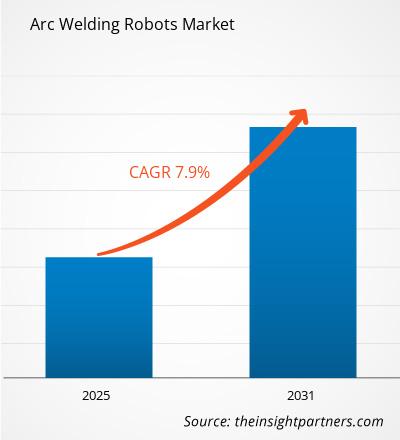
The Arc Welding Robots Market was valued at US$ 3.22 Billion in 2025 and is projected to reach US$ 4.1 Billion by 2034, registering a CAGR of 2.73% during the forecast period 2026–2034. Market growth is driven by increasing automation across manufacturing industries, rising labor shortages of skilled welders, growing demand for consistent welding quality, and expanding adoption of robotic welding systems in automotive, defense, heavy equipment, and metal fabrication sectors.
Key Market Insights
- Market Size (2025): US$ 3.22 Billion
- Forecast Market Size (2034): US$ 4.1 Billion
- CAGR (2026–2034): 2.73%
- Key Growth Driver: Increasing industrial automation and demand for high-quality precision welding
- Major Trend: Integration of intelligent robotic welding systems with Industry 4.0 technologies
- Forecast Period: 2026–2034
Get a Sample PDF of the Report: https://www.theinsightpartners.com/sample/TIPRE00010099
Market Drivers
Growing Adoption of Manufacturing Automation
Manufacturers are increasingly implementing robotic welding systems to improve production efficiency, reduce operational costs, and achieve consistent weld quality across high-volume manufacturing operations.
Shortage of Skilled Welders
The limited availability of experienced welding professionals is accelerating investments in automated welding technologies capable of maintaining productivity and manufacturing quality.
Expansion of Automotive Manufacturing
Automotive manufacturers continue deploying robotic welding systems across vehicle assembly lines to improve production speed, precision, and product consistency.
Increasing Defense and Heavy Equipment Production
Growing investments in defense manufacturing, heavy machinery, and industrial equipment fabrication are supporting demand for advanced robotic welding solutions.
Market Trends
Smart Robotic Welding Cells
Manufacturers are integrating robotic welding systems with artificial intelligence, machine vision, and real-time quality monitoring to improve operational performance.
Collaborative Robotic Welding
The adoption of collaborative robots is enabling manufacturers to automate low-volume and flexible welding operations while improving workplace safety.
Digital Manufacturing Integration
Arc welding robots are increasingly connected to manufacturing execution systems, industrial IoT platforms, and predictive maintenance solutions for intelligent factory operations.
Advanced Welding Process Control
Modern robotic welding systems incorporate adaptive welding technologies, real-time arc monitoring, and automated parameter optimization to improve weld consistency.
Get the Premium Research Report @ https://www.theinsightpartners.com/buy/TIPRE00010099
Regional Analysis
North America
North America accounted for approximately 27%–31% of the global market in 2025 and is projected to grow at a CAGR of 2.5%–3.1% during 2026–2034. Market expansion is supported by automotive reshoring, defense manufacturing, skilled labor shortages, and increasing investments in industrial automation. The US represented approximately 78%–82% of North America’s market in 2025 and is expected to register a CAGR of 2.6%–3.2%, driven by automotive production, aerospace manufacturing, heavy equipment fabrication, and robotic welding modernization.
Europe
Europe held approximately 24%–28% of the market in 2025 and is anticipated to grow at a CAGR of 2.3%–2.9%. Germany, Italy, France, Spain, and the UK continue driving adoption through automotive manufacturing, industrial machinery production, precision engineering, and advanced fabrication facilities.
Asia-Pacific
Asia-Pacific captured approximately 39%–43% of the global market in 2025 and is projected to register the fastest regional growth with a CAGR of 3.0%–3.6%. China, Japan, South Korea, and India continue expanding investments in automotive manufacturing, electronics production, industrial robotics, and smart factory automation.
Middle East and Africa
The Middle East and Africa are gradually increasing investments in industrial manufacturing, heavy equipment production, infrastructure development, and fabrication facilities, creating new opportunities for robotic welding technologies.
Segment Analysis
By Robot Type
The Consumable Robots segment accounted for approximately 72%–76% of the market in 2025 and is projected to grow at a CAGR of 2.7%–3.3% through 2034. The segment continues to dominate due to the widespread use of Metal Inert Gas (MIG) and Metal Active Gas (MAG) welding processes across automotive, machinery, and industrial manufacturing applications.
By Application
The Defense Applications segment represented approximately 8%–11% of the market in 2025 and is expected to register the fastest growth with a CAGR of 3.4%–4.0%. Rising investments in precision defense manufacturing, domestic sourcing initiatives, and advanced military equipment fabrication continue driving segment expansion.
Competitive Landscape
The Arc Welding Robots Market remains highly competitive as industrial robotics manufacturers continue investing in intelligent automation, machine vision technologies, artificial intelligence, adaptive welding systems, and digital manufacturing platforms. Companies are strengthening their product portfolios through innovations in robotic motion control, collaborative robotics, real-time weld monitoring, predictive maintenance, and integrated automation solutions to address increasing demand across automotive, aerospace, defense, heavy machinery, and industrial fabrication sectors.
Key Players
- ABB Ltd.
- Carl Cloos Schweisstechnik GmbH
- FANUC Corporation
- igm Robotersysteme AG
- Jiangxi Danbahe Robot Co., Ltd.
- Kawasaki Heavy Industries, Ltd.
- KUKA AG
- Nachi-Fujikoshi Corp.
- Panasonic Holdings Corporation
- Yaskawa Electric Corporation
Emerging Trends
The arc welding robots industry is advancing through artificial intelligence-enabled welding, machine vision inspection, collaborative robotic systems, industrial IoT connectivity, digital twin technology, adaptive arc control, predictive maintenance, cloud-based manufacturing analytics, automated quality inspection, and intelligent robotic programming. Manufacturers are developing next-generation welding automation solutions that deliver higher welding precision, improved production flexibility, enhanced operational safety, reduced manufacturing costs, and seamless integration into Industry 4.0 environments. These technological innovations are expected to create significant growth opportunities throughout the forecast period.
Future Outlook
The future outlook for the Arc Welding Robots Market remains positive as manufacturers continue investing in industrial automation, robotics, smart factories, and precision fabrication technologies. Increasing adoption of intelligent robotic welding systems across automotive, defense, aerospace, heavy machinery, and metal fabrication industries is expected to support sustained market growth through 2034.
Related Market Research Reports
Combi Boiler Market Trends, Size & Forecast by 2034
Vibration Monitoring Market Size, Growth & Demand by 2034
Security Cameras Market Size, Share & Trends by 2034
Network Slicing Market Demand, Size & Forecast by 2034
About The Partners
The Insight Partners is a Insight global leader in market research, delivering comprehensive analysis and actionable insights across diverse industries. The company empowers decision-makers with data-driven intelligence to navigate evolving markets and accelerate growth.
Contact Us:
- Contact Person: Ankit Mathur
- E-mail: ankit.mathur@theinsightpartners.com
- Phone: +1-646-491-9876
Also Available in :
