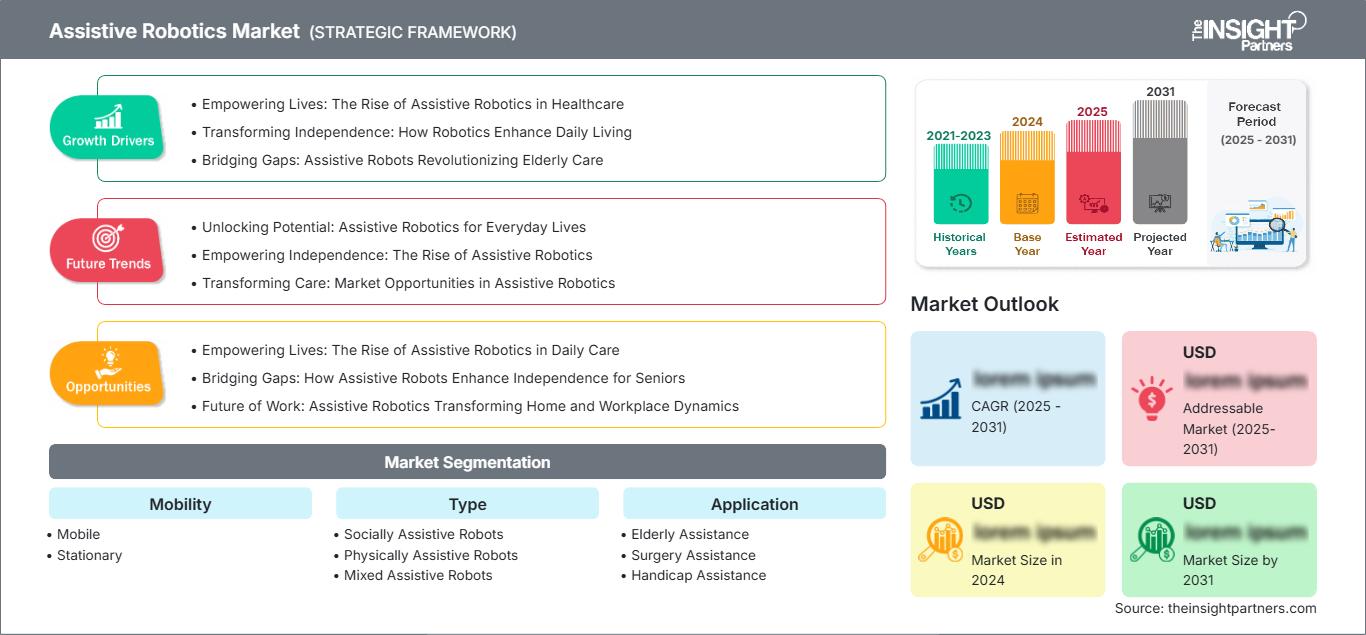
The Assistive Robotics Market is entering a transformative phase as artificial intelligence, automation, and advanced sensing technologies continue to reshape healthcare, rehabilitation, elder care, and personal assistance. Organizations across the world are investing in intelligent robotic systems designed to improve quality of life, enhance patient outcomes, support caregivers, and increase operational efficiency. From robotic rehabilitation devices and mobility assistance systems to collaborative robots designed for home care, innovation continues to redefine the capabilities of assistive technologies. Growing awareness regarding independent living, rising demand for personalized healthcare, and continuous improvements in machine learning are creating significant opportunities for manufacturers and technology developers. As governments, healthcare providers, and private organizations prioritize digital healthcare transformation, the Assistive Robotics Market is expected to witness sustained momentum through 2031.
Get a sample PDF of the Report: https://www.theinsightpartners.com/sample/TIPRE00007105
Recent technological breakthroughs have expanded the applications of assistive robots beyond hospitals into homes, rehabilitation centers, assisted living facilities, and educational institutions. Modern robotic systems are becoming increasingly adaptive, user-friendly, and capable of interacting naturally with patients and caregivers. AI-powered navigation, computer vision, speech recognition, cloud connectivity, and predictive analytics are enabling these systems to provide smarter assistance while reducing caregiver workload. Companies are also focusing on lightweight designs, improved battery performance, and enhanced human-robot collaboration to improve usability and accessibility. These developments continue to strengthen the long-term growth prospects of the Assistive Robotics Market across both developed and emerging economies.
Assistive Robotics Market Highlights by 2031
- Market Size: Strong expansion anticipated through 2031
- Market Share: Healthcare segment expected to maintain a leading contribution
- Market Trends: AI integration, collaborative robotics, rehabilitation automation, and smart mobility solutions
- Market Analysis: Rising investments in healthcare robotics and aging population driving adoption
- Market Forecast: Continued innovation expected to support sustainable industry growth through 2031
Growing healthcare expenditure and increasing acceptance of robotic technologies are encouraging manufacturers to introduce innovative solutions that address real-world challenges. Assistive robots are supporting rehabilitation therapies, helping elderly individuals perform daily activities, assisting patients with mobility limitations, and enabling healthcare professionals to improve productivity. Continuous software upgrades and intelligent automation are allowing robots to learn user preferences, making interactions more personalized and effective. As demand for accessible healthcare solutions rises worldwide, the Assistive Robotics Market continues to attract strategic investments from robotics companies, healthcare providers, and technology firms.
Another important factor supporting industry expansion is the integration of artificial intelligence into robotic platforms. AI algorithms enable robots to recognize objects, understand voice commands, detect obstacles, monitor patient health indicators, and adapt to changing environments. Combined with IoT connectivity and cloud computing, assistive robotic systems can now deliver real-time data insights that help caregivers and medical professionals make informed decisions. These technological advancements are expected to remain major growth catalysts for the Assistive Robotics Market throughout the forecast period.
Updated Market News
Recent developments indicate that robotics companies and healthcare organizations are accelerating investments in intelligent assistive technologies. Industry participants continue to introduce advanced rehabilitation robots, AI-enabled mobility solutions, and robotic systems capable of supporting elderly care with greater autonomy. Strategic collaborations between robotics developers, research institutions, hospitals, and technology companies are also becoming increasingly common as organizations seek to improve accessibility and patient-centered care. Innovations in humanoid robotics, wearable robotic devices, and robotic exoskeletons continue to demonstrate the expanding potential of assistive technologies across healthcare and personal assistance applications.
Market Drivers
The primary growth driver remains the increasing global aging population and the growing need for long-term care solutions. Healthcare providers are experiencing rising demand for technologies capable of improving patient outcomes while reducing workforce shortages. Assistive robots help streamline rehabilitation processes, support mobility, and enhance patient independence.
Continuous advances in AI, machine learning, sensors, and robotics engineering are making robotic systems more intelligent, responsive, and cost-efficient. These improvements are expanding their applications across hospitals, rehabilitation centers, home healthcare, educational institutions, and public facilities.
Government initiatives promoting healthcare modernization, digital transformation, and robotics research are also supporting broader adoption. Funding for medical robotics research and innovation programs continues to encourage technological advancements worldwide.
Market Challenges
Despite significant technological progress, several challenges remain. High development costs, regulatory requirements, cybersecurity concerns, and integration complexities may limit adoption in certain regions. Additionally, organizations must address data privacy considerations, interoperability requirements, and workforce training to maximize the benefits of assistive robotic systems.
Global Analysis
North America continues to demonstrate strong technological leadership due to advanced healthcare infrastructure, robust research investments, and early adoption of AI-powered medical technologies. The region benefits from active collaboration between robotics companies, universities, healthcare providers, and government agencies.
Europe remains an important innovation hub driven by aging demographics, supportive healthcare policies, and increasing investments in rehabilitation robotics. Countries across the region continue to encourage research focused on improving independent living and elderly care.
Asia-Pacific is emerging as one of the fastest-growing regions due to rapid healthcare modernization, expanding robotics manufacturing capabilities, growing healthcare awareness, and increasing investments in artificial intelligence. Countries including Japan, South Korea, and China continue to lead regional innovation in assistive robotic technologies.
Latin America, the Middle East, and Africa are gradually expanding adoption as healthcare infrastructure improves and awareness regarding robotic-assisted healthcare solutions continues to increase.
Regional Analysis
North America
- Strong healthcare technology ecosystem
- Significant AI and robotics investments
- High adoption of rehabilitation robotics
Europe
- Growing elderly population
- Government-supported healthcare innovation
- Expanding rehabilitation programs
Asia-Pacific
- Rapid robotics manufacturing growth
- Rising healthcare investments
- Increasing smart healthcare adoption
Latin America
- Improving healthcare infrastructure
- Growing awareness of assistive technologies
Middle East & Africa
- Digital healthcare initiatives
- Increasing investment in advanced medical technologies
Key Players
- ABB Ltd.
- Cyberdyne Inc.
- Ekso Bionics Holdings Inc.
- Honda Motor Co., Ltd.
- Hocoma AG
- Intuitive Surgical Inc.
- Kinova Inc.
- Panasonic Holdings Corporation
- ReWalk Robotics Ltd.
- SoftBank Robotics
- Toyota Motor Corporation
- Wearable Robotics SRL
Leading companies continue to strengthen their market presence through product innovation, strategic partnerships, acquisitions, and research collaborations. Their focus remains on developing intelligent, user-friendly, and cost-effective robotic systems capable of supporting rehabilitation, mobility assistance, and personalized healthcare. Continuous investment in AI-enabled robotics and human-machine interaction technologies is expected to shape the competitive landscape over the coming years.
Get the Premium Research Report @ https://www.theinsightpartners.com/buy/TIPRE00007105
Future Outlook
The future of the Assistive Robotics Market appears highly promising as advancements in artificial intelligence, robotics engineering, cloud computing, and connected healthcare continue to converge. Future generations of assistive robots are expected to become more autonomous, adaptive, and personalized, enabling greater independence for elderly individuals and people with disabilities while supporting healthcare professionals with improved efficiency. Increased collaboration between technology providers, healthcare organizations, research institutions, and policymakers will further accelerate innovation, expand accessibility, and create new opportunities across global healthcare ecosystems. As digital transformation continues across medical and personal care environments, the Assistive Robotics Market is expected to remain a key contributor to the evolution of intelligent healthcare solutions through 2031.
Related Reports –
Home Energy Management System Market Regional Share, Trend, and Growth Opportunity
Vision Transformers Market Regional Share, Trend, and Growth Opportunity
Differential-Pressure Mass Flow Controller Market Regional Share, Trend, and Growth Opportunity
About The Insight Partners
The Insight Partners is a leading market research and consulting firm delivering actionable insights through in-depth industry analysis and strategic intelligence. The firm supports clients across various industries in making informed business decisions by providing comprehensive market forecasts, competitive assessments, and growth opportunities.
Contact Us:
If you have any queries about this report or if you would like further information, please contact us:
Contact Person: Ankit Mathur
E-mail: sales@theinsightpartners.com
Phone: +1-646-491-9876
Also Available in :
Korean | German | Japanese | French | Chinese | Italian | Spanish

- Accounts Payable Automation Software Market Report: Key Drivers, Competitive Landscape - 2026-07-23
- Breast Ultrasound Market to Hit US$ 6.85 Billion by 2031 as Advanced Breast Imaging Gains Momentum - 2026-07-23
- Asia Pacific Wood Adhesives Market to Grow at a CAGR of 7.7% During 2026–2033 - 2026-07-23